How All Literary Rejection Letters Should Start

This lets you know right away that the rest of the email is not about your Pushcart nomination.

After the salutation, the very first word of the first sentence should be “unfortunately.” This saves writers from having to scan the rest of the text for the word. It also means that if the writer’s e-mail service shows body text previews, the writer doesn’t even have to open the email to know they’ve been slush-piled. I still recommend reading the actual rejections just in case there are specific comments or requests for more work.

This message has been brought to you by the editors of a review somewhere in the formerly industrial Midwest. Remembering which story I sent them four months ago is pretty tough, and it looks like they forgot the title, too.

Since many of you visit this blog looking for bits and pieces about the MFA process and the nuts and bolts of trying to get pieces published, I thought I’d share the secret hierarchy of rejection letters.

1: The standard form letter like the one seen here.  Not very gratifying, but don’t take it personally.  You’re busy, they’re busy, and that’s just how it goes.

2: The form letter with your name and the title of your piece.  Pretty standard practice.  I think I get more rejections with this level of personalization than without.

3: The personalized rejection letter with a personal note telling you how much they liked your story, even though it’s not for them, and encouraging you to send them more. In the super-competitive and completely subjective literary world, this can feel almost as good as an acceptance.  When you’re at this point with a specific piece or a specific market, you know that the editors really looked hard at your piece, thought about it, and saw enough promise (or whatever they look for) to personally encourage you as a writer.  No one owes you that, so when you get it, it’s a good thing.  Follow up with a thank you.

The most important thing to remember?  We’re talking about subjective responses to art.  You will “fail” often, especially in the beginning.  The thing is persistence and, very often, revision.

Stevenson on Whitman, Nietzsche on Dante and The Family Circus

Flavorwire has a list of the 30 Harshest Author-on-Author Insults in History up today.

Two of the first three don’t feel like insults at all:

Wouldn’t you love to be called a “large shaggy dog just unchained scouring the beaches of the world and baying at the moon” by RLS?  I for sure would.

Nietzsche’s aphorism about Dante is hysterical even if you think he’s wrong. It’s also brilliant.  And now, aren’t you thinking about how awesome it would be to write poetry on tombs?  I for sure am.  With the transcendent, absurd, holy, trippy joy through which I assume hyenas experience the world?  Yes, please!

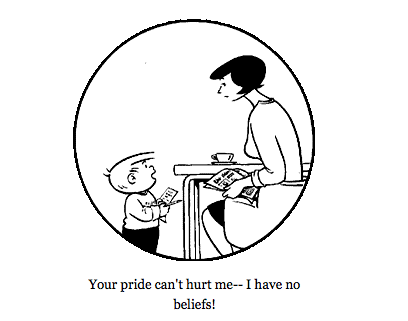
Speaking of Nietzsche, have you experienced Nietzsche Family Circus?  It takes a random Family Circus panel and pairs it with a random Nietzsche quote.   When you get results like the one below, you start to question if the whole thing isn’t rigged:

And then you keep clicking, only to watch Billy whispering into Jeffy’s ear that eventually the abyss will stare back into him (this while they’re watching their mother, Thel, playing with baby PJ) or telling Thel that God is dead. Dolly’s “why” for living is a pair of giant sunglasses.  Jeffy levels some pretty hard charges against the Keane regime, and then this, which cracks me up:

It turns out that Family Circus + Nietzsche = Calvin and Hobbes.

Electric Juxtapostion: “I Was Trying To Describe You To Someone” and “City of Electric Light” by Richard Brautigan and Chad VanGaalen

I came across Brautigan’s story on Flickr. It made me think right away of Chad VanGaalen’s beautiful song.  Begging your pardon as I channel my inner teaching assistant: What do you make of this juxtaposition? Different crafts and media, both discovered and shared on the internet, both hewn here in bits of data and binary code.  Are these pieces complimentary or contrary? Which one speaks to you more? Is one enriched by its presentation with the other?  Are both? I should point out that the video was made by a fan.  The scan of Brautigan’s story was, too.

r_brautigan

St. Patrick’s Day

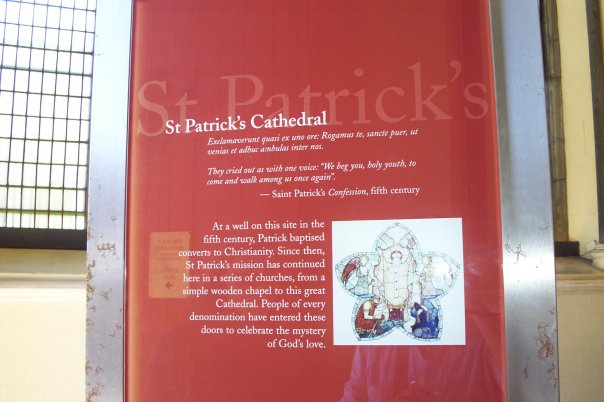
I just got back from spending some time with good friends in St. Patrick’s honor.  Here’s a picture from St. Patrick’s Cathedral in Dublin that I took when my wife and I visited Ireland.  On a wall outside there are memorials to many of Ireland’s famous writers including Jonathan Swift and Samuel Beckett.  Oscar Wilde’s boyhood home isn’t far away and there is, of course, the omnipresence of Joyce and Yeats everywhere in the city. The Book of Kells is another amazing piece of Ireland’s literary (and spiritual) legacy.  Reading the prologue of John’s gospel in something that beautiful and old, well, that’s an experience.