Ooopsy-daisy, AP. That line about where World got his nickname maybe should have been attributed, shared, and shared alike, don’t you think? (Click on image to embiggen.)
There are only so many ways to phrase how and why World got his nickname. And who knows, maybe the AP writer is the same Wikipedia editor who updated this page on the 19th before writing the AP piece yesterday. With that said, I should also attribute the CC image in the background of the graphic below right back at you, CC. Same for you, Wiki. AP, since you don’t do the CC deal, I’ll tread the fair use water with you and Shepard Fairey.
This lets you know right away that the rest of the email is not about your Pushcart nomination.
After the salutation, the very first word of the first sentence should be “unfortunately.” This saves writers from having to scan the rest of the text for the word. It also means that if the writer’s e-mail service shows body text previews, the writer doesn’t even have to open the email to know they’ve been slush-piled. I still recommend reading the actual rejections just in case there are specific comments or requests for more work.
This message has been brought to you by the editors of a review somewhere in the formerly industrial Midwest. Remembering which story I sent them four months ago is pretty tough, and it looks like they forgot the title, too.
Since many of you visit this blog looking for bits and pieces about the MFA process and the nuts and bolts of trying to get pieces published, I thought I’d share the secret hierarchy of rejection letters.
1: The standard form letter like the one seen here. Not very gratifying, but don’t take it personally. You’re busy, they’re busy, and that’s just how it goes.
2: The form letter with your name and the title of your piece. Pretty standard practice. I think I get more rejections with this level of personalization than without.
3: The personalized rejection letter with a personal note telling you how much they liked your story, even though it’s not for them, and encouraging you to send them more. In the super-competitive and completely subjective literary world, this can feel almost as good as an acceptance. When you’re at this point with a specific piece or a specific market, you know that the editors really looked hard at your piece, thought about it, and saw enough promise (or whatever they look for) to personally encourage you as a writer. No one owes you that, so when you get it, it’s a good thing. Follow up with a thank you.
The most important thing to remember? We’re talking about subjective responses to art. You will “fail” often, especially in the beginning. The thing is persistence and, very often, revision.
I used to work for a mutual fund company, but I’d never say I’m an expert on the economy. If you want to wax nostalgic with me about a time when money markets were paying more than .01 percent, I can handle that. If you want to talk about Series 6 and Series 63 licensing exams, I’m sorely out of date. That said, I retain the basics, and I happened to leave the industry just as everything started to crumble.
I say “started” because everything’s still crumbling. I’m no Amartya Sen, but we Americans have the long historical memory of the Great Depression always at our backs, and while most of us don’t really understand everything that’s been going wrong, our gut index is pretty savvy. We know when times are bad and we know when they’re not getting any better.
In the mid and late 70s, just before I was born, there was an energy crisis, a high Misery Index, inflation, bad geopolitical situations and, so I’m told by the media and everyone over 50, a prevailing and understandable emotional malaise. People were worried, afraid, out of work, strapped.
In 2011, the gut index tells a similar story. We know, deep down, that we’re still in an energy crisis and will be until renewable fuel becomes a nationwide efficiency and standard. The Misery Index is officially back in political discourse. The economy is abysmal, the world stage is a mess (with some hopeful things still happening), and people are worried, afraid, out of work, busted.
Once upon a time, when main street was “white washed windows and vacant stores,” we had the luxury of telling ourselves that even if our mid-sized industrial cities failed, the wealth of the burgeoning suburbs would save us. Fail our cities did, and so grew the suburbs, over green space, agricultural space, water tables, cemeteries. So grew our commuter corridors, our pollution emissions, our traffic patterns, and BMIs.
Take a look around your local suburban strip mall. Witness all the empty store fronts. Consider all the tier two stories at your local mall. If your gut’s like mine, it’s telling you things are getting worse.
I’m not an alarmist, but it seems patently obvious to me that the era of suburban mercantilism is over. And, like most forms of mercantilism, the suburban boom of the last 20 years was, itself, a bubble. On the frontier line of our industrial cities, townships had wide open space to develop and overdevelop. The businesses leaving our strip malls like they once left our downtowns are never coming back, that is, there will never again be the faux demand for that many grocery stories, hair cutteries, pet shops, Subways, and Chinese buffets. We simply don’t need that many Wal-Marts or Targets or Sears.
What to do now with these vacant spaces?
Knock a few walls down and mix open space in with surviving retail. Plant flowers, get benches. Make butterfly gardens and bike racks. Young people drive the economy, and young people like being outside. We like having access to options. We’d love to sit in the grass with our kids while our spouses run errands elsewhere on the strip. We like eating outside, learning outside, shopping outside. Tell us that your micro-greens in the suburbs are part of your commitment to sustainability, and even if we don’t believe you, we’ll use them. What goes better next to a Petsmart than a dog park? Why not put tables and chairs and umbrellas between Subway and the pizza place? How about some of those lawn games hipsters love? Maybe a fountain or two.
One of the things our suburban communities lack is access to open, common spaces at commerce centers. Target being close enough to drive to from soccer practice isn’t what I mean. I mean walkability and multipurpose. Micro-greens could bring these opportunities. Kids could paint murals and the real estate companies could compete for most beautiful, creative, or sustainable patch. There could be concerts and readings and rallies and ecological learning stations. There could be weather monitors and air quality sensors. There could be meetings and speeches from leaders. There could be questions. And all of the sudden I’m talking about sustainability in much larger terms. I’m talking about art and culture and civics, all of those other things not commonly associated with our suburban places, and I’m talking about doing them out in the open, in front of people as a way of engagement, ecology and economic innovation.
My gut index says many, many people are more likely to patronize a multipurpose complex like the kind I’m describing than the same old depressing vacant strip malls. My gut says people want creative solutions, more fresh air, more green grace and more synchronicity. In short, we want better options than the failed strip mall aesthetic, and we want to be able to access our disparate goods quickly and efficiently. Beat those vacant spaces into open ones. If you unbuild it, they will come.
Flavorwire has a list of the 30 Harshest Author-on-Author Insults inHistory up today.
Two of the first three don’t feel like insults at all:
Wouldn’t you love to be called a “large shaggy dog just unchained scouring the beaches of the world and baying at the moon” by RLS? I for sure would.
Nietzsche’s aphorism about Dante is hysterical even if you think he’s wrong. It’s also brilliant. And now, aren’t you thinking about how awesome it would be to write poetry on tombs? I for sure am. With the transcendent, absurd, holy, trippy joy through which I assume hyenas experience the world? Yes, please!
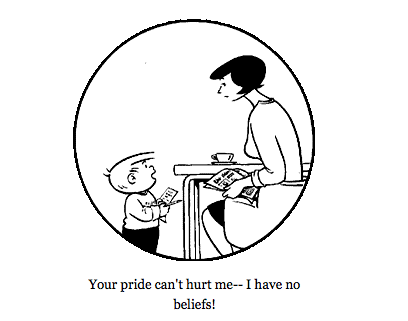
Speaking of Nietzsche, have you experienced Nietzsche Family Circus? It takes a random Family Circus panel and pairs it with a random Nietzsche quote. When you get results like the one below, you start to question if the whole thing isn’t rigged:
And then you keep clicking, only to watch Billy whispering into Jeffy’s ear that eventually the abyss will stare back into him (this while they’re watching their mother, Thel, playing with baby PJ) or telling Thel that God is dead. Dolly’s “why” for living is a pair of giant sunglasses. Jeffy levels some pretty hard charges against the Keane regime, and then this, which cracks me up:
It turns out that Family Circus + Nietzsche = Calvin and Hobbes.
If you’re here to read about the DC Comics reboot, you probably already know the news that’s come out since my last Titans post:
Bart Allen is Kid Flash (good).
Red Robin’s feather-cape lets him glide (okay, but from what does he propel?)
Red Robin has a jet-pack (oh, that’s right. So it’s not like the old Spidey cartoons where Spidey is just shooting up webs in the middle of fields and spiriting away after IceMan and Firestar).
The girl with the Feral hair is being called Bug Girl in promotional convos by the creators, but I don’t think that’s her real name. Now, your Daily Cocca thinks all the hatred going Bug’s way is pretty strong tea, but I’d be lying if I said my first impression of this character wasn’t “1993 called, in bad way.”
Now for the newish image, which you may have already seen elsewhere but I completely missed:
S-boy’s gloves are an intentional homage to the character’s 1990s origin. I guess that’s cool, even if it’s superfluous. The modern Superboy didn’t really come into his own until the last decade and the fashion sensibilities that came with it. Note to DC: Black t-shirts and blue jeans will probably always be cool. I’m not sure about the muscle shirt here. I want to commit to hating it.
Red Robin joins Bart in the shoulder-insignia club. Maybe Tim’s does something.






 Chris Cocca