There was another gas explosion in Allentown today. Thankfully, no one was killed. The fact that the explosion happened while the cast iron pipe was in the process of being replaced doesn’t make me feel any better. How long until all remaining 100-year-old cast iron pipes in the natural gas infrastructure are replaced by UGI? It hasn’t even been a week since this post about the sinkhole on 1oth Street and the degraded infrastructure below our residential neighborhoods.
The related articles below are recent looks at UGI’s financial health. I have an idea for the powers that be: take some of those extraordinary dividends and use them to fix the effing pipes.
Early this morning I posted a reminder about PEPFAR. Today I saw a note on Facebook from my friend Megan:
Sadly, PEPFAR has already lost a good bit of momentum, thanks to the Obama administration’s switch in focus from treating “expensive” diseases to treating cheap ones (like malaria). The recession is even affecting our estimation of how much people are worth.
Obviously, it’s good to treat malaria. But it’s not good to cut PEPFAR by $93 million. From the Center for Global Health Policy, dated December 16, 2011:
Critical global health programs still took a hit. The U.S. President’s Emergency Plan for AIDS Relief (PEPFAR) program sustained approximately $93 million in cuts compared to FY 2011 funding levels. This comes on the heels of an announcement by the Obama administration that AIDS is a U.S. policy priority and committing to putting 6 million people on HIV treatment by the end of 2013. The funding cuts will pose a challenge to these promises. If one were to project the number of individuals for whom PEPFAR could purchase medication in a given year with the $93 million – using the $335 per year per individual treatment costs through PEPFAR cited by Secretary of State Hillary Clinton in her address to the National Institutes of Health in November – approximately 277,612 would be covered.
The bill also commits $1.05 billion to The Global Fund to Fight AIDS, Tuberculosis and Malaria – the same amount committed last year. While a healthy contribution, it still puts the U.S. behind on reaching its three-year pledge to contribute $4 billion to the Fund by 2013.
To the chagrin of HIV/AIDS prevention advocates, the bill also gives the directive that no funds for domestic or global HIV/AIDS may be directed toward needle exchange programs, a critical means of protecting injection drug users (IDU) from HIV-infection. Of the approximately 16 million IDU in the world, 3 million are infected with HIV and one in three new HIV infections outside of sub-Saharan Africa is attributable to injection drug use.
I’m not sure how to feel about the IDU issue, especially given my other post from this morning showing that death by accidental poisoning (90% of which is drug poisoning) killed more people last year than motor vehicles.
Bracket the IDU aid for a moment. The AIDS crisis in Africa isn’t suddenly over. Eight years ago, I heard Bono tell Bill O’Reilly that our outright refusal to end the crisis would be akin to the 14th-cenutry civilizations of the East holding back the cure for Plague if they’d had one. He also said that even though some victims contracted the disease because of ignorance (he said “stupid practices,” but he didn’t mean the people were stupid), inaction on our part can’t be excused: “God is not going to accept that as an answer and history is not going to accept that as an answer.”
Look, I know we’re still funding this fight in big ways and that reducing aid isn’t the same thing as ignoring the problem. But when you think about some of the things we waste billions of dollars on privately and publicly, it should make you pause.
“The recession is even affecting our estimation of how much people are worth.”
If it’s true that the recession can also make us more grateful for what we have and more willing to part with things we don’t need so that others can have basic staples and care, maybe we’ll come through this okay. It doesn’t start with the federal government, but the federal government needs to hear you.
During the G.W. Bush administration, Rick Santorum was one of the few conservative voices championing what would become that President’s signature foreign aid program.
PEPFAR, the President’s Emergency Plan for AIDS Relief, is here. As my friend Joe said during Santorum’s Iowa speech, PEPFAR’s successor initiative, The Tom Lantos and Henry J. Hyde United States Global Leadership Against HIV/AIDS, Tuberculosis, and Malaria Reauthorization Act of 2008, is just one of things that could find itself on the perennial chopping block over the next few years. We need to remind the Obama Administration or any incoming Republican administration to remain committed to the goals of PEPFAR/Lantos-Hyde.
Paul Krugman Mellencamp has finally uttered the words. We’re in a Depression. His Sunday NYT piece, “Depression and Democracy,” is here.
Elsewhere, Leonard Cohen has shared about Depression and Depression:
LC: Well, you know, there’s depression and depression. What I mean by depression in my own case is that depression isn’t just the blues. It’s not just like I have a hangover in the weekend… the girl didn’t show up or something like that, it isn’t that. It’s not really depression, it’s a kind of mental violence which stops you from functioning properly from one moment to the next. You lose something somewhere and suddenly you’re gripped by a kind of angst of the heart and of the spirit…
– Leonard Cohen, French interview (trans. Nick Halliwell)
It’s hard to be hopeful about the world economic situation. But Cohen’s kind of depression — God, he’s right on, isn’t he, about there being different kinds? — the kind of mental violence, the kind that stops you from functioning properly from one moment to the next, the kind that grips you and won’t be shaken off without time and effort and help…maybe you see yourself in that. Unwanted thoughts, irrational compulsions, excessive guilt.
For years, I looked to Cohen’s quote and thought, well, shit, this is the condition of artist. I found out later that it’s also the condition of millions of people who, in addition to being sensitive, winsome, and artistic, also happen to not produce enough serotonin on their own. For many, such is the biology of general anxiety, OCD, and other depressions. If that’s you, please know there is help. If you don’t know if that’s you, please see a trusted physician and find out. A friend of mine said it best: “no one should have to suffer because of their biochemistry.” We’d never suggest a diabetic go without insulin. We’d never expect a diabetic without the right help to function in healthy ways, let alone thrive. Any physician worth her salt will tell you it’s the same with the way our brains process the presence or death of chemicals our bodies are making as best they can. Beloved, God has not given us the spirit of fear; but of power, and of love, and of a sound mind. A righteous mind.
I’ve been thinking a lot about the free market lately. In part, I’m wondering why Center City Allentown has one good drug store (Rite Aid), and why that one good drugstore is being displaced by the coming AHL hockey arena (I generally support the arena project), and what that drugstore is going to put up its next shingle in the suburbs, and where that leaves Center City residents no longer able to walk or take reasonable transit routes to a drugstore of any kind, and what all of that says about the degree to which markets are efficient at providing basic needs.
One might argue that the arena project would not be happening without governmental canoodling and the creation of a special tax district downtown. Sure. But that doesn’t explain why there’s only one viable option for prescription drugs within a reasonable distance for residents who either walk wherever they’re going (we all say we want walkable cities!) or take transit (we all say we want more people riding buses). Some arguments will come and go from the fiscally arch-conservative side: the people downtown are poor because the government’s meddling keeps them poor. If it weren’t for government, those people would have better jobs, cars, nicer places to live, better healthcare options and so on.
And yet, at a time when rental prices and retail space downtown are likely to be at their lowest points ever (so much vacant space, but lo, an arena project looms), I don’t see a whole hell of a lot of savvy business types flocking into even the nicest, newest spaces the city has to offer. If ever there was a time to come in from suburbs to set up shop, surely it is now. And yet. Indeed, the coaxing of various businesses with tax breaks and economically favorable statuses is a tweaking of the supposedly pure state of equilibrium the market is thought able to deliver. We’re in an economic mess, say some, because of government meddling. In the process of wars on poverty and building great societies, lots of people got screwed. These are not of themselves outlandish hypotheses. But when some fiscal conservatives take the next step to say that government has no real, legitimate role in trying to fix the mess it has created, I get confused, Columbo style.
Government makes mess. Government perpetuates mess. Government never should have made this mess in the first place, so now government has no role in trying to fix it.
That doesn’t sound right, does it? The real kicker: let business do what business wants and business will save everyone.
I’m not anti-business by a long shot, but I am very anti-dogma. Enron was a business. All those big banks that helped bring us to the brink of ruin were businesses. Wall Street is a business. Yes, Congress is a business. Like government, business can do harm and business can do good. Like government, business can be generative. Like government, business does not deserve our total, utter, faith and trust.
Here’s when the market really can cure all that ails you:
Perfect information is universally available, obtained, and understood on all sides of every transaction and hypothetical transaction.
Every consumer or investment choice is made by perfectly rational beings with the same exact meta-goals.
So, in other words…yeah. Sounds good on paper.
Unfettered beliefs in the efficiency and tangential goodness of markets or government aren’t tenable forever. At the local level, we long to believe that a rising tide will lift all boats, and, to a degree, I think it will. But I also read a Thai proverb today that gave me pause:
At high tide, the big fish eat the ants. At low tide, ants eat the fish.
I’m not calling anyone an ant. But isn’t this idea basically the fear behind the fear the well-horned have of the Occupy movement? And isn’t it the fear most people caught somewhere in the disappearing middle have in general, that when push finally comes to shove, when things get REALLY bad, it won’t be push and shove but blocks on fire, looting, violence, chaos?
Even if high tides lift all boats, low tides come regardless. Will we trust the government, the market, or will we invest now in each other, in communities, in partnerships, in new ways of being neighbors?
The Daily Cocca is proud to welcome Eric Sylvester back to our guest-blogger chair. Because all signs point to a proposed minor league hockey arena in downtown Allentown becoming the new home of the former Philadelphia Phantoms, I asked for Eric’s take on the team. Eric’s my go-to hockey guy, and with good reason.
Eric asked if he could write a piece about the 2004-2005 season, a time when big league hockey was locked out and a talented, neglected AHL team took the professional sport, and its near-professional fans across the country, on a wild, redemptive ride. Why is any of this important to me or to Allentown hockey in 2013? On a personal level, Eric’s a peach and I wanted him to a little bit about his beloved fandom. (He really did meet his girlfriend on WordPress, by the way, so you are beholding the power of blogging on two levels, here). But I’m also interested in the way sports narratives can galvanize communities. We’ve heard so much in the past few weeks about the kind of identify formation that happens at places like Penn State, but Eric was isolated hockey fan in Iowa who connected to a minor league team in South Philly. I don’t mean to overplay the sports-as-life narrative, because we’ve seen how devastating that can be. But in the right times and right conditions, fandom can bring communities together in positive ways, even across state lines and team loyalties.
Eric, thanks for the piece.
#
How I Learned to Stop Worrying and Love the Phantoms by Eric Sylvester, Special (Like a Pretenders song) to The Daily Cocca
One of the best things about blogging is getting to hear the stories of a multitude of different types of people. I’ve made friends in the hockey community, the political ring, and some genuinely hilarious people through blogging. I even met my girlfriend, Emily, via this blog (that’s two shameless plugs for your blog already, babe). Editor’s Note: she smiled and DIDN’T hit me. I’m surprised, too. Editor’s Note #2: Upon reading this, she called me a “jerk” and hit me. THAT’S the Emily I know.
Chris Cocca is one of these great people I’ve had the pleasure of befriending since I started the blog. It’s always awesome when we get a chance to randomly talk, primarily because we share many of the same weird interests. From our mutual love for comics to our shared affinity for vintage baseball facial hair, we tend to have some interesting conversations.
I guest-posted last year during the NHL Playoffs for Cocca and have an undying love for hockey. So, naturally, when he started talking about the possibility of the Philadelphia Adirondack Phanotms AHL hockey team moving to Allentown (Chris’ hometown), I had a story to tell.
You see, the (then) Philadelphia Phantoms were the story of the 2005 hockey world. Why? Because the 2004-2005 NHL season was lost to a lockout. As the only hockey fan in my small hometown in Iowa, I was mercilessly teased by my friends. They knew how much hockey meant to me and reveled in the fact that they got to watch their beloved NBA while I was deprived of my favorite thing in the world. I look forward to hockey season more than Christmas, and that year Christmas wasn’t going to come.
But there was hockey in 2004-2005, just not the hockey I was used to following. The American Hockey League, America’s highest level of minor league hockey, would still play their season. With minor league hockey as my only option, I thought I was going to be subjected to a subpar league for a full season. Still, I said, bad puck is better than no puck at all. Mediocre players playing mediocre hockey in empty arenas is still hockey. I soldiered on and said my prayers to the hockey gods every night, begging for the return of the NHL.
I kept tabs on the affiliate of my Colorado Avalanche, the Hershey Bears, who never seemed destined for a playoff berth (they missed a postseason spot by ten points). My Colorado Avalanche didn’t exist and their affiliate franchise was done for the season . The most depressing year of my fifteen-year life lingered on. Even though there would be no proxy-Avalanche to lift my spirits in the playoffs, something else happened; something I wasn’t expecting.
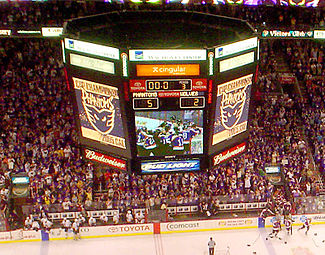
I fell in love with the Philadelphia Phantoms. This wasn’t some throw-away hockey team playing in the minors. They had some SERIOUS firepower, and featured a bevy of future NHL superstars. Led by goaltender Antero Niittymaki (now with the San Jose Sharks), the Phantoms featured future NHL All-Star Jeff Carter, eventual Flyers’ captain Mike Richards, and future Stanley Cup winners Patrick Sharp and Ben Eager. The Phantoms grinded their way to the Calder Cup Finals with a style of play reminiscent of their big-brother Philadelphia Flyers of the mid 70’s: tight checking, strong defense, phenomenal goaltending, and (most of all) local fan support. When the Phantoms completed the surprising four game sweep of the Chicago Wolves to win the Calder Cup, 20,103 fans filled the Wachovia Center to witness the glory.
Yes, the Wachovia Center. The home of the Philadelphia Flyers. While my friends were busy mocking me for watching a league that “nobody” cared about, the Philadelphia Phantoms sold out an NHL arena.
Before the AHL playoffs, my frustration with a league that was shut down by greed (and at hockey-ignorant friends for taking so much pleasure in my misery) was hard. But I realized I wasn’t alone. The Phantoms became my retreat from a rural Iowa community that will never understand the connection hockey fans feel with each other, that hockey is as much of a culture as it is a sport. There’s a communal imperative, a bond among hockey fans that’s unique in sports. No matter who our teams are, we actively seek out each other’s company. As die-hard acolytes of a sport less mainstream, these days, than NASCAR or golf, we’re a rare breed in fandom. As much as we love the game, and we LOVE it, it’s simply one aspect of being a fan.
The Phantoms celebrating their Calder Cup championship in front of a sold out crowd.
Deprived of an NHL to relate to, the lockout season started as especially difficult time in my life. While I was the only hockey fan in my school, I still could talk a little hockey with some of my sports-loving friends. One might catch the occasional game on ESPN (or at least see a highlight), and might seek me out with questions or for my brand of expert analysis. Hockey was, and is, so much a part of who I am that my classmates would rush to talk to me on a Monday simply because they had attended their first hockey game over the weekend. When the NHL season was lost I thought I’d lost my identity. I was no longer “the hockey guy”; I was the “guy who lost hockey.” As an angst-y fifteen-year-old, this was incredibly hard. And but for the Philadephia Adironack Allentown Phantoms, it would have stayed so.
In a year filled with pain and suffering for hockey fans across the world, I joined Philadelphia in embracing the Phantoms. I identified with them. The Philadelphia Phantoms were the minor league team in a city with an NHL team. The little brother. Mostly forgotten. They were the angst-y kid overlooked by the cute girls. Then, with the lockout, everyone knew me as the person most directly effected by the loss of a season and of a sport no one else cared much about in the small radius of our high school and town. In a strange way, the lockout didn’t take my identity at all; it bolstered my connection with something I thought I alone understood, and my reputation as someone with something at stake. That’s powerful esoteric sauce for kids figuring out who they are. (See: Cocca, Christopher; his love of Oasis). At the same time my identity formation was rising, the Phantoms went from Philadelphia’s forgotten team to the biggest story in hockey; among my friends and peers, I was the biggest story in hockey. The Phantoms were the greatest hockey team in the world, and I was the world’s biggest fan.
#
The Daily Cocca is happy to report that Eric is a well-adjusted college student preparing to lead our children into the 21st century as a teacher and weekly screener of Happy Gilmore. When the Phantoms come the Allentown, the local support Eric talked about will be crucial. So many of us have been rooting (and working) for downtown revitalization for so long, rooting for the Phantoms will require no adjustment. To the doubters or people less connected with the history of the city, we’ll need your help, too. Great things are already happening downtown. This could be a rallying and tipping point that helps foster a new stage of smart growth.


 Chris Cocca