Rollins, Zizek, Durruti, Tillich: Religion Deconstructed, Wisdom Demolished By Love

“History repeats itself, first as tragedy, then as farce.”  I had occasion to be reminded of that recently.  It comes from Marx and Engels, and Slavoj Zizek uses it as the title of a recent treatise.

In his affirmation of pyro-theology, Peter Rollins takes up Buenaventura Durruti’s claim that “the only church that illuminates is a burning church.”   Cross-search Durruti’s quote with Zizek and you get this, which basically encapsulates, beautifully, Rollins’ own project.  Hear Zizek:

For this reason, Christianity is anti-wisdom: wisdom tells us that our efforts are in vain, that everything ends in chaos, while Christianity madly insists on the impossible. Love, especially a Christian one, is definitely not wise. This is why Paul said: “I will destroy the wisdom of the wise” (“Sapientiam sapientum perdam,” as his saying is usually known in Latin). We should take the term “wisdom” literally here: it is wisdom (in the sense of “realistic” acceptance of the way things are) that Paul is challenging, not knowledge as such.

With regard to social order, this means that the authentic Christian tradition rejects the wisdom that the hierarchic order is our fate, that all attempts to mess with it and create another egalitarian order have to end up in destructive horror. Agape as political love means that unconditional, egalitarian love for one’s neighbour can serve as the foundation for a new order.

That Rollins takes Zizek (and Tillich) as major influences is clear, and I love the accessibility of Zizek’s piece in The New Statesman.  Rollins’ new book, The Idolatry of God, builds from ideas like these if this fantastic lecture is any indication.

This, plus mysticism is the Christian future.  I don’t see very many other ways forward, at least not very many that make sense, as Baptists say, to “us and the Holy Spirit.”

If Jonathan Fitzgerald is right that the New Sincerity is making a new, earnest morality possible, it’s also the case a that a New and Faithful Pluralism is helping more and more Christians explore themes like these, saved anew by the radical implications of a God bound by love over retributive justice.   Yes, please.

Conquering Our Moloch

An 18th century illustration of the Canaanite ...
An 18th century illustration of the Canaanite deity Moloch, as depicted in the Bible. (Photo credit: Wikipedia)

I’ve been considering John Milton’s Nativity Ode anew this Advent.  Today, I saw a tweet from The New York Review of Books quoting from Milton’s Paradise Lost about the blood lust of the pagan god Moloch and the gruesome terms of his worship, child sacrifice.

I clicked through to the piece, which you can read here. The gun, says Gary Wills, is our Moloch.  Maybe so. But if so, our collective and willful ignorance of America’s mental health crisis is something of an original sin from which we haven’t come close to working out or making right.

Wills reminds us that in Paradise Lost,  “Milton represented Moloch as the first pagan god who joined Satan’s war on humankind.”  Yes.  And in Milton’s Nativity Ode, Moloch is among the first to flee his seat of power at the birth of Christ, the coming of the Holy Child.

I left this comment at NYRB:

“To continue the Milton and Moloch theme, on the Third Sunday of Advent, we remember that Moloch only flees with the birth of the Holy Child. I don’t offer that as a bit of religious imperialism, but as a comfort to those who will find comfort in it, and as a point of literary irony worth considering in the larger context of the extended metaphor.”

There’s something fundamentally profound about the juxtaposition of the reign and flight of Moloch with the coming of the Prince of Peace as an infant, as a child.  I’m not offering a positivist religious fatalism, here.  I’m saying that Wills makes one of the best arguments for pacifism you’re likely to hear if you bear mind 1) the Mennonite insistence that the crucifixion of Christ was God’s clear condemnation of violence as a means of ending violence 2) Milton’s liturgical resister in Advent, and 3) Milton’s insistence that God’s overthrowing of idols happened not only at Christ’s death but also, fundamentally, in his birth.

In the Nativity Ode, Milton struggles with the now-and-not-quite-yet nature of the Prince of Peace’s reign.  I struggle with it, too.  The child Jesus would grow up to say “The Kingdom of God is here!” but few and far between are the kinds of communities that prove the claim.  Few and far between are the leaders who lead and live like Jesus, few and far between are churches with progressive witnesses for peace and mental health commitments.

Think what you will about guns.  But it’s hard to argue that with our wars, our drones, our violent entertainment and our voyeuristic gaming, we’re not sacrificing children to the grim god Moloch, to the military-industrial complex, to big businesses and lobbyists and other interests.  All the while spending a comparative widow’s mite on the nation’s mental health crisis.  That’s idolatry any way you cut it. That is injustice, that is sin, that is, frankly, evil.

A Bill of Rights for Mental Health Care

It turns out this was too much to ask for in 2013.  And 2016.  And 2018.  We have to do better.

From 2013:

The candidate I’ll vote for in 2016 will be the one with an ambitious and progressive plan to fight our nation’s dirtiest open secret: we face a monumental public mental health crisis the likes of which have never before been seen.

Mental health benefits for the poorest Americans are being lost left and right as states trim budgets.  In Pennsylvania, the Commonwealth decided years ago to shut down mental hospitals as a way of saving money, yet we pay more now per year per homeless mental health consumer than would have had the hospitals stayed open.  This is not to mention all the other societal costs.  This is not to mention the kinds of things none can put a price on:  healthy communities where everyone is safe and everyone is cared for according to their need.  In 2013, is that really too much to ask?

Lawrence O’Donnell Takes Off The Gloves: National Defense Authorization Act, Soft Journalism, and the Spoonfed Two Party System

Taking a cue from the pages of Superman, Lawrence O’Donnell lambasted the mainstream media Wednesday night for their failure to cover the Third Parties debate and for failing to address this little nightmare:

Imagine if Congress passed a bill that the president signed that allowed indefinite detention without charge or trial. That would be issue one at any presidential debate, wouldn’t it? The media’s favorite debate moderator, Martha Raddatz, would have forced a full discussion of that one at the vice presidential debate, wouldn’t she? Well, Congress did pass that law last year and President Obama signed it and he never mentioned it on his list of his accomplishments in any of the debates. And he was never asked about it, not by the media’s second favorite debate moderator, Candy Crowley, and not by Mitt Romney. It never came up at the two-party presidential debates.

Watch the video here.  It starts with the drug war (I’m not for legalization, but am for reform), and if that bothers you, fast forward to the part about the National Defense Authorization Act.  I kind of like how someone on Examiner.com put it:

But in the most shocking segment, O’Donnell laid out a serious charge against President Obama and the failure of the media and the public to hold him responsible due to a certain law that he signed called the National Defense Authorization Act, which according to O’Donnell will allow the government to detain, interrogate, prosecute or just make people who it suspects to be terrorists disappear without a trial of any kind, and this includes American citizens! O’Donnell then blasted all of the moderators of the three presidential debates between Obama and Romney for not bringing this issue up, and then he blasted the cowardly Mitt Romney for also being to [sic] sheepish to ask President Obama about this issue, instead of crowing about how he would repeal Obamacare, when he should be repealing this monstrosity.”

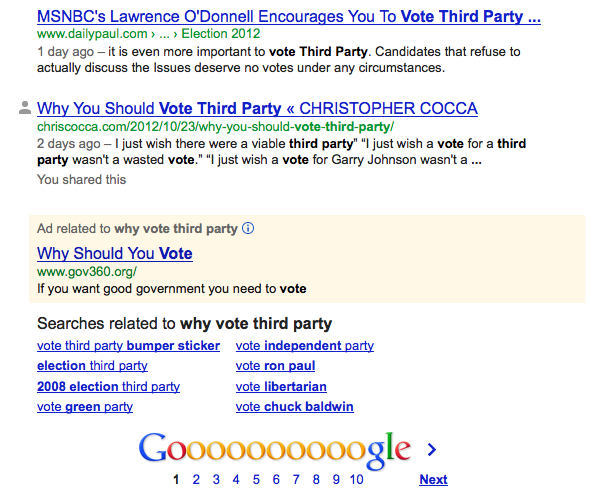
O’Donnell encouraged people to vote for third party candidates, especially in swing states.

Good for you, Larry.  Even if you were a few hours late to the party:

Bill Clinton Has Obviously Never Seen “The Big Lebowski”

From October 25, 2012.

Matt Bai says Bill Clinton’s advice to frame Mitt Romney as an extreme conservative rather than the nihlist voters believe him to be was a mistake (here in The New York Times).

Crux of the piece:

“The bottom line here is that one can over-think this whole notion of framing your opponent. Ninety-nine times out of 100, the line of attack that works best is the one that really rings true. In the case of Mr. Romney, whatever his stated positions may be, the idea that he’s a far-right ideologue, a kind of Rush Limbaugh with better suits and frosty hair, just doesn’t feel especially persuasive.

On the other hand, the notion that Mr. Romney isn’t centered in any philosophical impulse — that he will say or do whatever it takes to win — seems more plausible, given his contortions on a range of policies, and given his excessive caution as a candidate.”

Yesterday, Andrew Sullivan said that Romney’s singular skill at reversing positions whenever it seems expedient (or, to be generous, right) could be understood in the context of his mid-century Mormonism.  Mormons believe in continuing revelation, Sullivan says, pointing out that Africans and African Americans were classified as cursed in the LDS until 1978.   He quoted Mormon leader Bruce McConkie’s statement that year: “It doesn’t make a particle of difference what anybody ever said about the Negro matter before the first day of June of this year, 1978.” (Sullivan also points out that for close to 40 years, Mitt Romney remained active in a racist church, and that no one is raising that issue the way Obama’s connection to Jeremiah Wright was held up for all to see).

Sullivan claims that it’s okay to use Mormonism, “the only consistent intellectual thread in Romney’s life,” as a kind of decoder.  Readers accused Sullivan of not understanding what Mormons believe about the efficacy of continuing revelation.

Is it possible that Romney’s left-to-center-to-right-to-center-to-right-to-center dash of the last 18 months is simply the candidate’s inner life lived out in public?  Maybe.

And then there’s the belief, which Bai basically says most voters hold, that Romney is a manipulative nihilist.  The Lebowski Problem come home to roost.  Unfortunately for Barack Obama, Bill Clinton was otherwise engaged when Walter Sobchak instilled in us a deep distrust for that particular non-ethos.

Third party!