A Real Live Webpage from 1996, Preserved In Its Natural Habitat; Fiction as Public Engagement

Christopher Cocca

No, not the official Berkshire Hathaway page. I’m talking about the Periodic Table of Comic Books! If you’ve been trying to cross reference an element with its appearances in various comics over the last few decades, I’ve just given you the last resource you should ever need.

If you’re trying to explain the internet of the 90s to your kids between Legends of the Hidden Temple reruns on TeenNick, this will also come in handy. See if they can find the rotating “under construction” graphic before you do.

It’s funny: in some ways, the web has always been about the compilation of trivia (personal or otherwise) and the cataloging of human interests. Platforms like Twitter and Facebook enhance and also undermine that instinct: instead of Angelfire web sites and Tripod accounts with spinning pictures and MIDI music, we give our strange fascinations over to a few centralized social networks who keep meticulous, obsessive track of everything we say we love. While these services have been used powerfully for activism, there’s an argument to made about the ways we’ve regressed as owners of our ephemera. It’s easier, I suppose, to curate our interests with posts and tweets and likes and shares than to build the online shrines that once defined the consumer internet. But those repositories had what Mike Schmidt might call a certain charm that social media doesn’t capture. Maybe I’m remembering the world that seemed possible before we got the world that came. I don’t mean that cynically. Commitment to social action X over social action Y might mean no flying cars or jetpacks, but we have no way of knowing, really, in the short term.

More knowable, it seems, are the outcomes of politics devoid of concern for environmental regulations, economic justice, the sanctity of life, and the generative renewal of our communities. If you thought I wasn’t going to get from the Periodic Table of Comic Books to public ethics in a few short steps, you might not know that The New School (MFA ’11) just announced organizational changes to some of their graduate programs. The writing program, of which I am a proud graduate, is now part of the newly-named School of Public Engagement. TNS is making a bold cultural and political statement here: poets, fiction writers, and essayists trade in public engagement as a matter of vocation and as a matter of fact. It’s probably no coincidence that former TNS president Bob Kerrey shared similar sentiments with my entire class on the first night of our program.

Bloggers, artists, writers, musicians, comic book creators, coders, scientists, actors, preachers…the list goes on and on. We are enlisted in the craft, and it is a craft, of public engagement. The evolution of the social web from siloed shrines of quirky interest to the integrated platforms of curation, criticism, and creation shows just how powerful our drive to contribute something back to the avalanche of corporate politics, media, and culture-making really is.

It’s ironic and subversive that we do it on the corporate platforms of companies that make millions delivering targeted ads based on the content we create and share in resistance to the monolithic messages of people with vested interests in framing these conversations in very specific ways. That’s the world we live in, for better and for worse.

Let’s keep making it for the better.  And when you need a break, check out the Periodic Table of Comic Books.  And don’t forget to sleep.

PANK’s Sense of Humor, The Missouri Review’s Argument For Online Submission Fees

The Missouri Review
Image via Wikipedia

This post is from 2011.  Today (2019), online submissions are near-ubiquitous, and submission fees are, in my experience, even more common.

Sundry notes of the literary type ahead.

I got a rejection letter from PANK today.  Fine.  The address it came from?  awesome@pankmagazine.com.  Hilarious!

Dinty W. Moore, the  editor behind Brevity, shared a link to this piece from The Missouri Review today via Twitter.  From “Why Literary Journals Charge Online  Submission Fees” :

One of the things worth recognizing is that the cost of submitting to a magazine is a fixed prospective cost: a cost that will be incurred and cannot be recovered. Submissions have never really been free. It’s simply that the cost (paper, envelopes, postage, etc.) has been paid to the post office, not the magazine. It didn’t go to the magazines. And I’m not saying that it should have. Freed up from (some) of the costs of submitting to literary magazines, has there been an increase in subscriptions? Has there been an increase in financial support of literary journals from writers?

No. Not at all.

Later:

In fact, submissions increase significantly. This varies from magazine to magazine, but the increase in submissions is somewhere between twenty to thirty-five percent.

My comment:

The increase in submissions has more do with more people trying to be writers, getting MFAs, having to submit to more journals because of more competition, being unable to pay fees at every journal that charges them, or, if able to pay those fees, certainly not subscribing to more journals. It also just so happens that the streamlining of online submissions came at a great time: the world economy has been in the gutter for close to four years. I’m glad to be rid of the cost of paper and postage, but I’m not plunking those extra dollars down for more journal subscriptions. Yes, we keep hearing about how writers don’t have a lot of extra money, but that’s because, well, we (and you) don’t.

The fact that writers no longer pay the costs of postage to submit doesn’t mean that those phantom dollars are now a revenue stream to be captured.  That money’s already going to other things, like paying student loans.

Movies That Make You Put Down the Remote (And Stay Up Way Too Late)

True Grit (Glen Campbell album)
Nearly perfect.

I have a pretty easy rubric for knowing which movies are my favorite.  When I find it on TV, will I watch it till the end no matter what point it’s at and no matter how late at night it is?  For these, the answer is “yes.”   In no particular order:

  • True Grit (original)
  • Batman (1989)
  • Remember The Titans
  • The Godfather
  • The Godfather Part II
  • Legends of the Fall
  • The Graduate
  • A Few Good Men

I’m sure I’ll think of more.  What are some of yours?

Ross Perot Was Not My High School History Teacher (The Election’s Not Achtung Baby)

Ross Perot at the United States Department of ...
Not my 11th-grade history teacher.

This grew out of a response to comments by Mr. Salk and Chad Hogg (not a friend of Buddy Roemer, necessarily), but I thought I’d share it here, lest ye forget, lest, as my 11th-grade history teacher used to say, ye be bored.

Before Perot left the race in ’92 (only to come back later), he was polling double digits nationally, leading many or most of them. He was at 39% at one point in the cycle. In a three-way race, obviously, that’s saying something. Yes, his numbers started to fall as the summer went on and he made some critical blunders (or was compromised by outside forces, which he claimed).

Could he have ever won in the first place? It’s not likely, but it’s conceivable. Had he not dropped out of the race under bizarre circumstances, only to come back later, I do believe he would have polled the 20 percent nationally required for federal funds. That whole process itself is out to lunch, but it would have made enabled Perot to build what could be, by now, a truly viable third party. If if if if.

Incidentally, Perot advocated for electronic town hall style democracy 20 years ago. That’s actually possible now. Nevermind the fact that he owned an IT/data company with government contracts at the time…

Around here, we all know I heart the 90s.  But this “we’re really done with you, Republicans and Democrats” thing isn’t just some flight of nostalgic fancy.  It’s not that Legends of the Hidden Temple marathon you watched a few weeks ago or the forthcoming Achtung Baby reissue.   Still, the changes in the air in early 90s Europe resonate with me here, and that’s not just because of how hard the Scorpions rock.

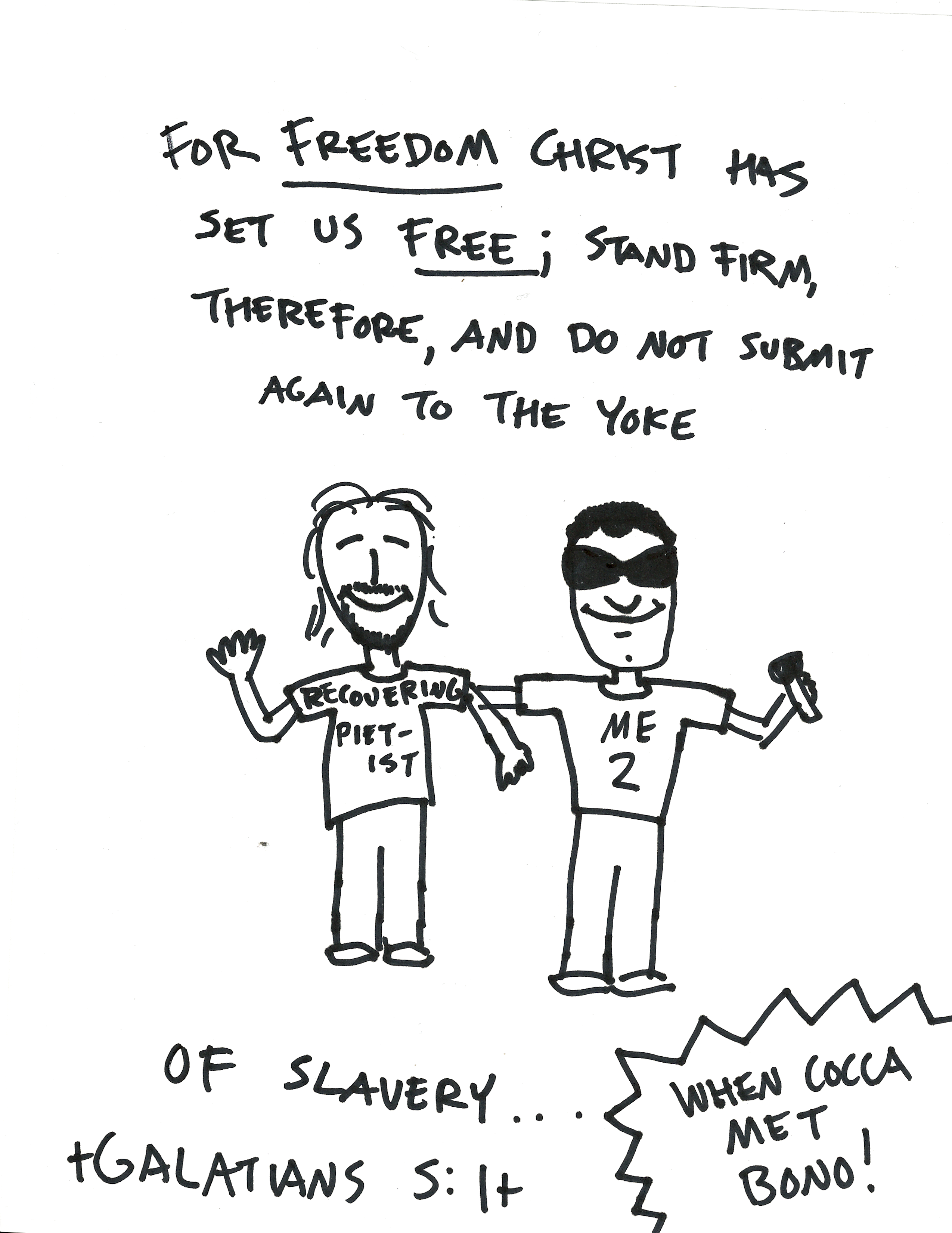
Recovering Pietists In Good Company: One of Many Lessons from the U2 Concert

Thanks to my sister and F. Bil (future brother in-law), my wife and I got to go to the U2 concert in Philly on July 14.  I have many thoughts, pictures, and reflections to share, and this post will be the first.

The show was great and, in a good way, exhausting.  There was so much content beyond the music, and I found myself analyzing every bit of video, every factoid on the massive screen before the show, every partnering of song-choice, faith, hope, and activism.  It was really, really great.

I’ll offer the cartoon below as my first bit of commentary.

I feel like I should say more, but I won’t.  We can do that in the comments. Or when I get around to writing about the thin line between (oops, there I go.  I said I wouldn’t say any more!)

To Boldly Go Where No Beard has Gone Before

This is from 2011.  I’ve had about 37 beards since then.

I’ve been getting f Zach Galifianakis love lately.  Random teenagers at Rita’s.  Kids at a fair.  Entire weddings.

A new claimant to Beard Twin has entered the fray, and this one is nothing short of amazing.

The text simply read: “I didn’t know you were in Star Trek?!”

In case you don’t know, I enjoy Star Trek.  I don’t dress up or go to conventions or anything, but I appreciate the franchise.  Maybe I comment on message boards from time to time.  Maybe I wanted to be James T. Kirk when I was a kid.  Maybe I have strong feelings about why he was the best captain and why Voyager isn’t as bad as people say it is.  Big deal.  I like narratives and monomyths, remember?  I’m in it for the craft, see?

These images look like they’re from Star Trek: The Motion Picture (1979), but it’s been a good 15 years since I’ve seen that film.  Can anyone confirm?  And yes, they were snapped with a smart phone from a television broadcast.  V’ger would be proud.

Onto the images themselves.  I just have to say: not only does this guy have my exact beard style, but he also actually really looks like me.  Perhaps my future self went to the past and filmed this scene?  I’ll find out soon.  He can’t be much older than I am now in these shots.  Who is this bearded fellow?  What is his destiny?  Memory Alpha, what say you?

This slideshow requires JavaScript.