The earnest boys from Jersey:
Clint Eastwood Makes a Republican Case For Gay Rights

My wife and I saw a trailer for Clint Eastwood’s J. Edgar recently, and boy, does it look good. As we watched, my wife leaned over and told me about Eastwood’s recent GQ musings about human rights in general and gay marriage in particular:
“I was an Eisenhower Republican when I started out at 21, because he promised to get us out of the Korean War,” Eastwood tells the magazine. “And over the years, I realized there was a Republican philosophy that I liked. And then they lost it. And libertarians had more of it. Because what I really believe is, let’s spend a little more time leaving everybody alone.”
Make a “get off my lawn” joke if you want, but Eastwood’s right about what the modern GOP becomes when put in the hands of Michele Bachmann and other dominionists in libertarian clothing. Americans of any or no party can certainly be of good will while holding some disparate political beliefs in tension, but we need to be honest about it. There’s certainly no good will coming from quarters that want to curtail gay rights.
Related articles
PANK’s Sense of Humor, The Missouri Review’s Argument For Online Submission Fees

- Image via Wikipedia

This post is from 2011. Today (2019), online submissions are near-ubiquitous, and submission fees are, in my experience, even more common.
Sundry notes of the literary type ahead.
I got a rejection letter from PANK today. Fine. The address it came from? awesome@pankmagazine.com. Hilarious!
Dinty W. Moore, the editor behind Brevity, shared a link to this piece from The Missouri Review today via Twitter. From “Why Literary Journals Charge Online Submission Fees” :
One of the things worth recognizing is that the cost of submitting to a magazine is a fixed prospective cost: a cost that will be incurred and cannot be recovered. Submissions have never really been free. It’s simply that the cost (paper, envelopes, postage, etc.) has been paid to the post office, not the magazine. It didn’t go to the magazines. And I’m not saying that it should have. Freed up from (some) of the costs of submitting to literary magazines, has there been an increase in subscriptions? Has there been an increase in financial support of literary journals from writers?
No. Not at all.
Later:
In fact, submissions increase significantly. This varies from magazine to magazine, but the increase in submissions is somewhere between twenty to thirty-five percent.
My comment:
The increase in submissions has more do with more people trying to be writers, getting MFAs, having to submit to more journals because of more competition, being unable to pay fees at every journal that charges them, or, if able to pay those fees, certainly not subscribing to more journals. It also just so happens that the streamlining of online submissions came at a great time: the world economy has been in the gutter for close to four years. I’m glad to be rid of the cost of paper and postage, but I’m not plunking those extra dollars down for more journal subscriptions. Yes, we keep hearing about how writers don’t have a lot of extra money, but that’s because, well, we (and you) don’t.
The fact that writers no longer pay the costs of postage to submit doesn’t mean that those phantom dollars are now a revenue stream to be captured. That money’s already going to other things, like paying student loans.
Movies That Make You Put Down the Remote (And Stay Up Way Too Late)

I have a pretty easy rubric for knowing which movies are my favorite. When I find it on TV, will I watch it till the end no matter what point it’s at and no matter how late at night it is? For these, the answer is “yes.” In no particular order:
- True Grit (original)
- Batman (1989)
- Remember The Titans
- The Godfather
- The Godfather Part II
- Legends of the Fall
- The Graduate
- A Few Good Men
I’m sure I’ll think of more. What are some of yours?
Picture: How Soda Caps Are Killing Birds. Image: What’s Really In Our Food?
I’ve written about the Great Pacific Garbage Patch (that is, the floating mass of plastic waste the size of Texas wreaking havoc in the Pacific Ocean) on quite a few occasions. It’s in the news a lot and is becoming better-known. And bigger. And more devastating. Take a look at this short piece from NPR today. Warning: it’s graphic. It should also be infuriating.
Consider also the eerie parallels between albatross parents mistakenly feeding their babies plastic and the degree to which we do or don’t know what’s really in most of the food we feed our kids.
But “Venn” Is Just So Fun to Say!
A few days ago, I shared this schematic and called it a “Venn Diagram for the New Revolution.”:
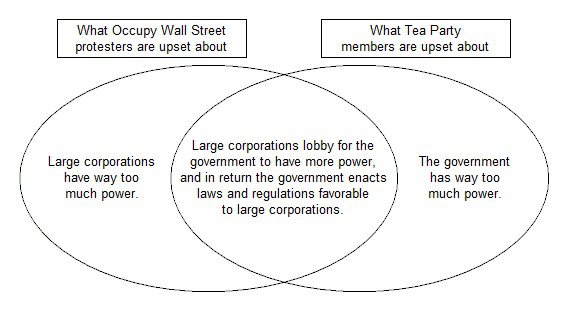
One reader responded thusly:
“except the statement in the middle neither says that the government has too much power nor is part of the tea party opinion pool
conclusion: the author neither understands venn diagrams nor political opinions.”
I’m glad she/he did so, because it brings up an important point I should articulate further:
The daily talking points from the Libertarian Party, which I understand is NOT the Tea Party as such but draws form the same well, tows this line: “corporations have too much power because the government has too much power.” Even though strong elements in the Tea Party believe that limited government inevitably means more real power for corporations (and crazily, they’re okay with that), I do believe that there’s an equally sizable pool that agrees with corresponding parts of OWS on the idea that both corporations and the government have too much power, and that the problem is self-sustaining. Yes, a simple diagram doesn’t get at these nuances. But it’s helpful for people who believe as do I and many readers that powerful constituencies in OWS and the TP could collaborate in meaningful ways.
Who Is the American Middle? Almost Everyone You’ve Ever Known Is Crazy (but Might Not Know it Yet)

Who is the American Middle that has the power to make the 2012 election something different?
Most people reading this post. That huge nexus of overlap between the responsible Tea Partiers and the responsible Occupiers. The employed. The unemployed. The insured and uninsured. Homebuilders and homeless. Students with too much debt, families without enough food.
A reader writes: “I know you joke about your Kuccinich/Paul dream ticket, but I go one step further: it takes a group of crazy D’s and a group of crazy R’s putting aside all that easily divides them and works toward helping real people overcome the big government and big business working against them. What a concept?”
What a concept. I hereby propose the noble and wrongly-maligned fox as the symbol of the next American electoral revolution. If crazy is Ds, Rs, Is, TPs, OWSs all working together for the kind of change we need, I’m crazy all day long.
 Chris Cocca