John Steinbeck on Telling Stories

Today, around your Thanksgiving table, I hope you’re able to hear and share good stories.  Meaningful stories.  Stories of how it is and was with you and all your people.

John Steinbeck, from this piece in The Paris Review:

“A man who writes a story is forced to put into it the best of his knowledge and the best of his feeling.

The discipline of the written word punishes both stupidity and dishonesty. A writer lives in awe of words for they can be cruel or kind, and they can change their meanings right in front of you. They pick up flavors and odors like butter in a refrigerator. Of course, there are dishonest writers who go on for a little while, but not for long—not for long.

A writer out of loneliness is trying to communicate like a distant star sending signals. He isn’t telling or teaching or ordering. Rather he seeks to establish a relationship of meaning, of feeling, of observing. We are lonesome animals. We spend all life trying to be less lonesome. One of our ancient methods is to tell a story begging the listener to say—and to feel— “Yes, that’s the way it is, or at least that’s the way I feel it. You’re not as alone as you thought.” Of course a writer rearranges life, shortens time intervals, sharpens events, and devises beginnings, middles and ends. We do have curtains—in a day, morning, noon and night, in a man, birth, growth and death.

These are curtain rise and curtain fall, but the story goes on and nothing finishes.

To finish is sadness to a writer—a little death. He puts the last word down and it is done. But it isn’t really done. The story goes on and leaves the writer behind, for no story is ever done.”
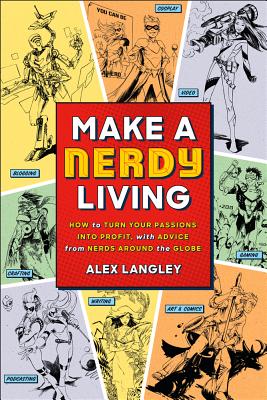
30-Second Book Review: Make a Nerdy Living

Make a Nerdy Living: How to Turn Your Passions Into Profit, with Advice from Nerds Around the Globe by Alex Langley scratches at least two itches.

One: It’s a motivator.  If other people can do it, you can at the very least try harder than you probably are.  The section on writing includes important, insightful reminders on the mechanics of creativity and flow. Langley’s funny, breezy style is endearing and accessible. It’s easy to see why he’s a successful web-writer.

I skipped the parts on how to make a buck cosplaying Firefly.

Which brings me to the second itch.  Once you’re done with the parts you care about, you can give it as a gift to that relative who cosplays Firefly and voice-acts fan-produced short films.  You love your brother-in-law, and this is right up his alley. Everybody wins.

Buy it here from an independent bookstore.

Using the links on this page to purchase this title help support local bookstores, and independent bloggers, in this case, me, who get a small commission.  Like I said, everybody wins.


Seeing Poetry, Looking Away

I think I first became familiar with the work of Stanley Fish in a literature seminar at Yale taught by the late Lana Schwebel.  The course, which focused on the work of John Milton, was cross-listed at the Div School, where I was a student, and the English department. 

One of the other students had just come from Chicago and could not stop talking about Stanley Fish.  Strangely, this student didn’t seem at all familiar with Leo Strauss.  He couldn’t seem to accept that someone had, perhaps, influenced his own academic hero.

Stanley Fish has a very popular piece I like to share from time to time called “How to Recognize a Poem When You See One.”  I haven’t returned to it lately, but, as what Milton called the “winter wild” draws near, and this “the month, and this the happy morn” with it, I think I will add it to my short list of recommended re-reading.

There are few things more frustrating than a poetic image that won’t fully reveal itself to a writer, or one that reveals itself too easily to a reader.  There’s a Milton-inspired poem sitting in another tab on my browser that I just can’t seem to finish.  I love it.  I hate it.  It’s brilliant.  It’s awful.  Maybe it’s not a poem at all.  I wish I could re-see it.  I wish I could un-see (undo) the reasons it exists.  I wish I could delete it.  I know I never will.  It’s terrible.  It’s awful.  It has one or two good images.  It’s intensely personal.  It’s too personal to mean anything to anyone.  It’s too sentimental to mean very much to me.  But there it sits.  There it stays. Maybe it’s a poem. Maybe it’s an epitaph.  Maybe it’s a tombstone.  Maybe some things can just be what they are.  


The best Bruce Springsteen songs – NME

As far as these lists go, this is a pretty tight one.  I’d leave off “Hungry Heart,” which is, to date, his only number one single.

It’s hard to say which Bruce Springsteen songs are the best because, frankly, they’re (mostly) all works of genius. Springsteen writes songs that plough deep into the American spirit and show the fragility, heart and heroism of the working man. Not to mention the fact that quite a few of them are total dancefloor bangers. […]

Source: The best Bruce Springsteen songs – NME

Good to Be Seen

I was at a reception last night for an organization I care a lot about (I also serve on the Board).  It was a great community event, and it reminded me, again, that no matter how good it is to be in the flow of the creative process, it’s also good to just be out in public.  People often say, “it’s good to see you,” and sometimes we say back “it’s good to be seen.”  That’s not just a cliche.  It’s true.  It is good to be seen.   And it’s good to see.

Like everyone else, I balance a lot of demands.  In some ways, I’ve been trying to slow my life down. It doesn’t always work. 

Two people shared very kind, unsolicited thoughts about my writing and my life in general in the course of conversation.  They know who they are, and I thank them here again.  

As one of them might remind me, with respect to Leonard Cohen, don’t fret about your cracks.  That’s how the light gets in.

Ring the bells that still can ring
Forget your perfect offering
There is a crack, a crack in everything
That’s how the light gets in