Cities and Prices (and Hockey), continued.

Friend of the blog Jon Geeting shared my Free Market post from yesterday with some good insights and responses at his blog today.  This is the kind of online discourse I really enjoy: people of good-will engaging each other respectfully across platforms. I encourage you to take part in the conversation at Jon’s blog, but I do want to share a small excerpt from my own response:

It’s fine by me that Rite Aid provides cheaper goods and medicines to Center City residents, and God bless them for it. But on the ground in Allentown, based on conversations I had downtown over the weekend, some civic leaders really are worried that it’s going to be hard to lure and place that kind of store in the near future. They’re not worried the same way about replacing the dollar store (which is also needed). Another question: why isn’t Rite Aid simply moving across the street or up or down a block? Why isn’t the efficiency of the market making it compelling for Rite Aid to stay in the city? And if Rite Aid won’t stay, why should we be confident that Walgreens will come? If the market worked exactly the way we wanted, there’d be no such thing as food deserts, or, in this case, prescription deserts, right?

For me, the immediate issue is also framed by the experiences some folks had at the three “arena open houses” last week.  For months, people have been complaining about the lack of transparency that seems to be guiding the hockey arena project.  Last week, open houses were held in which various stations were set up and the public could talk with city officials, developers, and the owners of the former Philadelphia Phantoms.  One of the problems with this format, well-intended as it might have been, was that there was no chance for real public discussion.  If I’m being cynical, I might suggest a sort of divide and conquer strategy at work.  In any case, the Rite Aid concern came to me from downtown religious and civic leaders following these open houses, and they are worried.  So am I.  I’m not at a point where I feel confident that the market, as such, won’t create a healthcare desert in Center City.

Thank you, Jon, for picking up this discussion!
The Free Market Works Best When (Or Hockey, Rite Aid, Thai Proverbs and Doubting Government and Business)

I’ve been thinking a lot about the free market lately.  In part, I’m wondering why Center City Allentown has one good drug store (Rite Aid), and why that one good drugstore is being displaced by the coming AHL hockey arena (I generally support the arena project), and what that drugstore is going to put up its next shingle in the suburbs, and where that leaves Center City residents no longer able to walk or take reasonable transit routes to a drugstore of any kind, and what all of that says about the degree to which markets are efficient at providing basic needs.

One might argue that the arena project would not be happening without governmental canoodling and the creation of a special tax district downtown.  Sure.  But that doesn’t explain why there’s only one viable option for prescription drugs within a reasonable distance for residents who either walk wherever they’re going (we all say we want walkable cities!) or take transit (we all say we want more people riding buses).  Some arguments will come and go from the fiscally arch-conservative side: the people downtown are poor because the government’s meddling keeps them poor.  If it weren’t for government, those people would have better jobs, cars, nicer places to live, better healthcare options and so on.

And yet, at a time when rental prices and retail space downtown are likely to be at their lowest points ever (so much vacant space, but lo, an arena project looms), I don’t see a whole hell of a lot of savvy business types flocking into even the nicest, newest spaces the city has to offer.  If ever there was a time to come in from suburbs to set up shop, surely it is now.  And yet. Indeed, the coaxing of various businesses with tax breaks and economically favorable statuses is a tweaking of the supposedly pure state of equilibrium the market is thought able to deliver.  We’re in an economic mess, say some, because of government meddling.  In the process of wars on poverty and building great societies, lots of people got screwed.  These are not of themselves outlandish hypotheses. But when some fiscal conservatives take the next step to say that government has no real, legitimate role in trying to fix the mess it has created, I get confused, Columbo style.

Government makes mess.  Government perpetuates mess. Government never should have made this mess in the first place, so now government has no role in trying to fix it.

That doesn’t sound right, does it?  The real kicker: let business do what business wants and business will save everyone.

I’m not anti-business by a long shot, but I am very anti-dogma.  Enron was a business.  All those big banks that helped bring us to the brink of ruin were businesses.  Wall Street is a business.  Yes, Congress is a business. Like government, business can do harm and business can do good.  Like government, business can be generative.  Like government, business does not deserve our total, utter, faith and trust.

Here’s when the market really can cure all that ails you:

  • Perfect information is universally available, obtained, and understood on all sides of every transaction and hypothetical transaction.
  • Every consumer or investment choice is made by perfectly rational beings with the same exact meta-goals.

So, in other words…yeah.  Sounds good on paper.

Unfettered beliefs in the efficiency and tangential goodness of markets or government aren’t tenable forever.  At the local level, we long to believe that a rising tide will lift all boats, and, to a degree, I think it will.  But I also read a Thai proverb today that gave me pause:

At high tide, the big fish eat the ants.  At low tide, ants eat the fish.

I’m not calling anyone an ant.  But isn’t this idea basically the fear behind the fear the well-horned have of the Occupy movement?  And isn’t it the fear most people caught somewhere in the disappearing middle have in general, that when push finally comes to shove, when things get REALLY bad, it won’t be push and shove but blocks on fire, looting, violence, chaos?

Even if high tides lift all boats, low tides come regardless. Will we trust the government, the market, or will we invest now in each other, in communities, in partnerships, in new ways of being neighbors?

It’s Okay, US Senate, We Got This: Due Process and The War on Terror

From the NYT:

“WASHINGTON — The Senate on Thursday decided to leave unanswered a momentous question about constitutional rights in the war against Al Qaeda: whether government officials have the power to arrest people inside the United States and hold them in military custody indefinitely and without a trial.”

Let me handle this for you, The Senate:

No.

With thanks to Kyle Minor for sharing the article on Facebook.

At Christmas, a Tale of Two School Districts

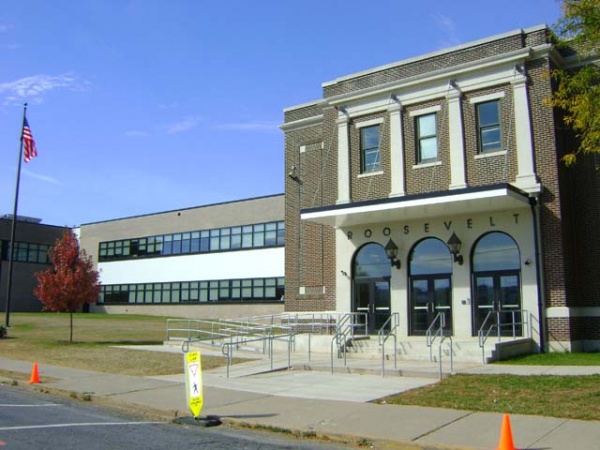
Roosevelt Community School

A few months ago, I attended my first Community Partner meeting at Roosevelt Community School here in Allentown.  For those of you not familiar with the Community School model or how in works in this region, visit this page at the United Way of the Greater Lehigh Valley.

Because of state budget cuts in education, elementary schools in the Allentown School District (a district and tax base not nearly as well-off as the Parkland School District that borders it) don’t have year-round gym, music, or art programs.  Instead, they get nine weeks of each.  Nine weeks of art.  Nine weeks of music. Nine weeks of gym in a district where over 40 percent of elementary students are either overweight or obese. Keep that in mind.

At Roosevelt,  Allentown Symphony Hall is a civic partner providing free music education five days a week via the El Sistema program for the length of the school year.  While I waited in the hall for my first meeting to start, I heard children talking to each other candidly and without prompting about how excited they were to be able to start El Sistema.  At another ASD elementary school, fliers for after-school fitness clubs paper the walls.  Mentoring programs, art programs, financial planning programs…these are all being organized and run by teachers, parents, volunteers, and, in the case of Roosevelt, a Community Director.

At Roosevelt, supplemental education doesn’t stop with children.  There are classes for parents, too, classes on parenting, financial basics, and English as a second language.  This philosophy is at least two-fold as far as I can tell:  parents with more resources and access help foster a better environment for success at home, and schools that are open to the community become places where parents, despite real or supposed cultural barriers, feel welcome.  That’s essential.

I’m sharing all of this for a few reasons that are related.

  • It’s extremely important.  As our city schools face continued challenges locally and nationally, and as budgets are cut because of the ongoing financial crisis or political maneuvering, I do believe these kinds of models will be an important way forward.
  • As Director of Mission at First Presbyterian in Allentown, I work with volunteers at Roosevelt.  100 percent of Roosevelt students are on free or assisted lunch.  Many don’t have enough socks, proper shoes, or warm winter clothes.  If you want to help with that, regardless of where you live, get in touch with me.
  • A few days ago, a post went up on the Valley610 blog telling people to add the Parkland Educational Foundation to your holiday gift-giving list. Jon Geeting jumped on this with a rather provocative headline.  By and large, Parkland has money.  By and large, gifts to the PEF will serve to maintain and further enhance the district’s profile as top in the region, and will help Parkland students maintain and enhance their already jack-pot experience.  That’s fine.
  • I owe a lot to the education I received in the 80s and 90s as a student in the Parkland School District.  We had a lot of opportunity, and kids there now have even more.  We had a ton of resources, and I can’t even imagine the kinds of resources that abound in each of the district’s schools at all levels in 2011.  In high school, I was Debate Team president and the President of the Class of ’98, and I understand even more now how lucky I was to be where I was and to have had parents, friends, teachers, and administrators who all impacted my life in profound ways.  Parkland has a great tradition, and I hope it continues.
  • But….

Kids in the ASD don’t have socks.  They don’t have winter coats.  They don’t have year-round gym or art or music.  Many can’t afford school lunch.  A few miles away sit schools bustling with opportunity in communities with money.

If you have a few expendable dollars this Christmas, give it to Community Schools like Roosevelt in the Allentown School District.  I like the intention, in some ways, behind the Parkland Educational Foundation’s idea of giving in honor of your favor teacher and so on.  But seriously, why not donate to the ASD in your favorite Parkland teacher’s name?  That’s what I’ll be doing.

Chuck Palahniuk and the Second Sunday of Advent

If your first thought is that the title of this post would be a great name for a band across multiple genres, I agree.  But the truth is, in this case, even cooler than the fiction.

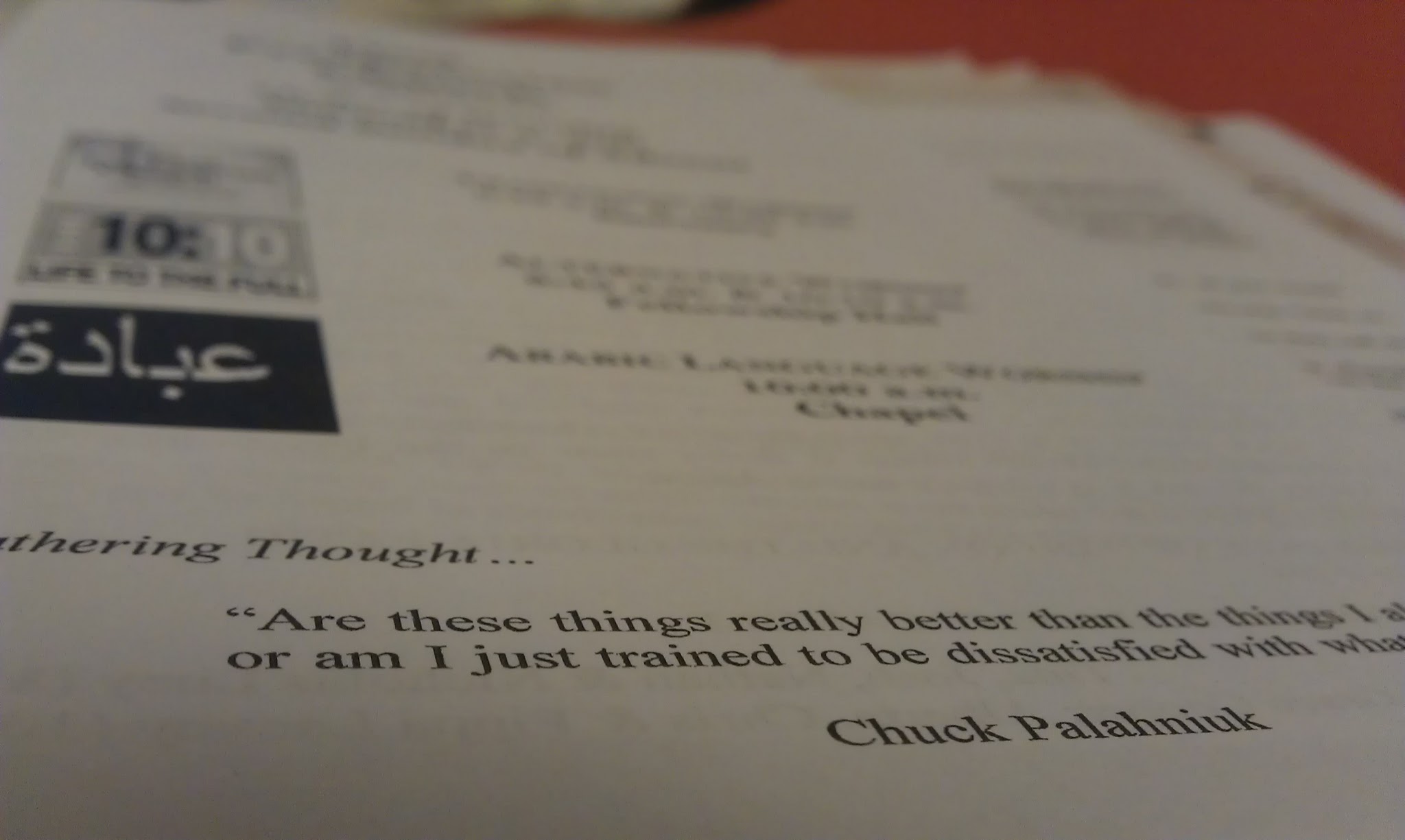
This is the Gathering Thought posted at the bottom of the cover of these week’s bulletin at First Presbyterian Church of Allentown:

“Are these things really better than the things I already have?  Or am I just trained to be dissatisfied with what I have now?”  – Chuck Palahniuk

I don’t know that I’ve ever seen Chuck quoted so prominently in a church setting.  For those of you who know of my fondness for some of Chuck’s work, I should also state that I had nothing to do with this bit of timely subversion.  Fits very nicely with the liturgy for the Second Sunday of Advent, and for the themes of the Advent Conspiracy at First Pres.

Rock and Roll Word Association

We start with Mumford and Sons:

Mumford and Sons: Fleet Foxes

Oasis: Blues Traveler (don’t say Blur. Don’t ever say Blur.)

Coldplay: Yellow

Beatles: Beach Boys

Kinks: Stones

Who: Led Zeppelin

Foo Fighters: System of a Down

Tom Petty:  Hearbreakers

Bruce Springsteen: E-Street

John Mellencamp: Pink Houses

Pink: Areosmith

Dream On: Dream Until Your Dream Comes True

Joe Perry riffing: Conan O’Brien

Morrissey: Kevin Max

James: Oasis

REM: Third Day

The Police: U2

R2D2: Not The Droids You’re Looking For