
The Last Man Standing in the Baseball Steroid Scandal
Okay, it’s really, really hot this week in most of the country. According to the Drudge Report, though, the heat index in usually-sunny California is a scant 19. I’m no meteorologist, but I’m pretty sure that’s wrong:

In the 90’s, Keith Olbermann was part of a flawless thing called SportsCenter. Even though the political commentary and overall style he’s developed since then isn’t everyone’s cup of tea, this Special Comment from the July 11th edition of Countdown is essential viewing for anyone who cares about the justice issues tied to humanity’s basic failures of compassion, empathy, and care.
“Face it,” Oblermann says, “we do not take care of one another. Not we as in progressives, not we as in Americans, not we as in the West. We as in a species.”
If we’re being honest, we know that Olbermann is right. And even though he’s not saying anything particularly new, the bluntness of the charge is just a little jarring, even in the context of waning hope in hoped-for change. We, the People, do not take care of one another. It’s no wonder that They, our leaders, do no better.
And what about another set of “we’s?” We the stewards of the planet,we the image-bearers of God? What about we who believe loftly things about the the Holy? For Christians, what about that we called the Body of Christ? I read a ten-year old stat estimating the global income of organized Christianity (churches, denominations, and parachurch ministries) hovers around $270 billion annually. I’ve read elsewhere that the yearly global income for Christian individuals (the compensation they get from having jobs) is $10 trillion. Extend the tradition of a 10 percent tithe from each of these groups toward eradicating poverty, and you’d do it in a year. We’re talking about $1,027,000,000,000. Don’t know what $1 trillion can buy? Look here and here. One Trillion Dollars can purchase all the homes that foreclosed in 2007 and 2008 or pay the rent for every US renter for 3 years. Universal preschool for all American 3 and 4 year olds? No problem! That only costs $35 billion. American Christians could pay that themselves.
But my 1 trillion number (see Ron Sider’s Rich Christians In an Age of Hunger) represents a global tithe, so let’s consider global implications. According to VisualEconomics, access to clean water for everyone on the planet now without it only costs $8.84 billion. That’s with a B. Christendom has $1 trillion, with a T, to play with every year. Clean water, then? Fine. What, Christians? You want to sponsor a million kids through Children International for a year? That’s just south of $300 million (with an M). No problem, Church! One new home at $175,000 a pop for each one lost in Katrina? You’re thinking bigger, but that’s only $48 billion. You’ve got $1 trillion and change to spend every year (plus the other $9 trillion you’ll use for basic needs, creature comforts (in developed countries), and, in some contexts, unprincipled extravagance). You could feed everyone, clothe everyone, give everyone access to water, heal the land, clean the water, and clean the air in perpetuity. Talk about an endowment. Oh, and you could send kids to school, heal diseases, and bring animals back from the brink of extinction. You could (and would) eliminate the root causes of war. Or you could keep trusting the bulk of the money you give away (via taxes) to people who keep finding new reasons to make war so vital.
The Church could end poverty, scarcity, sickness, and famine without a dime from the rest of the world. Obviously, that doesn’t mean it should do so by some centralized economic fiat. The last thing anyone needs is a megalith, even one as diverse and nuanced the global church really is, setting this kind of agenda. Noting that the Church could foot the bill for the saving of the planet doesn’t mean that the Church is otherwise equipped to do so, and it doesn’t even mean that something called “the Church” exists in any sort of organizationally connected way across the world. We may (and I do) believe in the mystical Body of Christ, but can you imagine the impossibility of mobilizing every Christian group under some sort of prime directive?
Then again, that’s what Jesus did by giving the Great Commission and promising the Holy Spirit. Perhaps if all Christians understood the economic power they possess and the practical implications of loving one’s neighbor as oneself, this phantom trillion would find its way to points of need. Perhaps if the Church was busy consciously investing even 10 percent of its annual income to overcome the systems that breed injustice, hate, and other things we still call sin, Jesus’ talk of the Kingdom of God being here even now would make a hell of a lot more practical sense.
Brennan Manning has said that one of the biggest causes of atheism with reference to Christianity are “Christians who acknowledge Jesus with their lips and walk out the door and deny Him by their lifestyle. That,” Manning says, “is what an unbelieving world simply finds unbelievable.” I’d go even further and suggest that the conformity of so many Christians to the status-values of consumption, possession, and unsustainability is also one of the biggest enablers of global scarcity and the atrocities that come with it. Faced with the kind of evil that flourishes where hope and charity do not, perhaps the oft-repeated “Where is God in this?” isn’t quite the question. Consider this instead: “Oh, God, where are the Christians? Where were the fraction of their resources that could have stopped this in the first place?”
Yes, I’m claiming scandal as a member of the movement. I’m appealing to classic Christian expectations of ourselves. I’m not saying the Church must act because all other faiths or governments have failed. I’m saying the Church must act because it has failed to be the Church. We’re good at giving time and talent, but what is it about the way we’ve spent our treasure that allows inequity and scarcity to run and reign so freely? Do we have a misplaced trust in the structures of church government and Christian organizations? Or are we, paraphrasing Jesus, seeing where our hearts don’t lie in the faces of all those who will die before this post is finished because we’ve finally let them?
Help us, Lord.
Yes, much of the phantom trillion gets used in responsible ways by good people towards precisely the things I’m talking about. But what if global Christianity were led from the margins (even as Jesus led)? What if we recast the idea of tithe as a fraction of our treasure given back to God in the world and not our institutions? What if we empowered charity: water to complete its mission? The enraging thing about that proposition is that we could really do it. And we aren’t. Not in intentional, global ways. Often not with the recognition that the outright care of other people is the Gospel. What if we helped WorldVision, Compassion International and other groups with scant administrative footprints put themselves out of business? Nothing would make them happier! What if we used our economic clout to be a global force against genocide in Darfur and Burma? What if we empowered local Christians and other people of good will already working in those places in system-changing ways? And what if the Holy Spirit helped us?
Even without a moratorium on traditional patterns of giving, and even recognizing that our poorest sisters and brothers can’t often give something as concrete as money, the rich Christians in the industrial world could raise a second trillion every year without denying themselves or their churches very much of anything. So far, we haven’t, and that’s the even greater greater scandal.
Help us, Lord.
Thanks to my sister and F. Bil (future brother in-law), my wife and I got to go to the U2 concert in Philly on July 14. I have many thoughts, pictures, and reflections to share, and this post will be the first.
The show was great and, in a good way, exhausting. There was so much content beyond the music, and I found myself analyzing every bit of video, every factoid on the massive screen before the show, every partnering of song-choice, faith, hope, and activism. It was really, really great.
I’ll offer the cartoon below as my first bit of commentary.
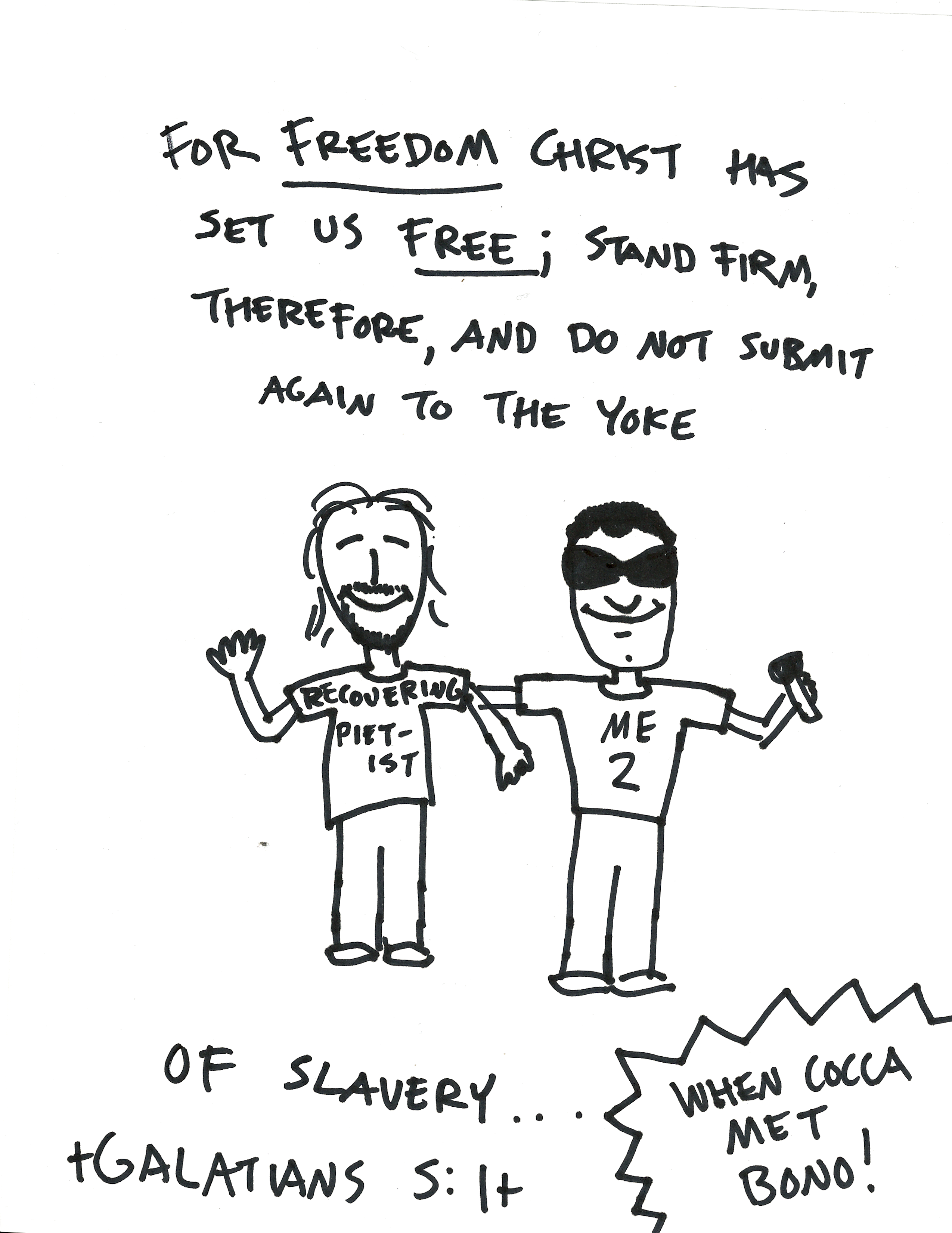
I feel like I should say more, but I won’t. We can do that in the comments. Or when I get around to writing about the thin line between (oops, there I go. I said I wouldn’t say any more!)
A piece I co-wrote with Megan Fitzpatrick from PennEnvironment is in today’s Allentown Morning Call. The essay is not featured on the Call‘s website, so I’ll paste the most recent version I have (may differ from what was ultimately printed in editorial details) and share some pictures of the hard copy here:
 With the summer vacation season in full swing, many Pennsylvanians find themselves longing to be outside enjoying everything the state has to offer. Memories of summers gone by are vivid as we daydream about upcoming getaways – to the mountains or shore, to IronPigs or Phillies baseball games, to visit family and friends, or even as we look forward to weekend activities.
Unfortunately, great memories and hopeful plans will be as far as some of us get. Feeling the hurt of high gas prices, unemployment, and the still-sluggish economy, many families have decided to scale down their summer vacation plans or opt for “stay-vacations.” But due to increasingly bad air quality and high gas prices, even our stay-vacations and local excursions may be sabotaged.
The people of Pennsylvania have had enough of the dire consequences of our continued dependence on oil. We’ve had enough of the price spikes, the air pollution, the catastrophic oil spills, and the global warming pollution that threaten our economy, our environment and our public health. And now, our oil dependence is even jeopardizing something as basic as the ability to enjoy our outdoor resources this summer.
Just two weeks ago, both South Mountain and Blue Mountain disappeared from sight on an Air Quality Action Day, blocked by a haze of ground-level ozone. The temporary absence of the Lehigh Valley’s defining physical features reminds us that we need to take bold steps towards cleaning up our air by cleaning up our cars and changing our transportation habits.
The longer we stay addicted to oil and the longer we fail to utilize opportunities offered by ride-sharing and transit, the worse these problems will get. The time has come to take bold national steps toward oil independence. Simply put, we can, and must, harness American ingenuity in the production of cars and trucks that will get us further on one gallon of gas.
PennEnvironment recently released a report that found that the average Pennsylvania family could save $452 in one summer if our cars and trucks met a standard of 60 miles per gallon—a standard that the Department of Transportation and EPA have deemed within our reach by 2025. While Pennsylvanians are expected to spend more than $4.8 billion at the gas pump this summer, meeting a 60 mpg standard would save over half that, while reducing oil consumption by 600 million gallons and cutting dangerous carbon dioxide pollution by 6 million metric tons.

We know that we can harness American ingenuity and use existing technology to make our cars and trucks much cleaner and more fuel efficient. Just this week, we were pleased to learn that higher demand for Mack’s line of near-zero emission trucks is expected to bring more jobs to the Lehigh Valley this summer. Additionally, over the next three years, more than a dozen electric vehicle models will be mass-produced in the United States. These new cars offer superior automotive performance while consuming no oil on most trips and producing no tailpipe pollution. And, these rides can be operated for less than three pennies per mile.
Recognizing that we have the technology to break our oil dependence, the Obama administration set standards for new cars and trucks built between 2012 and 2016 that will save billions of gallons of fuel. This, too, was an excellent start, but more must be done. The standards the administration is now developing for cars sold between 2017 and 2025 offer an excellent opportunity to do just that.
President Obama should move clean cars into the fast lane by issuing standards that ensure that the average new car and light truck meet a standard of 60 miles per gallon by 2025. He has every reason to do so—not only will it benefit Pennsylvanians at the pump, but it will protect our health and environment.
Americans work hard and deserve stable access to affordable transportation and a healthy natural environment. The Obama administration should push ahead with clean car standards that will make these benefits a reality. We’ll all be richer, and breathe easier, for it.
Megan Fitzpatrick is the Federal Field Associate with PennEnvironment, a citizen-based, non-profit environmental advocacy organization.
Chris Cocca is the Outreach Director for the Air Quality Partnership of Lehigh Valley-Berks, a public/private coalition of volunteers dedicated to improving air quality in Lehigh, Northampton, and Berks Counties.
Resolved: People, for whatever reason, tend to view Google as less of a brand and more of a utility.
Suggested reasons: Google is, in fact, utilitarian. It’s under-branded to the extreme, and even its logo is generic. Before anyone had Google accounts or Gmail, we were already using “google” as a verb. The lack of flash, the absolute dearth of iconography…the lame font and funny multi-colored name, these things are disarming almost to the point of making you forget that Google wants each and every bit of your personal information even more (perhaps) than Facebook.
Facebook is nothing if not a brand. Rightly or wrongly, we think we get what Mark Zuckerberg is all about, and that necessarily flavors our understanding of his company’s ethics, ambition, and culture.
I said last week that when I’m using Google+, I don’t feel like I’m in some proprietary fishbowl circa 1990s AOL. Google looks and acts like a utility, and we’ve come to think of access to what Google does best (search) as precisely that. Facebook is a fishbowl by design, and Zuckerberg’s quest to keep you in/on Facebook for all your webly needs shows that he’s bound and determined to validate and more effectively monetize Steve Case’s old vision. Maybe Google+ does, as Zuckerberg claims, validate Facebook’s (old) vision, but only in terms of ambition. Plus is built with the relationships grown-ups have in mind, and Facebook was built as a college network. It has adapted over the years to fit the needs of adults, but it still feels like your last visit to the pediatrician. Early adopters are hitting 30 and needing a social network that’s intuitive and easily customizable, something more akin to real-world connections than “friending” and more useful and dynamic than boring old LinkedIn.
Last week we learned that Google will retire the Blogger and Picasa brands as they begin to roll those services into Plus. Is everyone starting to understand that Google+ is Google, and Google is Google+? Blogger.com is the epitome if Web2.0 branding, and if you’re not already using Picasa, it just feels like another thing. So Google is rolling these brands into itself, making them more useful and more generic than they’ve ever been. The lighter the brand recognition, the more likely we are to trust you with our data. Silly, isn’t it, given Google’s size, influence, and sometimes-faltering commitment to publicly stated values? Sure is. But it’s also true.
Don’t think so? Check out Delloitte’s recent study proving that we already hate branded apps. While Facebook is busy becoming the largest branded app in history, Google is de-branding everything but YouTube (which also doesn’t feel like a brand). Interesting, isn’t it?

 Chris Cocca