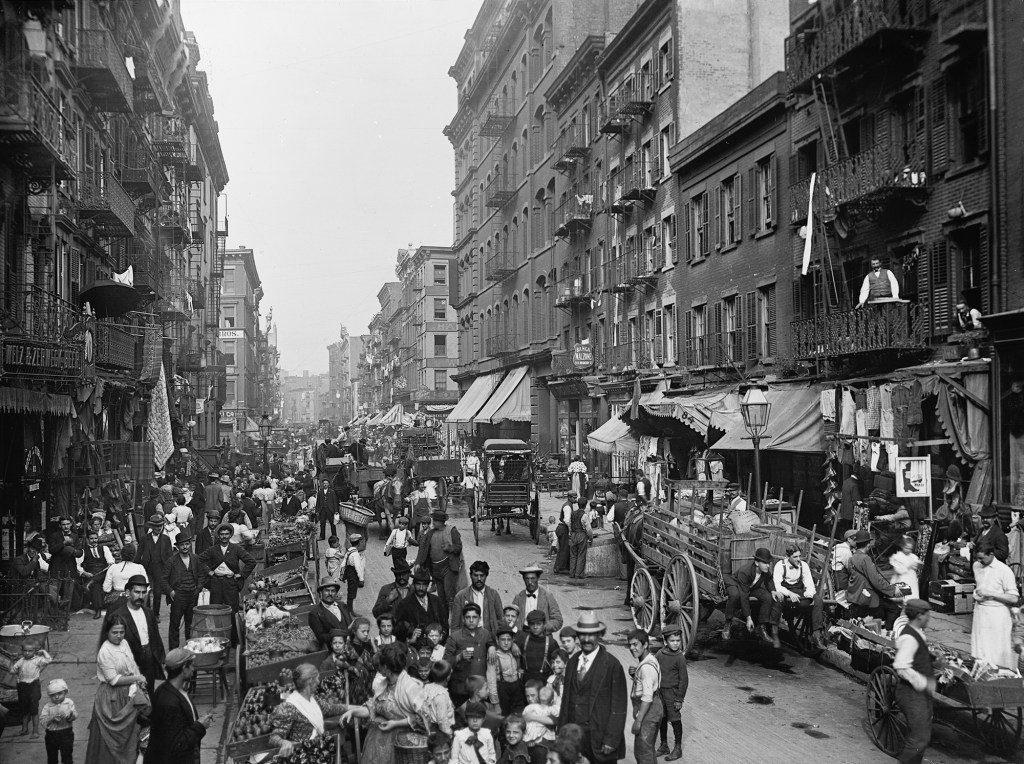
Mulberry Street, NY, circa 1900. Library of Congress
Someone recently told me they think this newsletter has wide appeal. I appreciate that. Worth noting: this praise was via text, with a key word originally mistyped: “I think your writing has white appeal.” That’s funny, right?
Speaking of:
Updating Mario
People are mad that Chris Pratt’s Mario doesn’t-a-talk-like-a-dis. I, for one, am amazed Nintendo got away with that shit for so long. I haven’t watched the Mario trailer, but it did come a few days after Colin Jost’s joke about whether or not Italians are white. (Colin Jost is the waspiest wasp to ever come out of Staten Island, which is a big part of why the joke worked1). If you don’t understand the context (“wait, Italians are white now?”) there’s no shortage of literature on the subject. Here’s one place to start.
Italian Americans have reached just about every summit of American life. As much as our contributions have enriched and transformed every facet of the larger culture, the stereotypes persist in almost every popular editorial medium: our men are affable buffoons, petty toughs, or mob chieftains; our women are some variation of Strega Nona or Marissa Tomei2 from My Cousin Vinny.
Understanding Michael
When we’re in charge of the tropes, the art’s irrepressible. The Godfather, The Godfather Part II, A Bronx Tale, etc. Michael Corleone’s whole quest to become legitimate is, after all, an allegory for becoming “American.”
Consider the exchange between Senator Pat Geary and Michael in Tahoe:
Senator Pat Geary: I can get you a gaming license. The price is $250,000, plus a monthly payment of five percent of the gross of all four hotels. [sneers] Mr. Corl-ee-own-eh.
Michael Corleone: Now, the price of a gaming license is less than $20,000. Is that right?
Senator Pat Geary: That’s right.
Michael Corleone: So why would I ever consider paying more than that?
Senator Pat Geary: Because I intend to squeeze you. I don’t like your kind of people. I don’t like to see you come out to this clean country with your oily hair, dressed up in those silk suits, passing yourselves off as decent Americans. I’ll do business with you, but the fact is that I despise your masquerade, the dishonest way you pose yourself. Yourself and your whole fucking family.
Michael Corleone: Senator. We’re both part of the same hypocrisy…but never think it applies to my family.
Senator Pat Geary: [exasperated] Okay. Some people need to play little games. You play yours. Let’s just say that you’ll pay me because it’s in your interest to pay me. But I want your answer and the money by noon tomorrow. And one more thing. Don’t you contact me again, ever. From now on, you deal with Turnbull.
Michael Corleone: Senator? You can have my answer now, if you like. My offer is this: nothing. Not even the fee for the gaming license, which I would appreciate if you would put up personally.
I don’t personally know any Italian Americans who are proud of the legacy of the Mafia. But I believe I know plenty of people who see in Michael’s offer to Geary a kind of comeuppance, even a certain kind of justice, long deferred. An Italian American forced into the Cosa Nostra by circumstance turning the tables on Geary’s wop-shaming WASP, a stand-in, of course, for a century of very real anti-Italian hatred. As much as we hate the gangster stereotype, we’ve been allowed few other heroes outside of Christopher Columbus.
Of course Michael Corleone courts and marries Kay Adams.3
Tackling Columbus
If we’re hell-bent on locating Italian-American pride on an historic figure fundamentally tied to the American founding, Filippo Mazzei might be a model. A friend of Thomas Jefferson, it was Mazzei who famously wrote “All men are by nature equally free and independent” in a pamphlet promoting the cause of liberty in colonial America years before Jefferson made the sentiment famous in the Declaration of Independence. Unlike Jefferson, Mazzei seems to have managed to utter those thoughts without also owning slaves.
It’s Italian American Heritage Month, but the idea of Columbus as avatar of Italian American pride is, in 2022, ridiculous. Columbus, the man, is not worthy of that kind of honor for reasons I shouldn’t have to list. I’m not talking about general, anti-colonial tropes (although those are valid). There are specific reasons, and they have everything to do with his own specific, heinous deeds. Italian Americans need to hear this. But we also need to be heard, and as long as we’re having this discussion, we need everyone else to be honest about the degree to which Anti-Italian and Anti-Italian-American sentiments remain widespread and acceptable in everything from political journalism to children’s entertainment.
Italians are white, but we’re not exactly from the Shire. We are without a doubt privileged because of our whiteness, even if our whiteness (and Americanness) has only been wholly accepted in the third or fourth generation of our families’ presences here. In Columbus, we, a despised and displaced people, laid a pre-emptive claim to a pre-emptive America in the face of the WASP power structures that not only controlled economic and social capital, but the literal definitions of “white” and “American.” That power of that symbol for Italian immigrants, and for their children and grandchildren and great-grandchildren, is real. Ask me how I know.
These days, Italians Americans aren’t marginalized the way people of color or white people from the wrong parts of Europe are, but we’re still gangsters and clowns and a-people who talk like-a this. I’m proud of Mario for consistently saving the Mushroom Kingdom and for his work as a plumber, but I find Nintendo’s later-day characterizations of his patterns of speech wholly offensive. The same is true for just about-a any-a chef you’ve ever seen on any-a children’s show.
Our ancestors were olive-skinned, non-English-speaking whites, but as everything from popular sentiment to my great-grandmother’s federal immigration papers make clear, we were only white (and in those days, “American”) in relation to darker-skinned people. Columbus Day was meant to cement our claim to Americanness, whiteness, and social respectability, wedding us with and contrasting us to other American whites, Anglo whites, the same whites casting us as idiots, wop-shaming us as a matter of practice and policy. Columbus Day is full of these kinds of ethnically, racially charged ironies. As human beings, Italian Americans ought to despise the evils inherent to the Columbian Exchange. I’m sure most of us do. We struggled as Other for over a century, a situation mitigated and frustrated by our fringe position within canonical whiteness.
You’ve likely heard of Sacco and Vanzetti. You likely don’t know about the mass lynching of Italians in New Orleans in 1891, or how both tragedies were driven by anti-immigrant and anti-Italian hatred. Italian Americans are right to want to celebrate our historical struggles in and contributions to the United States and the Americas more generally. How ought we tell our stories without becoming the locus of marginalizing power ourselves? Rather than cling to Columbus, shouldn’t we be ready and able to find alternative icons for ourselves, for the spirit that brought our ancestors here, and our shared belief in what America can be regardless of what it sometimes is?
Remembering Mazzei
If we’re hell-bent on locating Italian-American pride on an historic figure fundamentally tied to the American founding, Filippo Mazzei might be a model. A friend of Thomas Jefferson, it was Mazzei who famously wrote “All men are by nature equally free and independent” in a pamphlet promoting the cause of liberty in colonial America years before Jefferson made the sentiment famous in the Declaration of Independence. Unlike Jefferson, Mazzei seems to have managed to utter those thoughts without also owning slaves. Seems like a good place to start.
We can remember Columbus’ place in history without idealizing Columbus the man. We can and should continue to teach, learn, and understand the unvarnished history of 1492 and all that came after. We can and should do all of these things without feeling the need to honor Columbus as the prototypical Italian American. He wasn’t. Our ancestors were. That’s enough.
Reading Ferlinghetti
I’ll finish this post with a poem. There’s a pedantic debate among some Italian American writers and scholars as to whether Lawrence Ferlinghetti counts as an Italian American. I would never say that’s the only way to think of him, but I don’t understand the need some have to excise him from the tradition. I understand it rhetorically, but I fail to see what it accomplishes. Here’s what I know: the night he died, I dreamt about my late grandfather, zizis, great uncle. We were trying to put names to the ancestors buried in Campania. This poem, to me, is one of his best:
The Old Italians Dying
For years the old Italians have been dying all over America For years the old Italians in faded felt hats have been sunning themselves and dying You have seen them on the benches in the park in Washington Square the old Italians in their black high button shoes the old men in their old felt fedoras with stained hatbands have been dying and dying day by day You have seen them every day in Washington Square San Francisco the slow bell tolls in the morning in the Church of Peter & Paul in the marzipan church on the plaza toward ten in the morning the slow bell tolls in the towers of Peter & Paul and the old men who are still alive sit sunning themselves in a row on the wood benches in the park and watch the processions in and out funerals in the morning weddings in the afternoon slow bell in the morning Fast bell at noon In one door out the other the old men sit there in their hats and watch the coming & going You have seen them the ones who feed the pigeons cutting the stale bread with their thumbs & penknives the ones with old pocketwatches the old ones with gnarled hands and wild eyebrows the ones with the baggy pants with both belt & suspenders the grappa drinkers with teeth like corn the Piemontesi the Genovesi the Siciliani smelling of garlic & pepperoni the ones who loved Mussolini the old fascists the ones who loved Garibaldi the old anarchists reading L’Umanita Nova the ones who loved Sacco & Vanzetti They are almost all gone now They are sitting and waiting their turn and sunning themselves in front of the church over the doors of which is inscribed a phrase which would seem to be unfinished from Dante’s Paradiso about the glory of the One who moves everything… The old men are waiting for it to be finished for their glorious sentence on earth to be finished the slow bell tolls & tolls the pigeons strut about not even thinking of flying the air too heavy with heavy tolling The black hired hearses draw up the black limousines with black windowshades shielding the widows the widows with the black long veils who will outlive them all You have seen them madre de terra, madre di mare The widows climb out of the limousines The family mourners step out in stiff suits The widows walk so slowly up the steps of the cathedral fishnet veils drawn down leaning hard on darkcloth arms Their faces do not fall apart They are merely drawn apart They are still the matriarchs outliving everyone in Little Italys all over America the old dead dagos hauled out in the morning sun that does not mourn for anyone One by one Year by year they are carried out The bell never stops tolling The old Italians with lapstrake faces are hauled out of the hearses by the paid pallbearer in mafioso mourning coats & dark glasses The old dead men are hauled out in their black coffins like small skiffs They enter the true church for the first time in many years in these carved black boats The priests scurry about as if to cast off the lines The other old men still alive on the benches watch it all with their hats on You have seen them sitting there waiting for the bocce ball to stop rolling waiting for the bell for the slow bell to be finished tolling telling the unfinished Paradiso story as seen in an unfinished phrase on the face of a church in a black boat without sails making his final haul
Sometimes I wonder what the hell any of us are doing. Every other day I’m fairly convinced that if we’re not in World War III already, it’s just a matter of time and semantics. I’m not a pessimist, but I *have* been doom-scrolling. I don’t believe global catastrophe is inevitable, but I also know that most people around the world live in catastrophic settings all the time. Sometimes it feels very odd to be going on and on about literature and poetry and art and books at what feels like the end of the world. But I think we need to.
The long and the short of it: send me your previously published stuff if it’s uplifting and peace-making and you’d like me to boost its signal (even a little).
Built in 1955 to augment the nation’s first true superhighway, the Northeast Extension of the Pennsylvania Turnpike runs from Plymouth Meeting to Clarks Summit, connecting the east-west route from the Philly Metro through the Lehigh Valley, the Poconos, and into Lackawanna County.
Before and after the Lehigh Tunnel, bored by Army engineers in the 50s, there are stunning views of expansive green…
…Adam Smith’s invisible hand, is, for far too many people, more like a middle finger. Whether or not you contribute to food banks, you likely have accepted them as a para-capitalist solution to a problem capitalism itself was supposed to solve…
Note: This post is also available via my Substack. Subscriptions are free.
Pilgrims
Some synchronicity this week. The other day I saw a tweet asking “if money were no object, where would you go on pilgrimage?” I said Bora Bora.
Shortly after, Lawrence Wright shared a picture of Plymouth Rock and said “Plymouth Rock has to be one of the most unremarkable artifacts of American history.”
He’s not wrong.
The LARPing at Plimoth Patuxet (formerly called Plymouth Plantation) is great. They haven’t broken character (or kayfabe) since the 60s. But the rock? It feels kind of shammy. By all means, go to Plymouth. By all means, see the rock. But don’t expect a transcendental encounter with history.
I remember being somewhere once, some tourist destination, and they were advertising free pictures with then-President George H. W. Bush. The father of the family ahead of us in line was incensed at the big reveal: an unconvincing wax figure with River Phoenix hair. Plymouth Rock is not that experience, exactly. It is a rock, after all, and it is in Plymouth, and it doesn’t take much work to imagine that the shore enshrined beneath the 1880’s granite canopy was, indeed, the first ground William Bradford trod since leaving Holland.
In any case, Plymouth is lovely and has many points of interest.
I did a big haul last weekend from 2nd & Charles. One of the books I picked up was the Dover Thrift Editions Great American Short Stories edited by Paul Negri. 19 stories for a dollar fifty, and some great ones. The first entry is “Young Goodman Brown” by Nathaniel Hawthorne, early luminary of American letters, writer of The Scarlet Letter, hung-up great-great-grandson of unrepentant Salem witch judge John Hathorne. Hathorne (Nathaniel changed the spelling for greater distance) was also made, by reputation, the fiend-appointed judge in Benet’s “The Devil and Daniel Webster.”
It’s hard to read “Young Goodman Brown” (written in 1835) from anything but a modern perspective. And so the journey into the woods, the meeting with the devil, the damned-to-hell-ness of everyone he knows (his minister, his deacon, his catechist, his father, his grandfather, and so on) reach us through lenses curved by later figures (Jung and Freud, Marx and Bryan, many more). We have, of course, the young person’s native instinct for exposing hypocrisy and bullshit. We have Hawthorne’s greater literary project (deeply psychological, deeply personal). We have, of course, New England Calvinism. We have, I suspect, the echoes of personal trauma, moral failure, family shame. Which is to say, we have in this old work a modern writer and a modern story.
Speaking of Which
As far as I can tell, there are two essential things a writer has to do to be a writer.
A writer has to write.
A writer has to read.
I doubt writers have more hang-ups and compulsions, per capita, than other people. Everyone has something. Some things are idiosyncratic. Some are ticks we share with millions of other people.
In my quiver? OCD. If you have it, you know it’s a massive, intrusive, often-maddening pain in the ass. If you don’t have it, I hope you’re not one of those people who throw the term around like it’s some kind of Marie Kondo superpower that helps you power through your chores. It is absolutely not that. Not by any means.
OCD is usually treatable. If you have it, treat it. I treat mine. The ticks and pulls and triggers are no longer all-consuming, thankfully. There are vestigial habits, the temptation to think magically, and so on, but, for the most part, these needless organs seldom burst. I just said they aren’t useful for keeping house or paying bills or finding the remote, but I do wonder if, now that I understand them, they’ve begun to help in other ways.
Last year, I decided I was going to read the most books ever. I started strong with James Baldwin, Willa Cather, and Bessel van der Kolk. I read a good bit of Marianne Moore and Wallace Stevens and other poets. But somewhere, let’s call it March, I lost my zeal. Something happened somewhere; something else took precedence, I got distracted, I forgot about my big plans as the demands of every other (needful) thing took over. My writing also suffered.
People engaged in creative work talk a lot about flow. It’s real, circling back to pilgramic, it can be ecstatic. It turns out my flow state is best primed by really good reading. I suspect as much is true for almost any writer. Sometimes I feel out of words, completely tapped. Reading fills the cistern with new images, new idioms, new ways of seeing things.
I’m reading a lot this year. There’s something decidedly different about my approach and appetite. I am more energized and more committed than I was last March. I think there are three reasons:
I’m reading more widely. Great literature, stellar nonfiction, books on craft, even the kind of motivational books I’ve tended to avoid.
I don’t force myself to finish one book before starting another. I keep a relatively even pace across a few different titles and genres, and I’m incrementally getting closer to finishing them all. If I start a book and hate it, I don’t force myself to finish.
To keep track of my progress, I use an e-reader. Knowing exactly how close I am, percentage-wise, to my goal of finishing a book allows me to redirect idle, time-sucking compulsions toward a goal I actually want to achieve and actually helps me. Seeing my progress helps my subconscious mind create and recreate the compulsive itch into something actually worth scratching. I started the year with a hunch that this would work, and now, halfway through September, I see how I’ve been more able to gamify my progress with physical books as well.
I’m not saying these will work for everyone, and it’s not some cure-all suggestion for managing your mental health. I’m not making light of compulsions worse than mine. I do, however, think that learning to rewire our neural pathways through positive habits is a good thing, and I know how it’s helped me. A word about those self-help books. They basically teach the same thing. The reason the habits of highly effective people work is because neuroplasticity is real.
If you struggle with compulsions, depression, anxiety or other things, please seek proper care. The right help will make a world of difference, and you’ll be freer than you’ve ever been to train your mind to work in tandem with your heart and spirit.
Phil Christman’s Substack was recommended to me by the algorithms because I follow Phil on Twitter. It’s a reader supported newsletter, but some posts are free. This is one of them, and I think he makes some very good points.



 Chris Cocca