Found years ago (not by me) in Google Books:
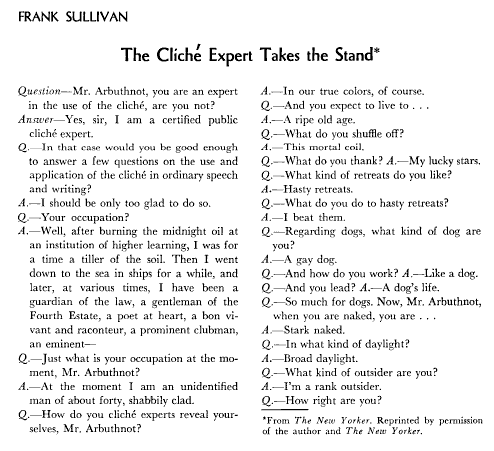
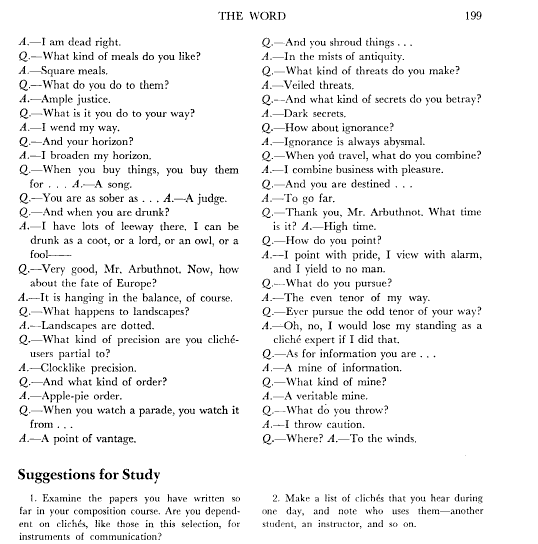
Make sure you check out the Suggestions for Study.
Found years ago (not by me) in Google Books:
Make sure you check out the Suggestions for Study.
Literature Map says:
What else do readers of [any other famous author] read? The closer two writers are, the more likely someone will like both of them. Click on any name to travel along.
Did it map you right?
I found this poem by accident one spring a few years ago. You should read it. Here.

A good and very practical demonstration on what the ear wants from the late Gary Provost:
“This sentence has five words. Here are five more words. Five-word sentences are fine. But several together become monotonous. Listen to what is happening. The writing is getting boring. The sound of it drones. It’s like a stuck record. The ear demands some variety. Now listen. I vary the sentence length, and I create music. Music. The writing sings. It has a pleasant rhythm, a lilt, a harmony. I use short sentences. And I use sentences of medium length. And sometimes when I am certain the reader is rested, I will engage him with a sentence of considerable length, a sentence that burns with energy and builds with all the impetus of a crescendo, the roll of the drums, the crash of the cymbals–sounds that say listen to this, it is important.
So write with a combination of short, medium, and long sentences. Create a sound that pleases the reader’s ear. Don’t just write words. Write music.”
here.

This is an except from something I wrote a few years ago. Below it is a Spotify link to the song “Chicago.”
It’s possible to encounter O’Connnor’s stories (you never really just read them) without explicitly discerning her deep, abiding belief in literary art as Christian vocation or her mission to show, as she said, “the action of grace in territory held largely by the devil.” Clear about these motives in her essays and letters, she’s almost never so obvious in her fiction. Perhaps because she uses the evangelical cosmologies of her neighbors as Tolkienesque proxies for her own traditional Catholic systems it’s easy to infer a sort of distance between O’Connor’s art and faith where she in fact saw none. In the same way, it’s possible to listen to Stevens’ biggest hit, “Chicago,” without immediately sensing the plaintive Christian hymn at its core, but “Casimir Pulaski Day,” “Oh God Where Are You Now?,” “The Lord God Bird,” “To Be Alone With You,””God’ll Ne’er Let You Down”… well, these and others comprise a body of work that, like O’Connor’s, raises and answers questions about what makes art “Christian.” Like O’Connor, Stevens operates outside of expectation: his confessional work is among his best, but you’d never call him a Christian artist the way, say, Amy Grant is a Christian artist.
From 2013, when I had the pleasure of teaching English Composition at The College of New Rochelle.
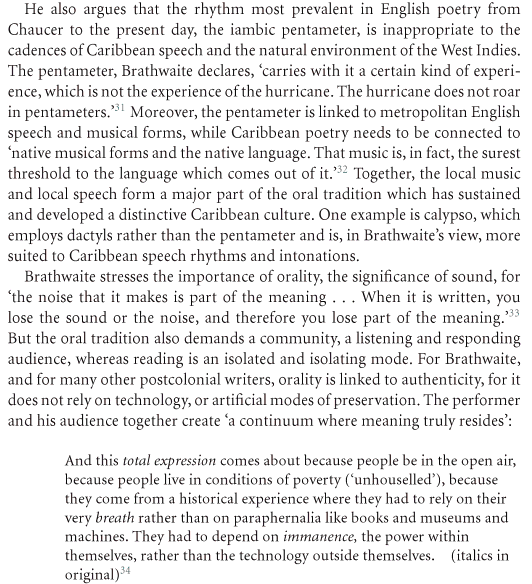
Last week, I shared this (regarding Brathwaite), with my students:
I got that from the amazing Robert Antoni.
In the context of the class I’m teaching, it’s important to present the modern formal structures of essay clearly, and for students to be able to execute these schema even as they learn to hear, develop, and deliver their unique, respective voices. It’s also important that they (and that all of us) read widely and across foreign and familiar cultural and linguistic settings.
Braithwaite, of course, is not saying that iambic pentameter is a more formal, academic, or polished form of expression than are the cadences of his experience. The old English forms, unlike the basic structures of essay taught at the undergraduate level, are not conventions to be mastered and then moved on from. They are simply different from other expressions, and just as valid. But the insight he gives about the ways in which experience, geography, and culture influence our voices and our framing devices is brilliantly stated: the hurricane does not roar in pentameters.
In writing, the old sports adage also holds true: you have to get good before you can get fancy. Braithwaite or Ferlinghetti aren’t “fancy” in this sense, nor are the old English conventions necessarily “good.” But we do, all of us, carry points of reference, and for better or for worse, the discipline, practice, and art of writing in English or in the West in general requires a certain level of engagement with things like pentameter and people like Shakespeare, Chaucer, and, later, Whitman, Emerson, Twain, Conrad, Hemingway, etc. In writing and in physics, we’re dealing with relative values and definitions: neither our experience nor our execution manifest in vacuo, neither are they hatched like Athena, fully formed, fully armed, out of Zeus’s head. Motion is always relative, and so too is the spectrum from “good” to “fancy.”
But developing our voice as writers or as people requires the mastery of certain modes of expression. We might even say that without the narrative frames afforded to us by the convention of language, we’d be a very different species arranged in very different communities. Even if we can’t read or write, language has given us the ability to think of ourselves as objects with stories moving through time. Self-reflection is in most cases a function of narrative, ours or someone else’s. Mastering the elements of basic structure (getting “good” with the basic tools of the written trade) brings deeper possibilities of expression closer to our reach. I may understand, conceptually, a great many things about black holes, but I’ll likely make no significant contribution to the study of them if I’m not conversant in the language of higher mathematics, even if I say, with Einstein, that all motion and velocity are relative (save the velocity of C). “Good” and “fancy” may be relative terms, but they occur within a written and spoken frame of reference alongside our experiences and efforts toward understanding and expressing them.

It’s been said by Malcolm Gladwell (and Macklemore and Ryan Lewis) that it takes 10,000 hours of practice to master any given discipline. I like for students to keep this general idea in mind: you have to get good (proficient, comfortable, familiar, conversant) before you can get fancy. Visually, I’ve used the work of Picasso to drive this point home. Before he did his groundbreaking work, he become very proficient at using the language of the art world around him. Before he was a cubist or surreaist, he plied his craft in the artistic realm of realism. He became conversant at this formal aspect of the craft and, of course, transcended it. But without The Physician’s Palette, we wouldn’t have The Old Guitarist or Guernica.
We’ve been talking about all of these ideas over the first few weeks of class. While preparing for our most recent session, I decided I wanted to revisit the Brathwaite quote in particular and did a google search for “the hurricane does not roar in pentameters.” The second result was for a tumblr blog called Poets of Color using the quote as a tag line. The most recent post on that blog?
2
Even my hat mocks me
laughing
on the inside of my grief –
My twisted mouth
and gnashing teeth,
my fingers fat and clumsy
as if they were still wearing
those gloves –
the bloodstained ones you keep.
What has happened
to the pupils
of my eyes, Picasso?
Why do I deserve
such deformity?
What am I now
if not a cross between
a clown and a broken
piece of crockery?
3
But I am famous.
People recognise me
despite my fractures.
I’m no Mona Lisa
(how I’d like to wipe
the smugness from her face
that still captivates.)
Doesn’t she know that art, great art,
needn’t be an oil-painting?
I am a magnet
not devoid of beauty.
I am an icon
of twentieth-century grief.
A symbol
of compositional possibilities
My tears are tears of happiness –
big rolling diamonds.
14
Picasso, I want my face back
the unbroken photography of it
Once I lived to be stroked
by the fingers of your brushes
Now I see I was more an accomplice
to my own unrooting
Watching the pundits gaze
open-mouthed at your masterpieces
While I hovered like a battered muse
my private grief made public.
15
Dora, Theodora, be reasonable, if it weren’t for Picasso
you’d hardly be remembered at all.
He’s given you an unbelievable shelf-life.
Yes, but who will remember the fruits of my own life?
I am no moth flitting around his wick.
He might be a genius but he’s also a prick –
Medusa, Cleopatra, help me find my inner bitch,
wasn’t I christened Henriette Theodora Markovitch?
Picasso, I want my face back
the unbroken geography of it.
– Grace Nichols
Dora Maar (nee Markovitch) was Picasso’s long-time partner and the muse/model for much of his best-known work. She was also an up-and-coming artist in her own right in the 30s and 40s and photographed the creative process of Guernica. The diamond tears Nichols speaks of refer to Maar’s role as the face of The Weeping Woman, a sort of Guernica writ large. She also wrote poetry, and so we’re able to move from seeing Maar through Picasso’s lens to hearing Maar in Nichols’ voice to finally arriving at a place all writers want to be: seen as we see ourselves, heard in our very own voice:
Pure as a lake boredom
I hear its harmony
In the vast cold room
The nuance of light seems eternal
All is simple I admire
the full totality of objects.
The soul that still yesterday wept is quiet — it’s exile suspended
a country without art only nature
Memory magnolia pure so far off
I am blind
and made from a bit of earth
But your gaze never leaves me
And your angel keeps me.
The hurricane does not roar in pentameters. Dora Maar does not speak in the voice of Picasso or Nichols but is still, for them, an indelible symbol, a cypher for their own struggles (theirs and their peoples’). Behind that is a person with a point of view and a voice, a photographer-poet wrestling with the ecstatic anxieties of having both and of using them. That’s what we’re talking about here.
 Chris Cocca