I’ve had a poem accepted at The Junction, a journal on the Medium platform founded and edited by Stephen M. Tomic. Look for it soon.
Tag: writing
Writing in the Margins
By most definitions, I’m not part of any marginalized community. My great-grandparents, who came to the United States from Southern Italy over a hundred years ago, were economic refugees arriving here at the height of anti-Catholic, anti-Italian (anti-anything-ethnic) nativism. Their experience on the margin of American life and systems is something I try to imagine but do not (and cannot) directly experience.
I have student loan debt, and I know what it’s like to struggle through bad economies and upside-down housing markets. But at the end of the day, I’m a white American man with two advanced degrees, a job, and some time left over to pursue other things.
I have worked closely with many people from all kinds of backgrounds experiencing chronic homelessness and food insecurity. I have tried to use my relative privilege to make a difference. Sometimes, the small parts I’ve played have aligned with the hard work of others and people have been lifted out of destructive cycles they didn’t choose. Sometimes, people just need a break. Sometimes, they come out of the homeless camps and stay housed.
Other times, funding is cut and lifelines are lost. Misguided fiscal conservativism, in the guise of common sense, creates more (and more expensive) problems than it solves. I’ve seen people put out in the street when assistance is cut by as little as $150 a month, and I know from years of experience that the actual dollars-and-sense cost of homelessness is far, far greater.
I don’t live in these kinds of margins, but I’m closely tied to them.
*
I have never been a big fan of John Lennon. I’m just not. Even at the height of my mandatory teenage Beatles obsession (for me, the late 90s, the Anthology, Abbey Road, MMT, the red and blue alums, etc), I was more a George person. For all of his commitments to peace in some general sense, he seemed to me like so many other people of his era, either unwilling or unable to come to terms with his own brokenness. I get that he tried, which is more than many folks do, and I don’t mean to discount that. Let’s just say he had a hard time not bullying everyone close to him, except maybe for Yoko (who knows). Of course, that brokenness comes from somewhere. From specific places, and from that collective nightmare we might just call Modern Life. (Now that we’re two decades into the 21st century, using “the 20th century” as shorthand for near-apocalypse doesn’t seem honest).
Most readers and writers are fundamentally interested in these kinds of margins, in the business of what Lennon said happens when we’re busy making other plans. I still haven’t decided if he was being precious or prescient or cruel in that assessment. What plans are we making? Why are we making them? Lennon’s terrible job being a father to Julian fuels my suspicion.
At the same time, there’s something to this idea of life as something that happens in the margins. Or parts of life, anyway. To help people on actual margins, and to keep myself from being on the economic margins that drove my ancestors from the dirt farms of Campania, I have often only found time for writing in the margins of other activities. I write, literally, in the margins of books, but blog posts like this one are another example. I’m between other things at the moment, this precise moment, between work and other commitments, between reading any number of things, between doses of medication, you name it.
I’m not writing from the margins the way many folks are. But I’m writing from my own kinds of margins, from my slice of collective student-loan debt, from my experience in fields that don’t pay much, that require many sources of funding, some of those sources inexplicably, obscenely political. I’m certainly writing in the margins. Of books, of this CMS, of my other commitments. Life isn’t really what happens when you’re busy making other plans. Life is the plans and the busy. The print and the margin. The book.
What I’m Reading, What I’m Writing
Reading:
Burning Down the House: Essays on Fiction, Charles Baxter
The Sun Also Rises, Ernest Hemingway
Blanco, Allen Wier
I’ve written a short (1200 words) essay about one of the pieces in the Baxter collection and sent it to a few places. I may run it here soon. One of the interesting things about Burning Down the House is that it was written 20 years ago the first essay, “Mistakes Were Made,” anticipates the narrative dysfunction gripping what’s left of the national discourse.
Hemingway is a re-read. I’m enjoying most of it. There are some things I cringe at, which forces me to ask question I probably wasn’t asking as a younger reader (and as a hunger human being).
I recently watched a talk by Allen Wier on YouTube and really liked it. I just started reading his first novel, Blanco. It was published in 1978. I’m only two chapters in, but the writing is tight and I’m excited to see where it goes.
Writing:
I have a second, very brief essay (650 words) out to a few markets. It’s about relationships, which, really, all fiction is.
I have a new short story (5000 words) out for editing, and a second new story sitting at about that length with probably 2000 words to go. It hasn’t stalled, but I have had to put it aside because the final piece of it is, for me, too emotional at the moment.
I’m revising a novel manuscript that I worked on during my MFA. Doing that brings lots of highs and a few lows. There are bursts of new creativity, and characters are doing things that surprise me. My subconscious is planting symbols and loose ends that are being addressed later, the narrative is coming together. I suppose the only thing I’m really afraid of in life (apart, of course, from things involving relationships) is that I won’t finish this project. Not because it’s hard (it is, and should be), but because of the chance that something stupid will stop me in the middle. So, I need to keep that crucible, imposed only by my own anxiety, in check.
I visited with a friend in the hospital this past week and we talked about the things we need to do be in good head space. When I find anxiety medicine working, I eventually forget to take it. He had a good solution: “set an alarm on your phone.” What I’m trying to say is that anxiety is not a great muse. The things I’m reading are helping with the way I’m thinking about narrative structure, and that, in itself, brings some anxiety. But on we go.
On we go.
George Orwell on Dying Metaphors
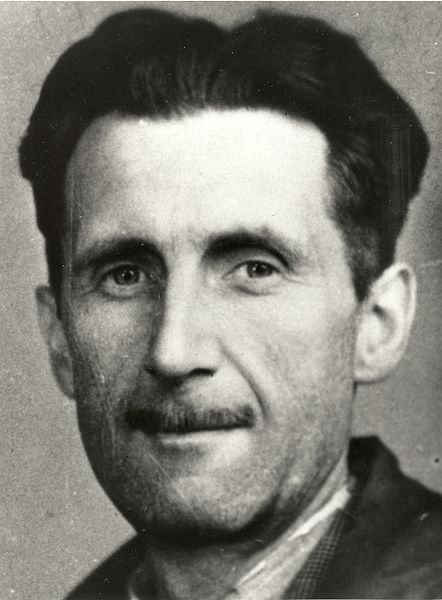 Get rid of cliched placeholders for better, truer writing.
Source: Literary Lexicon: What’s A Dying Metaphor? – Chris Cocca
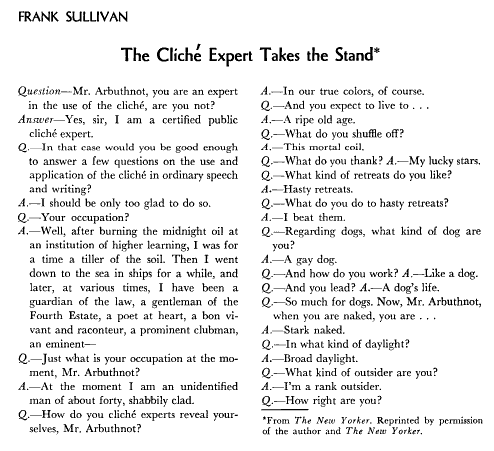
The Cliché Expert Takes The Stand (Frank Sullivan, The New Yorker, 1935)
Found years ago (not by me) in Google Books. It’s also in The New Yorker online archives. Be sure to note the “suggestion for study” at the end.

Allen Wier on Craft: Sewanee Writers Conference
I really enjoyed this and have been meaning to share.
Story: A Winter Ascetic
A Winter Ascetic
The house is cold at 60 and January lies. Outside everything’s washed bold under bright sun and heavy light but the air’s still cold like New Year’s. The shadows are crisp, too, I can see without my glasses, but the lines of my hardwood floor run together at the door. I won’t go outside today.
The dog got walked twice on Tuesday and yesterday the same. He’ll be fine for now with the city paper in the basement. I don’t give him the free paper, though – that I save that for kindling. It’s not as good a grade and burns much cleaner than our subscription rags.
I teach here in the Valley, English at the county’s liberal arts college, and we’re still on what my editor and the administration insist on calling Break, but I don’t get much done. They brought me here after my dissertation because of the exciting work I was doing on cognizance and the nonnegotiable particulars of a working Kantian regime in British Lit. I scrawl it out in pencil or pen on blue lined sheets of paper with thin red ledger lines. They’re curling on my curio and they blur together, too.
The dog comes in with my fedora. The fedora is for Thursday walks, he knows, with the beret and scarf for Sundays. I scratch behind his ears and tell him not today. “I’m working on the ending, Scout, and then I will be finished. Once more through the ending and then the intro after that.” No one reads the middles so I don’t even bother. Better authors put their real points there, buried in a paragraph or single sentence, buried in the middle where no one reads. To me it’s just a vehicle, an excuse for clever starts and pithy, pithy ends and I think maybe I should have been a poet.
###
Publication notes: This is another of those pieces that is so old that it was published at one of the early online microfiction journals, in this case, a venue called Thieves Jargon. Like elimae and Tuesday Shorts and others from those days, the Jargon is no longer. “A Winter Ascetic” was published there in December of 2007. Copyright Chris Cocca 2007 – 2018 and in perpetuity.
 Chris Cocca