An Open Letter to the President on Libya, etc.

Joseph Campbell
I look like the guy from Fringe, but I'm really Joseph Campbell. I totally called this.

Dear Mr. President,

This is the part of your hero’s journey where you’re tempted to refuse the return.  Having ascended to the greatest height of political power our planet offers, you have been expected for some time to bring the boon back from the heavens and bestow it upon the world, or at least upon your ideological fellows.  As you’re fond of saying, elections have consequences.

You have done some of this.  But in matters of war, of geopolitics, of, say, Guantanamo Bay, you have not. (There are some 70 fewer detainees at Guantanamo under the current administration, and Obama has reserved the right to hold prisoners indefinitely without trial. The Bush Administration released some 500 detainees itself, leaving 242, compared to Mr. Obama’s remaining 172. Yes, you can read that to say that George Bush release 10x as many Guantanamo detainees as has the man who made promising to close the facility and axiomatic plank in his election platform.)  Some might say, sir, that you are keeping the boon.

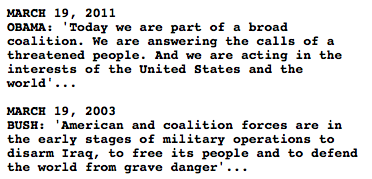
This brings me to Libya, where the complaint from many has been that U.S. air-strikes there, and our larger assumed role, smack of Bush Era (that is, like, so0000 three years ago) policy.  On Monday night, you tried to diffuse that.

You said, if I may paraphrase:

  • Some nations may turn a blind eye toward looming humanitarian crisis, but the United States is different. (American exceptionalism on Line one, sir.)
  • We are engaging in military action in Libya to prevent a humanitarian crisis.
  • We are protecting innocent civilians from the brutality of their own government.
  • We are preemptively ensuring that the likely exodus of destabilizing refugees into Tunisia and Egypt won’t happen. (Preemption on Line 2.)
  • We are not fighting on the rebels’ behalf.
  • Our goal is not regime change.
  • Our military action is focused on preventing a humanitarian crisis, but our larger interests (and our role in Libya’s future) is open-ended.  Because:
  • Our military goal is short and concise, but our long-term geopolitical, nay, geosocial goal is nation-building. (Campaign rhetoric denouncing nation-building is lighting the hell up on Line 3, Mr. President).
  • But remember, our military goal is not regime change.
  • But our larger, peaceful, goal, once regime change happens, is nation-building.
  • We have a duty (and an implied right) to do this.
  • We, the Administration, is really afraid of the phrase “regime-change.”  Except freaking Hillary.  Biden thinks it’s about the revolving cast of former popstars endorsing ProActiv.

Because you’re Barack Obama, I need to say something about your delivery.  The speech was clear in small pieces, but lacked the uniting coherence that got you elected (probably because it lacked all of the ideology that got you elected). At times, you seemed overly defensive.  Clintonian.  Which makes sense, given that I can’t be alone in thinking this is Hillary’s Kosovo.

What you need to do now:

Convince us that everything going on in the Middle East and North Africa will not end with yet another summit of rich Western nations drawing lines on maps.  We’ve been there before, sir, (see, if you’re Woodrow Wilson, nationalism and self-determination are all well and good for anyone north of the Mediterranean) and it, more than freedom, is why proponents of Arab nationalism and Islamism so often define themselves against a what they see as a recalcitrant, oppressive, evil West.

You’re on quite a tight rope.  Of course we can’t stand idly by while people are slaughtered by their governments, but shit, Mr. President, doesn’t it feel awful opportunistic to say that we’ll go ahead and spend our troops and treasure when there’s a humanitarian crisis that just so happens to also involve American (and let’s not forget NATO) interests?  Doesn’t that sound like so much bullshit?  Doesn’t that sound like imperialism?  What you’ve said, in effect, is that you won’t wait to see images of carnage before we act (asterisk) when there’s a clear and compelling national interest in stopping that carnage.  It’s like we’ve forgotten about the oil in Sudan, and that it goes, of all places, to China.  But yes, let’s secure Italy’s, France’s, and Spain’s Libyan reserves post haste, Mr. President.  This is alliance at its finest.

Mr. Obama, I don’t envy your job. I don’t envy your responsibilities. But I do have to live with the consequences of how you choose to execute your duties.  There’s that word again, consequences.  The consequences of your administration seem to be a muddled, confused, engagement against a regime that has, by any standard, forfeited its already-tenuous right to rule.  I understand that you don’t want to seem eager to orchestrate Gaddafi’s ouster (Ms. Clinton on Line 4, sir), and I respect that.  You’ve also said things like “Gaddafi must go”, but you announced yesterday that you’re not ready, yet, to call for negotiations that would send him packing.  That’s a little too cautious given that we’re already bombing him, don’t you think?  Actually, that’s the whole problem: you have to be overly cautious about calling for regime change precisely because we’re bombing him, don’t you?

What a mess.  Suspicion of chemical weapons in Libya is on Line 5.  There’s a G.W. Bush on Line 6, and he’s ready to help with your next crack at this.

Ed Koch and the Afterlife of FDR

Edward I. Koch, mayor of New York City, sports...
not a recent photo.

Christopher Cocca

Ed Koch has a very interesting piece up on RealClearPolitics.  I’m not going to get into the Israel-Palestine debate in this post, but I did want to point out Koch’s religious eclecticism on matters of the hereafter.  I’m not in the business of opining on the eternal fate of people, but I do sympathize with the religious and legislative impulse behind Koch’s placement of FDR in the not-quite-sweet by and by.  Certainly, it feels icky when civic leaders speculate about these kinds of things.  On the other hand, like the Sinead O’Connor piece I posted yesterday, Koch’s essay captures a public figure in raw struggles around faith, life, death, justice, and forgiveness.  You need to know, before reading the excerpt below, that Koch has just described newly-found evidence of FDR’s less than progressive attitude toward the fate of Jewish professionals living in a newly liberated North Africa following World War II.  I’ll also mention that I remember learning about FDR’s rather crass sentiments toward the Jewish members of his own administration in high school.  Yes, I went to high school in the 90’s, but I doubt this was a case of revisionism.  On to Koch:

I appreciate FDR’s contributions to the survival of our country. At the same time, I have never forgiven him for his refusal to grant haven to the 937 Jewish passengers on the SS St. Louis, who after fleeing Nazi Germany had been turned away from Cuba and hovered off the coast of Florida. The passengers were returned to Europe, and many were ultimately murdered in the Nazi concentration camps before World War II ended. I have said that I believe he is not in heaven, but in purgatory, being punished for his abandonment of the Jews. The concept of purgatory is Catholic. I am a secular Jew, but I am a believer in God and the hereafter, and I like this Catholic concept. The Casablanca document reinforces my conviction that President Roosevelt was, at heart, not particularly sympathetic to the plight of the Jews.

I’m not sharing this piece to stir up a big debate about FDR’s eternal reward.  But I am very interested in and sympathetic to the way Koch rather nonchalantly identifies himself religiously in the excerpt above. “The concept of purgatory is Catholic.  I am a secular Jew, but I am a believer in God and the hereafter, and I like this Catholic concept.”  Period.  I don’t relish the thought of anyone being stuck in purgatory, but I love Koch’s honesty about spiritual beliefs he has chosen, some informed, indelibly, by his inherited Jewishness, others by the pluralistic settings of successive communities and constituencies.

Here and there, I’ve described myself as an eclectic or even provisional Christian.  Even though I am a protestant, traditions from across the wider Christian experience appeal to me in various ways, as does a whole lot of secular philosophy.  This sort of up-front religious navigation strikes me as honest and compelling in ways that weren’t readily accessible to the pilgrims of other eras.


Monday

Someone once said if you’re not outraged, you’re not paying attention.  Someone else once said “these are times that try men’s souls.

Dateline: Monday – Unrest and protest in Syria and Saudi Arabia today.  Continuing crises in Yemen, Bahrain, Libya.  And those are just the things going on at the top of the news cycle having to do with wider North African/Middle Eastern developments.  There’s the natural, humanitarian, and nuclear crisis in Japan. The irradiation of Japanese milk and spinach, long lines and scant groceries and gas. There are new reports, and, it seems, new evidence, of military atrocities on the part of a rogue element in the US Army in Afghanistan.

Are you outraged?  How does your soul feel? I feel sick, disgusted, and tired. And I’m a relatively safe, healthy, American civilian.  The image of President Obama at the foot of  Christ the Redeemer in Brazil last night triggered all kinds of cynical thoughts for me about the audacity of hope.  Then I read a piece suggesting that perhaps the President was taking a kind of solace there.  Some might say he’s been taking solace for weeks, failing to lead, etc.  I don’t know how I feel about all of that. I don’t know if he was prevailed upon by State to authorize the strikes in Libya when his gut seemed to be telling him to keep the US role there as limited as possible.  I don’t know.

But I do know this.  1) We private citizens and co-people of Earth cannot succumb to soul fatigue.  We cannot ignore the news, and we cannot settle for the coverage we are given.  Free people especially must use their freedom to stay informed.  That’s just how it is. 2) If you are the praying kind, I hope to God you’re praying.  For everything.  For everyone. 3) Find some solace, but please, God, don’t roll up.

Libya, Afghanistan, Iraq; Qoheleth, Pacifism, Action.

Look, I don’t think Iraq and Libya are the same situation or have identical sets of circumstances.  I do think that the only legal rationale for either action is the pretty standard assumption that once your regime starts killing civilians, your regime loses the sheen and protection of an observed sovereignty among the nations.  It’s the closest thing to international common law we have.

Related:  Does it feel to anyone else like as soon as President Obama took office the media stopped reporting very much about Iraq?  Everyone keeps saying Afghanistan has become Obama’s war, but you just don’t hear very much about Iraq, or about protests and calls to hasten the official end of our presence there.  You hear bits and pieces, you hear reports, but it’s not like it was.  I don’t have anything else to say about that, really.

In my heart, I feel like striking military targets in Libya to impede government forces from killing people is a good thing, but let’s not forget that the Libyan resistance is not unarmed.  They’re underarmed, to be sure (there’s no Bill of Rights in Libya), and yes, the government fired first.  The sham regime lost any lingering claim to sovereignty it had that day, which was weeks ago.  It’s simply just the case today that in attacking Libya now, we’re not only protecting peaceful protesters. We’re also aiding an armed resistance.  The armed resistance is acting in response to its unjust treatment by the regime in the only way that makes any rational sense.

I know a lot of people who believe in total pacifism.  People who believe that nations and oppressed groups can collectively turn the other cheek when their civil disobedience is met with murder as a matter of national political policy.  Most of these people are Americans who will never really have to worry about choosing between ideology/Anabaptist piety and protecting their families from agents of the government.  Some of these people tell me that the cross is God’s sign that violence is not overcome by violence, and most (not all) of these people live in relative safety. At any rate, we Americans, we French, we British, most of us, anyway, have the absolute privilege of being morally and spiritually vexed.  People living through it need to do just that, and they need our prayers, our support, our solidarity.  Figure out what that means for you.  Then do it.

The End of the Cold War as Summated by “Brands of the World”

When deep space exploration ramps up, it’ll be the corporations that name everything: the IBM Stellar Sphere, the Microsoft Galaxy, Planet Starbucks. – Fight Club

We all know that companies (and specifically, the economic polices set forth by mercantilism) played a huge part in the founding of European America.  It’s probably safe to assume with The Narrator that when they run out of stadiums, giant companies will, indeed, have a hand in naming the stars in the next push of industrial expansion.  Behold, friends, The Facebook Nebula.

There’s a reason “branding” has become such a ubiquitous noun-verb in recent years, and it’s obviously tied to our increasing consumption of dynamic visual media.  In a nifty meta-critical move, sites like Brand New and Brands of the World help we consumerist natives remember our lives in corporate logos even as they help curate (you knew it was coming) good and bad design features from which emerging and veteran creatives can draw inspiration or caution.

I’m working on a new infographic for the blog that I hope to put up later today.  During my research, I was struck by the succinct political history implicit in what’s going on here:

Put your shoe on, Nikita.


Considered in light of the grist-milling  Soviet system, “designer: unknown” and “contributor: unknown” become rather chilling political statements.  “Status: Obsolete” heralds the world we still live in:  Soviet weapons and technology still unaccounted for, Soviet scientists still off the grid, regional economies still shaky, but also millions and millions of people more free; in some places, truly, in others by comparison and in degree.  Imperfect, even dangerous as all of this is, we’re reminded again and again that people cognizant of their dignity as human beings will rise to demand that dignity recognized, that sovereignty civilly reckoned with if not yet fully honored.

The CCCP’s obsolescence was as far from inevitable as is the rise of true freedom in Russia even now.  Consider all that remains to be seen as revolution moves through North Africa and possibly beyond.  We have seen freedom ramp up, and if and when it coalesces into free societies and governments, it will be the people that name everything: Free Egypt, Free Tunisia, Free Libya.  Free Iran. What might these emerging societies teach us about our own bondage to the Dutch West India Companies of our day, and to entrenched political attitudes that keep us from the business of prudent, engaged, informed civil life? Might this be the end of the world as we know it?  Let’s hope.


Martian Starbucks by firexbrat via Flickr.

His Grandfather Drove a Covered Wagon. He Walked on the Frickin’ Moon.

Mark Zuckerberg
You have nothing to say.

“My great grandparents came across the southern United States in the 1870s to start a new life in the western territories. They were in a covered wagon drawn by horses, driving a few cattle to start a new herd. The railroads had not been completed, automobiles had not been invented; the electric light had not been invented. My father was born shortly after the Wright brothers made the first airplane flight — and I went to the moon…In less than a hundred years we went from covered wagons to going to the moon.”

I haven’t read the rest of this article yet, but go ahead and re-read the above paragraph.  Forty years ago today, Edgar Mitchell walked on the Moon.  His grandparents were honest-to-goodness pioneer pioneers, coming across the US when the US still had continental territories and things like horses and herds.  Two generations later, Edgar walked on the effing Moon.  How crazy is that?  This is something that’s always intrigued me about the 19th and 20th centuries…how someone born before the airplane was invented could live to see lunar landings.  Mitchell’s family history makes the point poetically.

In less than 100 years, we went from Conestoga wagons to walking on the Moon.  What have we done in the last 40?  Focused on the vastness of the microchip’s inner space, which is all well and good, but (and you know I’m serious) where are our jetpacks? Where are our Lunar and Martian settlements?  What’s the hold up?

Mark (Where’s Your Jetpack?) Zuckerberg image by jdlasica via Flickr