You Can’t Spell Toxic without X

Right there in the middle of the word “toxic” is X, the everything app.

Headlines last night were about how people have stopped buying Teslas because Elon has become too toxic.

I think that’s probably true. And there’s been a retraction in the EV space in general. I’m not completely sure why. But I do know, anecdotally, about a lot of self-styled experts who say the cars are no good, wherever they’re from.

A lot of it is fear. A lot of it is certain demographics holding on to the internal combustion engine because they feel like they’ve lost everything else.

As for Things Elon Does. I’m completely off Twitter/X. Not necessarily because of him, bu that’s part of it.

I have this theory, not particularly well-developed, that Michael Jackson was a gestalt figure at the crux of celebrity, race, exploitation, and child endangerment. He personified the symptoms of our disordered relationship with art, commerce, and the end product: superstar. Elvis had some of that, too. Whatever else he is, Donald Trump is a gestalt célèbre, a self-identified symptom of what’s sick about our political system in general. He has said so himself (“the system is rigged, she knows it, and that’s why she won’t fix it. It benefits her and her donors.” Chappelle makes a very good point about that). In the same way, Elon Musk is social media personified. He needs to unplug. He needs to touch grass (the real kind). We all do.

Headlines this morning were about how 40% of adults go three days without in-person interactions. That’s part of why keeping us polarized has become so damn easy. Shares of Truth Social may have plummeted, Musk may have all but destroyed Twitter, but people are still making money keeping us so hell-bent on hating each other. If you’re sucked into this matrix, if you think these billionaires want to save you, maybe turn your phone off. If you’re one of these 40%, left, right, or middle, go talk to a neighbor. Volunteer somewhere. Take someone soup. Do something in person. Remember that people are complicated, we all work from faulty assumptions, we’re all prone to fooling ourselves. Play pickleball (if you must). Find a way to connect, flesh and blood, Vitamin D, birds chirping. The good stuff.

St Paul put it this way: “Finally, brothers and sisters, whatever is true, whatever is noble, whatever is right, whatever is pure, whatever is lovely, whatever is admirable—if anything is excellent or praiseworthy—think about such things.”

Henri Nouwen said this:

“If you know you are the Beloved, you can live with an enormous amount of success and an enormous amount of failure without losing your identity. Because your identity is that you are the Beloved… The question becomes ‘Can I live a life of faith in the world and trust that it will bear fruit?’”

Nouwen’s not so-secret secret? We’re all the Beloved. If you struggle to see the image of God in others, congratulations, you’re human. But part of that burden is trusting that putting your faith into work will, indeed, bear fruit.

In November, we’ll elect a president. We are not crowning a Messiah. Celebrities have agendas like the rest of us, and it turns out that not even the technocrats will save us.

“Darkness cannot drive out darkness; only light can do that. Hate cannot drive out hate; only love can do that.” MLK said that, paraphrasing Jesus.

This post is a work in progress. More to come as I have it. But please, stop worshiping political figures, celebrities, and internet clout.

Why I’m Leaving Facebook, or, Weaning off The Feed (and Watching Finches)

I have been weaning off of social media. Yesterday, I deleted my Twitter account entirely. I’ve decided to be far less active on Facebook, except for sharing things with people who might be interested.

The Feed is was gets me. It’s too much. It’s too much all at once. I gave it a shot. I gave it ten years. I told it everything I liked and everything I didn’t. After ten years, it was all at once too much.

I don’t need all of those inputs.

I just need a few.

I don’t need to play emotional/mental/spiritual roulette, good news, bad news, red space, black. Hot takes, rants, yours and mine. Pictures of everything just so.

I don’t want all of those inputs. I want the sun, the rain, the seasons. Sometimes, I want Pennsylvania to be more like California, I think, though I’ve never been there.

I want to go there, though.

I want the inputs of voices and eyes and inflections. People stuttering and blushing. The rolled-up gum of sweat and dirt and effort in the creases of my hands.

The Feed is what gets me. It’s left me overweight and undernourished, it’s an anemic drip I’m done stabbing myself for.

Today is the first sunny day in Pennsylvania in what feels like a week. There are goldfinches outside my window, eating seed I put there just for them. They are common, people say. I have never really noticed.

Even so, they’re brilliant.

Meta Sermons and Social Media

I’m very grateful for the opportunity I had to share the message at First Presbyterian Church yesterday at the 8:45 and 10:10 alternative services. Thank you!

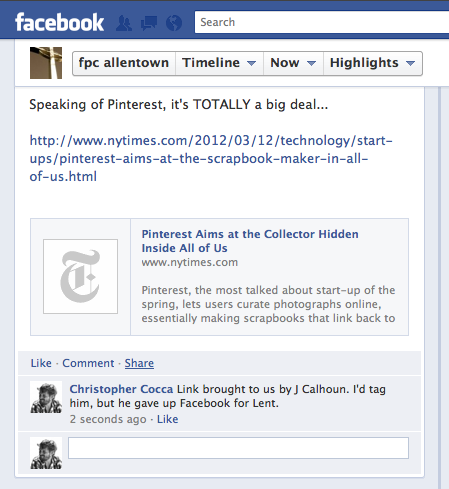
I used social media to frame part of the message, saying that Pinterest had bucked conventional wisdom because it’s a platform where people share inspiring and uplifting things.  By offering a new kind of experience and an environment where generative things are shared and curated, Pinterest now drives more traffic to external sites than Twitter.

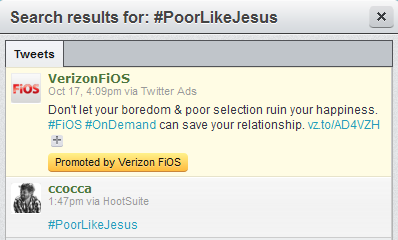
A bit of meta fun before I hit the hay:

ImageImage

Blessings, all, and peace.

A Real Live Webpage from 1996, Preserved In Its Natural Habitat; Fiction as Public Engagement

Christopher Cocca

No, not the official Berkshire Hathaway page. I’m talking about the Periodic Table of Comic Books! If you’ve been trying to cross reference an element with its appearances in various comics over the last few decades, I’ve just given you the last resource you should ever need.

If you’re trying to explain the internet of the 90s to your kids between Legends of the Hidden Temple reruns on TeenNick, this will also come in handy. See if they can find the rotating “under construction” graphic before you do.

It’s funny: in some ways, the web has always been about the compilation of trivia (personal or otherwise) and the cataloging of human interests. Platforms like Twitter and Facebook enhance and also undermine that instinct: instead of Angelfire web sites and Tripod accounts with spinning pictures and MIDI music, we give our strange fascinations over to a few centralized social networks who keep meticulous, obsessive track of everything we say we love. While these services have been used powerfully for activism, there’s an argument to made about the ways we’ve regressed as owners of our ephemera. It’s easier, I suppose, to curate our interests with posts and tweets and likes and shares than to build the online shrines that once defined the consumer internet. But those repositories had what Mike Schmidt might call a certain charm that social media doesn’t capture. Maybe I’m remembering the world that seemed possible before we got the world that came. I don’t mean that cynically. Commitment to social action X over social action Y might mean no flying cars or jetpacks, but we have no way of knowing, really, in the short term.

More knowable, it seems, are the outcomes of politics devoid of concern for environmental regulations, economic justice, the sanctity of life, and the generative renewal of our communities. If you thought I wasn’t going to get from the Periodic Table of Comic Books to public ethics in a few short steps, you might not know that The New School (MFA ’11) just announced organizational changes to some of their graduate programs. The writing program, of which I am a proud graduate, is now part of the newly-named School of Public Engagement. TNS is making a bold cultural and political statement here: poets, fiction writers, and essayists trade in public engagement as a matter of vocation and as a matter of fact. It’s probably no coincidence that former TNS president Bob Kerrey shared similar sentiments with my entire class on the first night of our program.

Bloggers, artists, writers, musicians, comic book creators, coders, scientists, actors, preachers…the list goes on and on. We are enlisted in the craft, and it is a craft, of public engagement. The evolution of the social web from siloed shrines of quirky interest to the integrated platforms of curation, criticism, and creation shows just how powerful our drive to contribute something back to the avalanche of corporate politics, media, and culture-making really is.

It’s ironic and subversive that we do it on the corporate platforms of companies that make millions delivering targeted ads based on the content we create and share in resistance to the monolithic messages of people with vested interests in framing these conversations in very specific ways. That’s the world we live in, for better and for worse.

Let’s keep making it for the better.  And when you need a break, check out the Periodic Table of Comic Books.  And don’t forget to sleep.

Drew Olanoff on Klout and Doing Things

Image representing Klout as depicted in CrunchBase
Image via CrunchBase

An excerpt from “Klout Is Breaking Up With Early Adopters”  at The Next Web:


Klout is going after middle-American novice tweeters who might have mentioned a body spray once or twice. With its service, Axe could reach people like that directly in large bunches and give them samples of new products.

How do we know this? Because Klout recently changed its scoring algorithm. People absolutely lost their minds in the comments on the post and on Twitter.

This type of comment was posted over and over again there:

Very unhappy with this change. My score went from 73 down to 53. 20 point drop. I’ve been working for months to increase my Klout score. Please fix this.

This is proof that people who are “working” on being relevant shouldn’t use any type of service. As my good friend Alex Hillman says and has tattooed on his arm, “JFDI”. Just do it, and don’t worry about what you’re getting out of it, and all will be fine.


He’s right, isn’t he?  It’s tempting to worry about Klout, to obsess about why your Facebook friend count is down or why someone stopped following your blog.  It’s easy to fixate on stats.  Just do what you like and do it well.  Curate that beauty and be that unique voice.

Also: It can’t be a coincidence that JFDI is just one letter from Jedi.