An Honest Question in a Mad Time

When they told you it was okay to kill George Floyd over counterfeit 20s, or Eric Garner for selling loose cigarettes, did you really think they would condemn the murders of Renee Good or Alex Pretti?

As the regime falters, as the lies are exposed, two things are happening. The base is shrinking, but it’s getting more vocal. It’s getting mad at having to do the mental gymnastics, and it’s taking that anger out on everyone else. This is how systems work.

This isn’t about politics, per se, though we need political solutions.

Our system has always been tenuous, has often forced us into zero-sum, binary assumptions.

But our system has not always yielded such toxic fruit.

You can be skeptical about both major parties but also realize that the President and his closest allies are pushing specific buttons for illiberal, undemocratic reasons.

People in both major parties have always lied, cheated, and stolen. Most humans do. That doesn’t excuse us from saying other true things. That doesn’t mean the specter of actual fascism is something we just live with because both so-called sides are “equally bad.”

The truth is, they aren’t. And I’ll be nuanced: MAGA and Republican aren’t the same thing. At least, they didn’t used to be. George W. Bush created ICE, but he never weaponized it like this. Barack Obama, Democrat, deported more people than Trump could ever dream of, but he didn’t do it like this. I don’t recall suggestions from either of those administrations that ICE could or should operate with complete impunity. I don’t recall either administration begging federal judges to allow warrantless searches. I don’t remember either of those presidents suggesting that someone like Alex Pretti was probably a criminal because he was legally carrying a firearm while helping a woman who’d been assaulted by federal agents.

In a sane time, no one would need bother pointing this out. But, as Wendell Berry said:

To be sane in a mad time
is bad for the brain, worse
for the heart. The world
is a holy vision, had we clarity
to see it—a clarity that men
depend on men to make.

That’s frustrating. Heartbreaking. Maddening. Probably true.

I will have missed much in this short post. I’m white, straight, middle class. We now know those things won’t necessarily save me from ICE, but I also know they mean I’m already, by default, safer than many people I love. I may have been too gracious in parsing good-actor Republicans from the red-hatted polloi. Afterall, even many non-MAGA folks have repugnant views and vote in unconscionable ways. I’m also aware that saying we need a whole different system can present as expecting perfection from Democrats, and that’s not helpful, either.

As I write this, much of the country is covered in snow and under Cold Weather Advisory. Dangerous conditions, apt metaphors.
What’s Really at Stake in the Medicaid and ACA Fight — and the Myth About “Free Healthcare for Illegals”

Visit just about any major government agency webpage and you’ll get a message that the “Radical Left has shut down the Government.” The President and his allies say it’s because Democrats want to give free healthcare to undocumented people (or, in their parlance, illegal aliens, even if many have provisional status).

The heart of the matter:

  1. Deep cuts to Medicaid enacted in 2025 — tighter eligibility, reduced federal support, and added red tape;
  2. The potential end of enhanced Affordable Care Act (ACA) subsidies, which help millions of Americans afford health insurance.

Democrats argue that both measures will lead to skyrocketing costs and coverage losses for working- and middle-class families. Independent analysts — including the Congressional Budget Office (CBO) and the Kaiser Family Foundation (KFF) — largely back up those warnings.

Millions of Americans have already been notified by their insurance providers that their premiums will dramatically increase to unstainable levels.

But the debate has also been clouded by a wave of misinformation, particularly claims that Democrats are trying to give “free health care to illegals.” That talking point has little basis in fact.

1. The Real Impact of Medicaid Cuts

The Republican reconciliation law known as the “One Big Beautiful Bill Act” (OBBBA), passed on July 4, 2025, slashes over $1 trillion from Medicaid and the Children’s Health Insurance Program (CHIP) over ten years, according to the CBO.

Analysts estimate that between 7.8 and 10.3 million people are projected to lose Medicaid coverage by 2034, depending on how states respond:

Many of those who lose coverage still technically meet eligibility rules but get tripped up by new work-reporting or documentation requirements — procedural “drop-offs” that states are not equipped to handle efficiently.

Rural hospitals, which depend heavily on Medicaid reimbursements, face what Axios calls a “one-two punch” of funding cuts and coverage losses. Several could close outright.

The Medicare Rights Center estimates these changes could lead to tens of thousands of additional deaths per year due to reduced access to care.

1A. Context: The Current October 2025 Shutdown

To clarify the present fight: OBBBA is already law. The current October 2025 government shutdown has big triggered by its fallout. As the law’s healthcare provisions began to take effect, millions started receiving notices about coverage loss or higher premiums.

In response, Democrats are refusing to approve new government funding — via a continuing resolution (CR) or budget package — unless it restores or delays OBBBA-driven Medicaid cuts and extends ACA subsidies. Republican leaders have insisted the OBBBA reductions remain in place. That standoff is what has shut down large parts of the federal government this month.

In short, this is a funding fight over whether to reverse or uphold OBBBA’s Medicaid and ACA subsidy changes.

2. The ACA Subsidy Rollback: Premium Shock

Even for those not on Medicaid, another looming threat is the expiration of the enhanced ACA premium tax credits, which were expanded during COVID and later extended through the Inflation Reduction Act. If they lapse, millions will see monthly premiums jump sharply — in many cases double or more:

  • The CBO projects that 4.2 million additional people would lose insurance if these subsidies expire.
  • KFF’s modeling shows an average 75% increase in out-of-pocket premiums.
  • Some states could see hikes exceeding 100%, according to insurer filings reported by Health System Tracker.

In other words: the claim that ending these subsidies would “soar insurance costs for millions” is not hyperbole — it’s consistent with the best available data.

3. Are the Democrats Right?

On balance, yes. Projections from nonpartisan and centrist sources largely support their case: OBBBA’s Medicaid cuts and allowing enhanced ACA subsidies to expire are likely to lead to millions losing coverage and sharply higher costs for those who remain insured.

Exact outcomes depend on implementation — e.g., whether states cushion the blow with their own funds, whether Congress delays certain provisions, or how strictly administrative burdens are enforced — but the trendlines are clear and unfavorable for low- and middle-income households.

Even FactCheck.org, which scrutinizes partisan claims, finds that these warnings are “largely consistent with independent projections.”

4. The “Free Healthcare for Illegals” Myth

One of the more charged talking points is that Democrats are fighting to give “free health care” to undocumented immigrants. That’s a myth.

What the law actually says:

  • Undocumented immigrants are barred from Medicaid, Medicare, CHIP, and ACA subsidies under federal law. (KFF explainer)
  • The enhanced ACA subsidies Democrats want to preserve do not apply to undocumented immigrants; they benefit U.S. citizens and lawfully present immigrants. (Georgetown CCF fact check)
  • A few state-funded programs (e.g., in California, Illinois, New York) offer limited coverage to undocumented residents — but those are state initiatives, not federal policy.

So why the myth? Because it’s effective politics. By implying that “illegals” are receiving taxpayer-funded benefits, opponents distract from the actual content of the bills — which overwhelmingly affect citizens and legal residents. As The Guardian notes, the strategy is to pivot away from coverage losses toward resentment-driven sound bites.

5. What’s Really at Stake

At its core, this is a fight over priorities:

  • Do we fund healthcare access for low- and middle-income families, or redirect those funds toward tax cuts and deficit trimming?
  • Do we sustain programs that reduced uninsured rates to historic lows, or accept millions losing coverage to save on federal spending?

In the context of Trump-era tax cut agendas and GOP fiscal goals, there is a deeper tension at play: the drive to lower taxes (especially for high earners) often requires offsetting cuts somewhere, and social programs like Medicaid and ACA subsidies are frequent targets.

The CBO, KFF, and other independent watchdogs have made the tradeoffs plain. One side warns of fiscal restraint (while cutting taxes for higher earners); the other warns of human cost and of the unsustainable systemic cost of millions of people losing coverage.

It’s hard to imagine arguing in favor of the former at the expense of the latter under the guise of fiscal responsibility.

What’s certain is this: the outcomes won’t be abstract. They’ll show up in hospital closures, family budgets, and community health — not in the scare stories about “free care for illegals.”

Related Reading

How the Big Beautiful Bill Threatens Everyone

I’ve done both street-level and systems-level work with—and among—the people who are about to lose their healthcare because of the so-called “Big Beautiful Bill.”

I want to dispel a few persistent myths—about the people most affected by this legislation and about what’s actually happening behind the political spin.

1. The Myth of the Idle Poor

One of the favorite talking points of BBB supporters is that this bill only takes Medicaid away from “able-bodied, able-minded” individuals who simply refuse to work. If only that were true.

In all my experience, I’ve never met a person who actually wants to be homeless, who prefers instability, or who wouldn’t welcome connection to services—most of which only become available once you have a permanent address.

I have met countless individuals who are clearly disabled, yet have not been officially classified as such by the Social Security Administration. Why not? Because the process is deeply flawed.

Homeless people, by definition, have no stable, permanent address. That should be obvious.  It should also be obvious that a safety net that requires an address can’t possibly catch or help the most vulnerable.  Homelessness  makes it nearly impossible to receive correspondence, fill out paperwork, or remain in contact with agencies. And even when those hurdles are somehow overcome, the SSA routinely denies initial applications—sometimes automatically.

I’ve seen cases take years to resolve, even when the person has clear medical documentation and even when highly trained social workers and counselors are doing everything right.

Until now, Medicaid has been a critical lifeline during this liminal period—a bridge that allows people to access care while navigating the slow-moving machinery of disability classification. When the BBB kicks in, that lifeline will be cut.

And when it is, thousands of people stuck in this bureaucratic no-man’s-land will be left with nothing. It’s not just immoral. It’s economically reckless.

2. The Myth of Government Waste

Another popular refrain is that Medicaid is bloated, mismanaged, and wasteful—that it’s a drain on public resources and ripe for cuts. But this argument falls apart when you look at the actual impact of the program.

Medicaid isn’t just a health plan. It’s one of our most cost-effective tools for preventing larger-scale social and economic crises. It keeps people out of emergency rooms, where care is exponentially more expensive. It reduces hospitalizations. It lowers incarceration rates and decreases the burden on mental health and addiction systems. In short, it keeps people stable.

Cutting Medicaid in the name of “fiscal responsibility” is like smashing the brakes on your car to save gas. You may feel like you’re saving something now, but you’re setting yourself up for disaster later. We will pay for these problems one way or another. The only question is whether we’ll do it preventively—with dignity and foresight—or reactively, through crisis management that’s far more expensive and far less humane.

3. The Myth of the Deserving vs. Undeserving Poor

Perhaps the most harmful myth of all is the one that divides people into the “deserving” and the “undeserving” poor. We’ve told this story in American policy and culture for generations. It’s the quiet moral justification behind countless cuts, restrictions, and barriers.

But real life doesn’t fit neatly into those categories. People lose jobs. They get sick. They flee violence. They struggle with trauma, addiction, and mental illness—often without support. These aren’t personal failings; they’re deeply human realities, compounded by structural inequities: underfunded schools, unaffordable housing, generational poverty, systemic injustices that cut across race, gender, and geography. 

To speak of “undeserving” poor is to ignore these realities—and to ignore our own responsibility. It allows us to believe that someone else’s suffering is somehow earned, or inevitable, or irrelevant. The BBB doesn’t punish people for poor choices made with the best of intentions.  It punishes them for circumstances they were born or thrust into.  It punishes homeless veterans, opioid addicts, people in poverty regardless of color, and, ironically, it punishes many of the people who think they support it.

What’s more, many people don’t even realize that the healthcare they rely on is Medicaid—because it goes by different names in different states. In some places it’s called MassHealth, in others, TennCare, or Medi-Cal. These programs may feel local or distinct, but they’re all part of the broader Medicaid system. That means people who support the so-called Big Beautiful Bill may not even realize that they’re voting to gut their own coverage—or the coverage that keeps their parents, neighbors, or children healthy. The disconnect is dangerous, and it’s being exploited.

Where This Leads

The “Big Beautiful Bill” isn’t beautiful. It’s devastating. It punishes the vulnerable while claiming to protect taxpayers. It strips essential care from people already fighting uphill battles against illness, poverty, and bureaucracy. And it does so based on myths that are convenient for those in power—but ruinous for the rest of us.

The Big Beautiful Bill Threatens Minnesota’s Boundary Waters

A month ago, I would have told you that opening federal land on the periphery of the Boundary Waters to mining was a terrible idea.

Since this article was published, I’ve been there. Some of me still is (not just the 5 lbs I lost rowing, portaging, and camping). I can’t put into words what this place is like. And the Big Beautiful Bill puts one of America’s most important and impressive natural resources at risk.

From the linked article, published by the Guardian and the Public Domain:

Earlier this month, conservationists cheered when Congress withdrew from the reconciliation bill several provisions that would have sold off hundreds of thousands of acres of federal land in Nevada and Utah. Those provisions had sparked fury among public land advocates and staunch opposition even from some Republicans, including the representative Ryan Zinke of Montana, who vowed to oppose the bill if the land sell-off provisions were retained.

Despite that fury, a lesser-known public lands giveaway remained in the reconciliation bill. If approved as currently written, the provision could lease in perpetuity land near Minnesota’s Boundary Waters wilderness, an enormous complex of pristine lakes and untrammeled forests, to Twin Metals Minnesota, a subsidiary of the Chilean mining giant Antofagasta PLC.

Becky Rom, the national chair of Save the Boundary Waters, a campaign to protect the wilderness area from mining, described the provision as “a giveaway of critical and sensitive federal public land forever to a single mining company”.

“It is a giveaway,” Rom added. “This is forever.”

The “Big Beautiful Bill” has been passed. The Boundary Waters might seem inconsequential in light of the real human damage cuts to Medicaid will cause. But we need to be doing more large-scale environmental protection, not less. It’s not about securing scenic vistas for would-be poets; it’s about the things that can happen when people and polities (in this case, the US, Canada, the Ojibwe, Minnesota, Ontario, Manitoba, and more) work together to preserve a natural heritage that’s every bit the right that life and liberty (and in some jurisdictions, healthcare), are.

Part of me wishes I were still on the water. All of me wishes there were a line item in the federal budget for every American to make the trip. You can’t really appreciate what’s at stake until you’ve been there.

We’ve gone to great lengths to remove ourselves from the severities of nature; I get it, that’s what humans do. We move, we learn, we grow. But we’re also inextricably connected to places far less hospitable than the houses, neighborhoods, or cities we call home. Spend a few hours in the ocean. On the lake. Do it wisely, but open yourself up to pristine settings, natural beauty, spend a week without plumbing or TV. Go someplace where you can really see the stars.

Take a hike. Grow a plant. Consider the supply chains and the net strain of most convenience.

This is what I was getting at with this poem, a relatively small example. There’s so much more at stake.

Broken Frames, Dim Lenses

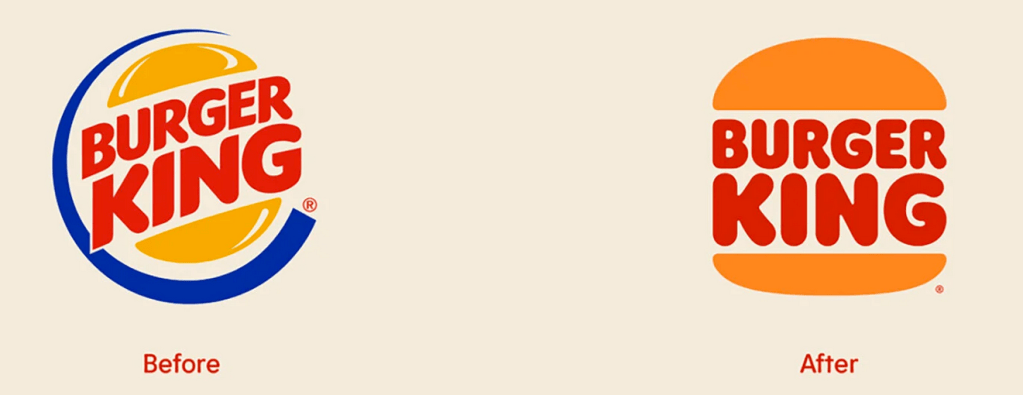
Burger King is going back to its former logo. Smart branding move for all kinds of reasons, not the least of which is the chain’s need to keep differentiating itself from industry leader McDonald’s and perpetual internet-winner Wendy’s.

Here’s what I think is interesting. My kids, who were born well after Burger King dropped its classic branding, have always thought the 1999-2020 BK logo looked like a frying pan full of eggs.

They’re absolutely right. I’d never seen it because I knew what the logo was supposed to be.

Context really matters.

Yes, this is a logo for a giant corporation that sells mostly shitty food, but it’s a good reminder for artists, writers…anyone who is trying to communicate something to someone else.

Is what I have to say clear? Is what I have to say true? How do I know? What contexts have I assumed are understood, shared, taken for granted? What social constructs have I mistaken for objective frames and lenses?

On one hand, “perception is reality” can be a lazy excuse for all kinds of willful ignorance. On the other hand, if the things we have to say matter, it matters enough to do the best we can with them. Perhaps more to the point: we don’t know what we don’t know until we make the decision to learn about the world beyond our native settings.

Would you believe I’d never heard of James Baldwin before college? It’s true, and I went to well-funded public schools (that also happened to be predominantly white, and by a lot). I don’t think we were asked to read anything by Black writers except for (maybe) The Color Purple and a few lines of Langston Hughes. Worse: school kids in the 80s and 90s, at least in my experience, were meant to intuit that anything resembling racial injustice had been conquered by 1970. That’s probably something most of the adults in our lives wanted to believe themselves.

It’s been a long time since I was in school. I don’t know if we do a better job now or not. I do know that budgets in struggling districts continue to be slashed, that music programs are cut, gym programs are cut, the school district I went to is richer now, than ever, and the city schools a mile away have a fraction of those resources. I know that conservatives like to say that in America, we’re granted equal opportunity, not equal outcomes. I know that only half of that statement is true.

I wish I could say that the events of January 6 seemed surreal to me. Sadly, they were predictable (and predicted). What maybe does feel surreal: trying to go about my normal course of business in this moment. Nothing I do seems serious enough, almost everything I do seems very trivial. And I’m a person who benefits from a great deal of privilege. Maybe you are, too. If so, think about your frames and lenses. Think about the fact that there are many things we’re just not seeing. Many points of reference and perspectives we don’t have. Think about how we were taught to take up space, demand attention; think about how the insurrectionists were treated and how they would have been treated had they been mostly brown or Black.

I’m not saying Burger King’s branding language is some kind of metaphor. But there are an effing lot of Burger Kings. There are an effing lot of us (myself included) who need to unlearn an awful lot of shit.

Excerpts from Michelle Obama’s Statement on the Failed Insurrection

“Like all of you, I watched as a gang—organized, violent and mad they’d lost an election—laid siege to the United States Capitol,” she continued. “They set up gallows. They proudly waved the traitorous flag of the Confederacy through the halls. They desecrated the center of American government. And once authorities finally gained control of the situation, these rioters and gang members were led out of the building not in handcuffs, but free to carry on with their days.”

“What if these rioters had looked like the folks who go to Ebenezer Baptist Church every Sunday? What would have been different?”

“I think we all know the answer. This summer’s Black Lives Matter protests were an overwhelmingly peaceful movement—our nation’s largest demonstrations ever, bringing together people of every race and class and encouraging millions to re-examine their own assumptions and behavior,” Obama wrote. “And yet, in city after city, day after day, we saw peaceful protestors met with brute force. We saw cracked skulls and mass arrests, law enforcement pepper spraying its way through a peaceful demonstration for a presidential photo op.”

You can read Michelle Obama’s full statement on Instagram.

To Statecraft Embalmed – Marianne Moore

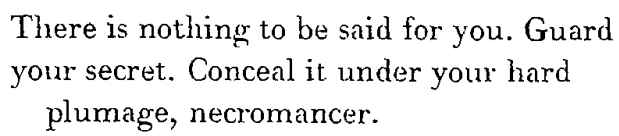
An early work, and I love it. “To Statecraft Embalmed” starts with an image that might just as easily refer to a certain (current) political figure:

The only version of the full text I can find online isn’t formatted exactly how piece is presented in her Collected Works, a volume I seem to have misplaced precisely as I sat down to write this post.

The whole thing reads to me as uncanny prophesy, hard plumage and all.