Many thanks to Earth & Altar and arts and culture editor Terry J. Stokes for thoughtfully engaging this piece and giving it a wonderful home.
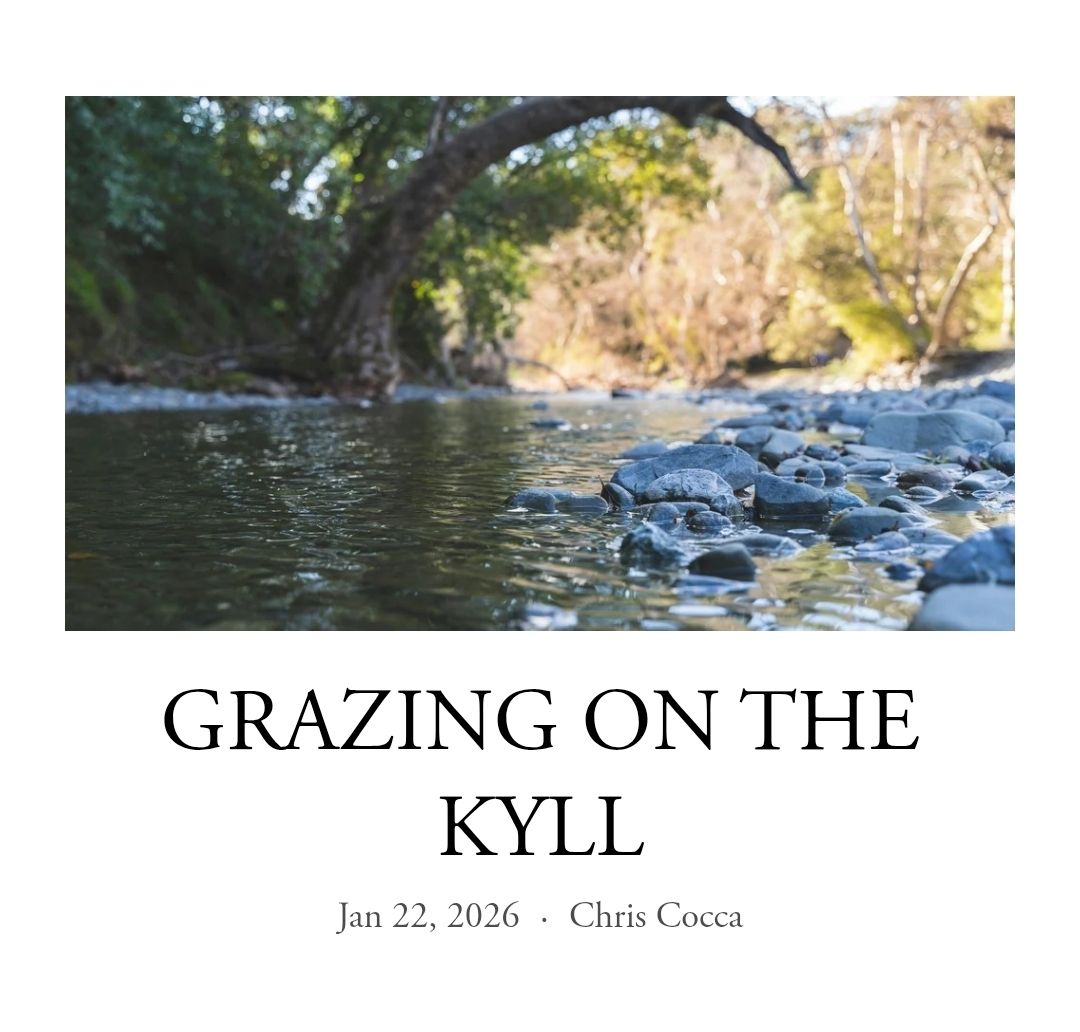
“Grazing on the Kyll” is a sonnet in the Petrarchan or Italian model, inspired by recent reading and revisiting of formal structures. It opened up the writing of two other pieces, which I hope to place soon.
While I have never been of the opinion that there is only one way to write (and I don’t typically write formal verse), the challenge of the form was rewarding for me as a writer. I hope it will be rewarding for readers, too.
Another prescient and necessary piece, this time from Carl Sandburg.
Hope is a tattered flag and a dream of time. Hope is a heartspun word, the rainbow, the shadblow in white The evening star inviolable over the coal mines, The shimmer of northern lights across a bitter winter night, The blue hills beyond the smoke of the steel works, The birds who go on singing to their mates in peace, war, peace, The ten-cent crocus bulb blooming in a used-car salesroom, The horseshoe over the door, the luckpiece in the pocket, The kiss and the comforting laugh and resolve— Hope is an echo, hope ties itself yonder, yonder. The spring grass showing itself where least expected, The rolling fluff of white clouds on a changeable sky, The broadcast of strings from Japan, bells from Moscow, Of the voice of the prime minister of Sweden carried Across the sea in behalf of a world family of nations And children singing chorals of the Christ child And Bach being broadcast from Bethlehem, Pennsylvania And tall skyscrapers practically empty of tenants And the hands of strong men groping for handholds And the Salvation Army singing God loves us….
I remember learning about Langston Hughes at some point, maybe in high school. I am sure we read one (I am sure it was no more than one) of his poems, and talked about him in the context of the Harlem Renaissance. I’m also fairly certain that whichever poem we read was not “Let America Be America Again.”
Hughes wrote the piece in 1935. I didn’t learn it in 1995, ’96, ’97, or ’98. I came across it last night on a poetry playlist on Spotify. Amazing how prescient, especially considering the ironic foreshadowing of the prime political slogan and dog whistle of the last decade. An excerpt, lest you think Hughes was only concerned with things going on in Harlem:
“Say, who are you that mumbles in the dark? And who are you that draws your veil across the stars?
I am the poor white, fooled and pushed apart, I am the Negro bearing slavery’s scars. I am the red man driven from the land, I am the immigrant clutching the hope I seek— And finding only the same old stupid plan Of dog eat dog, of mighty crush the weak.”
I took a good look at some things I’d felt were finished years ago. Printed them out. Marked them up.
Some have stayed the same. Some are now better. Many are on their way out the door; we hope for good journeys and stoked editorial reception.
What do we think of this as a streamlined bio?:
Chris Cocca is a Pushcart-nominated poet and writer whose work explores spirituality, memory, and place. His writing has appeared in The Huffington Post, Brevity, Hobart, Appalachian Review, VIA: Voices in Italian Americana, Belt, Schuylkill Valley Journal, and more. He holds degrees from Ursinus College, Yale Divinity School, and an MFA from The New School. Chris lives in Allentown, where he continues to write, teach, and advocate.
For me, I’d have to say it’s the near-constant rejection. Or maybe the discourse on the platform formerly known as Twitter.
Ha ha.
Seriously, though. Writing is its own reward. The process. Figuring things out, creating a voice or a tone or a character. Describing something with images and meter. Using creative neuro-pathways. All of it.


 Chris Cocca