I’ve had a poem accepted at The Junction, a journal on the Medium platform founded and edited by Stephen M. Tomic. Look for it soon.
Tag: poetry
100 Words at a Time
I have always loved to write. I first started writing creatively as an adult sometime during Divinity School, in my early 20s. I wrote stories and poems in high school of course, but most of what I wrote in college was more academic.
Between finishing my Master of Divinity and starting my Master of Fine Arts in Creative Writing, I wrote many small pieces of fiction and prose poems. I grew fond of writing things that were exactly 100 words. It was a good practice in rhythm, word choice, and brevity.
This piece, which I rewrote yesterday from an older draft that didn’t go where I had hoped, is 98 words:
There’s nothing to say now to Eugene Victor Debs or William Jennings Bryan. No spring under iron wheels and no thaw in the concrete borders of compassion. No dispersing from the lock-step forms of ill-formed fear, fear of self, of other, fear of washing rain, revealing living oneness, fear of drowning in it. There’s no green in our window-boxes, no stray cats in alleys and nothing left to feed them. Only fat birds always eating and the statues of our past, the ideal likeness of forgotten shapes and forms, fat birds always eating, bleaching white our skin-toned stories.
I have also found that I inevitably tend to write paragraphs of about 100 words in my fiction, especially why I’m attempting a birds-eye view seeking to balance external and internal settings, or when I’m doing an extremely close third-person read.
After quite of bit of struggle with one story yesterday, I read and took a break. Later, I revised the poem above. Then I went about the other things I had to do. Later still, I wrote a post about DH Lawrence, Sherwood Anderson (both very good at the external/internal balance and the shift from mundane to sublime) and Ernest Hemingway (ever a muse for brevity). Then I returned to another story, one I had been avoiding for personal reasons, and wrote this, which is, not surprisingly, about a hundred words:
On his ten-speed, the new present from his father, Riley arced and waved, his course unfettered and unhinged, free from the attraction of large bodies, the fundamental laws of physics. The nurses crossed the Fairgrounds. Birds roosted in the trees. The Sisters of St. Catherine were called to daily office, everywhere the brides of Christ were moving to the music of the set-in-motion world. In the Market lot, where the families sold their wares, where the men had trained to serve in war, where the Milltown Fair lit August sky with fireworks and neon, on that swath of pavement bordered by the hospital and graveyard, a boy, still small, still boyish, rode his brand-new bike.
I’m sure I’ll revise and refine that, but for now I rather like it. In the context of the story, it’s a sort of capstone.
For whatever reason, I tend to write more or less 100 words at a time. There are days when these bursts add up, 1000 or 2000 words. There are days like yesterday, where I revised 98 and wrote 120 more.
Dialogue is like the 12-point Courier New of daily word goals. Even in the piece I struggled with yesterday, I managed 300 words of decent dialogue in service of the story.
Some days net a ton of words you cut down later. Some days net a ton of words you keep. Some days are more about the planting, some days about the harvest.
If you’re writing and/or reading today (and I hope you are), happy sewing, watering, reaping.
Poem: The Birds
There’s nothing to say now to Eugene Victor Debs or William Jennings Bryan. No spring under iron wheels and no thaw in the concrete borders of compassion. No dispersing from the lock-step forms of ill-formed fear, fear of self, of other, fear of washing rain, revealing living oneness, fear of drowning in it. There’s no green in our window-boxes, no stray cats in alleys and nothing left to feed them. Only fat birds always eating and the statues of our past, the ideal likeness of forgotten shapes and forms, fat birds always eating, bleaching white our skin-toned stories.
Revising after Rejection: Re-Seeing, Re-Listening, Re-Hearing
Like most necessary things, writing is hard. Communicating mental images or flashes of memory or triggering smells with tools that are, themselves, none of those things, takes work. Doing so in ways that makes sense not just to you but also to readers takes even more work.
I submitted some things to a great journal a few months ago. Even though the work I shared wasn’t ultimately accepted, I’m quite pleased with the feedback. Having given myself some time and space, I’ve come back to the piece they particularly liked with new eyes and ears. (Revision is always, literally, re-seeing. But it’s also re-listening and re-hearing.)
I greatly appreciate what the editor here is saying, and the time he took to say it, and the time he and the rest of the team take thinking deeply on these things:
We are writing with mixed news. While we are not accepting these poems, your submission made it through multiple editorial rounds. We particularly enjoyed “[title redacted]” with its exploration of anxiety and attempts at self-soothing. Our main concern, ultimately, was that there were moments when the piece felt too expository. We’d love to see the entire piece rooted in the wild imagery of the last third of the poem.
We recognize how much talent and skill went in to your submission, but we can only publish a small percentage of the work we receive. In the final round of selections, we start looking for the smallest of reasons–reasons in line with our own personal tastes–to reject a manuscript. This part of the process, we understand, is so very subjective. So we want you to know that while we are not accepting this manuscript, we were pleased with your submission, it was a joy to read, and we hope we’ll see more of your work in the future.
Seeing Poetry, Looking Away
I think I first became familiar with the work of Stanley Fish in a literature seminar at Yale taught by the late Lana Schwebel. The course, which focused on the work of John Milton, was cross-listed at the Div School, where I was a student, and the English department.
One of the other students had just come from Chicago and could not stop talking about Stanley Fish. Strangely, this student didn’t seem at all familiar with Leo Strauss. He couldn’t seem to accept that someone had, perhaps, influenced his own academic hero.
Stanley Fish has a very popular piece I like to share from time to time called “How to Recognize a Poem When You See One.” I haven’t returned to it lately, but, as what Milton called the “winter wild” draws near, and this “the month, and this the happy morn” with it, I think I will add it to my short list of recommended re-reading.
There are few things more frustrating than a poetic image that won’t fully reveal itself to a writer, or one that reveals itself too easily to a reader. There’s a Milton-inspired poem sitting in another tab on my browser that I just can’t seem to finish. I love it. I hate it. It’s brilliant. It’s awful. Maybe it’s not a poem at all. I wish I could re-see it. I wish I could un-see (undo) the reasons it exists. I wish I could delete it. I know I never will. It’s terrible. It’s awful. It has one or two good images. It’s intensely personal. It’s too personal to mean anything to anyone. It’s too sentimental to mean very much to me. But there it sits. There it stays. Maybe it’s a poem. Maybe it’s an epitaph. Maybe it’s a tombstone. Maybe some things can just be what they are.
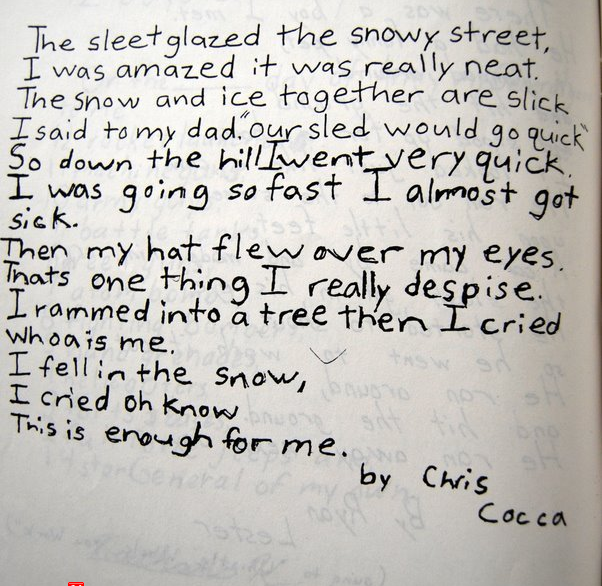
A Snow Poem, 1989
A few bits of context for when you find the errant homophone: I was old enough (9) to know better, and this was something we did in the gifted program. You can almost hear the laughter of glastnost-era Soviets.
Whatever, because Roddy Piper was feuding with Rick Rude at the time and that consumed most of my attention.
Required Reading: “Last Picnic” by Charles Simic
I found this poem by accident one spring a few years ago. You should read it. Here.

 Chris Cocca