A few months ago, my wife and I were listening to a WXPN interview with Hawaiian ukulele virtuoso Jake Shimabukuro that was nothing short of awesome. As we were about to get out of the car, Shimabukuro said that he was going to play an original arrangement of “Bohemian Rhapsody” to show just what his four-stringed, two-octave ax could do. Needless to say, we stayed in the car for the next eight minutes.
I just stumbled upon this video of Shimabukuro doing the same thing at TED. It’s fantastic, and you can’t help but believe what he says about the uke and world peace:
A few days after the World Cafe session in our car, I found a ukulele at the Salvation Army thrift store. I think they wanted four bucks, and it came with instructions that had clearly been printed before 1970. So I picked it up as a gift and immediately informed the giftee of my impossible find. As I was carrying my new hipster treasure around the store, I noticed two young ladies in my peripheral vision. I sort of got that feeling you get when people are talking about you, and then I heard one of them say “should we say something to him?” My first thought was “my fly must be down. This is embarrassing.”
If only.
The question emerged:
One of them: “How much do you want that ukelele?”
Me: “Like, a lot.”
Them: “Really?”
Me: “Yeah. It’s going to be a gift.”
One of Them: “Oh.”
The Other: “See, I told you you shouldn’t have set it back down.”
Me: “Honesty, I would give it to you if I hadn’t already promised it to someone else.”
Them: “No, that’s cool.”
But I don’t have to tell you how it feels to have a find like this slip through your fingers. Remember the vocab word crestfallen? I would have been, too. Thankfully, they were really cool and didn’t make me feel bad.
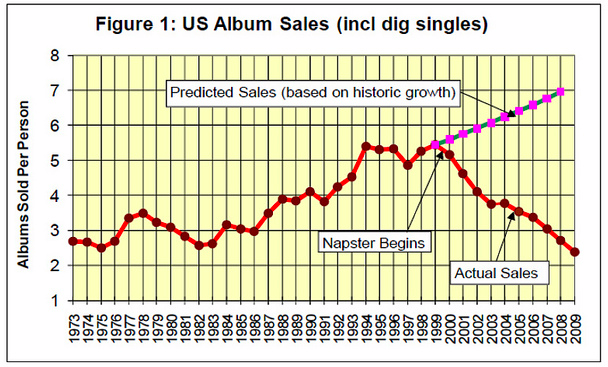
Okay, so the music industry is suing LimeWire. Sue away, Lars Ulrich, sue away. You should, I guess. But you have to admit that this image, supposedly showing how much dough the biz has lost since the creation of Napster, is pretty convenient:
Isn’t it amazing that projected sales based on historic growth show none of the, er, historical plateauing you expect from any healthy graph and in fact see as having occurred here many times pre-Napsters and then NEVER AGAIN IF NAPSTER HADN’T HAPPENED.
Please.
Guess what, MusicTown? Even if Generation Y hadn’t happened, and even if the youngest members of Generation X kept buying music instead of (okay) stealing it in college, the economic still would have gone in the crapper at least twice since then. You’re not really saying that incing Napster early would have stopped the dotcom bubble burst or the downturn after 9/11 or the mortgage crisis, are you?
And remember how you abandoned all the Baby Boomers once you got your hands on their kids’ allowance? Remember how you stopped producing Adult Contemporary, remember how you colluded with radio stations and sales tracking companies? Remember how you gave us post-grunge? You’re saying that would not have happened? Are you saying MTV and Vh1 would have kept showing your ready-made commercials instead of banking easy cash from reality shows and nostalgia trips (which ironically tended to feature the very artists you’d stopped promoting)? For real?
Music Industry, you can do so much better than this. Throw in some downward trends to make this graph realistic. I’m disappointed in you, frankly.
Napster or no Napster, there’s no way I buy seven albums this year, friends. Radio is free, dynamic, and serendipitous. I do iTunes, but almost only when I have gift cards. Last album I bought? Neil Young Live at Massey Hall (digital download). Before that? No Line on the Horizon, physical copy. Both were excellent choices and lived up to the album mystique. But I knew that beforehand. Buying albums from new acts is, like, seriously committing. I don’t know. Though now that I think of it, I did buy a Taize album for someone for Christmas, and that was a good call.
Sales graph shenanigans aside, what do you think? Are albums (even digital ones) obsolete? Has Steve Jobs (not Napster) really killed the music business like His Royal Joveness says?
This is another dip in the old search-query-that-brought-someone-here-mailbag. This question is honest and simple, and I spent a good part of my mid-20s trying to figure it out. Here’s what I came up with:
Generation Y.
Yes. Everyone who was just becoming a teenager as the 90s wore down, I’m talking about you. This is what happened:
Your boomer parents gave you a lot of disposable cash for no good reason.
You spent it on Britney Spears, boy bands, and clothing that wasn’t ironically cool (that is, clothing that cost more than $4.)
You did not spend it on Oasis or Nada Surf or Harvey Danger. You did not spend it on The Flys or New Radicals. You absolutely did not spend it on REM. You also didn’t didn’t spend it on AOR or Adult Contemporary (goodbye, that whole genre). No New Bohemians, no Mazzy Star. Good bye John Mellencamp. It’s been fun, John Secada. Peace out, Tonic, Gin Blossoms, Dishwalla, Joan Osbourne, Black Lab.
Hello, TLR.
Hello, all delighted teensters with your expendable non-work-related dollars. Hello, Generation Bigger Than The Baby Boom. Hello, malleable taste-makers, hello.
Goodbye, alternative radio formats. Goodbye, Y-100. Goodbye, you last hangers on of Generation X, you would-be Cusacks. Goodbye, Empire Records.
Sometimes we talk about Rupert Murdoch, but it’s a Stuart Murdoch Saturday here at The Daily Cocca. Love this song, and always forget to post it on a Saturday: Another Saturday. Beauty curated.
Well they blew up the Chicken Man in Philly last night you know they blew up his house, too. -Bruce Springsteen
I hate seeing things I loved as a kid get torn down or paved over. Green space in Lehigh and Montgomery Counties, PA, for example. The cornfields behind my old neighborhood mowed down for overvalued McMansions that block the fireworks from three cities on the 4th of July. More recently, Veteran’s Stadium. Now, finally, the Spectrum.
America's Showplace
You might not know this, but the Spectrum invented the concept of arena as rock show apogee. Without it, Bruce Springsteen would, quite literally, not have been possible. Opened in 1967, the Spectrum was the first of its kind, “America’s Showplace.” The Sixers and Flyers won championships there. I saw Dr. J play there, and Charles Barkley. I held a Hulk Rules sign and swore the Red and Yellow pointed right at me from the ring in post-win celebration. I saw Shawn Michaels roll Marty Janetty over while the seeds of their inevitable feud were being sewn.
Bruce Springsteen and hundreds (thousands?) of others got their first big-venue gigs at the Spectrum, due in part to Philadelphia’s legendary support of rock radio and working-class talent. Sure, there were old-time concert halls and places like Madison Square Garden, but the Spectrum was the first indoor sports facility to have been specifically built with popular music shows also in mind. It was the first premier arena of the rock era. As such, it was the place to be seen and heard, and like Esther Smith would say, it was right here in my own back yard.
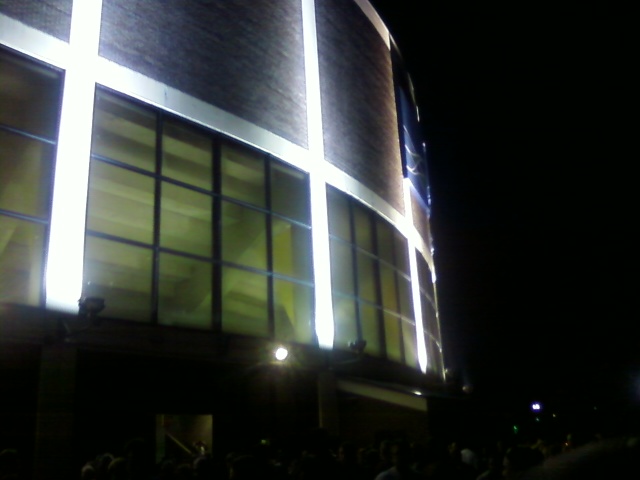
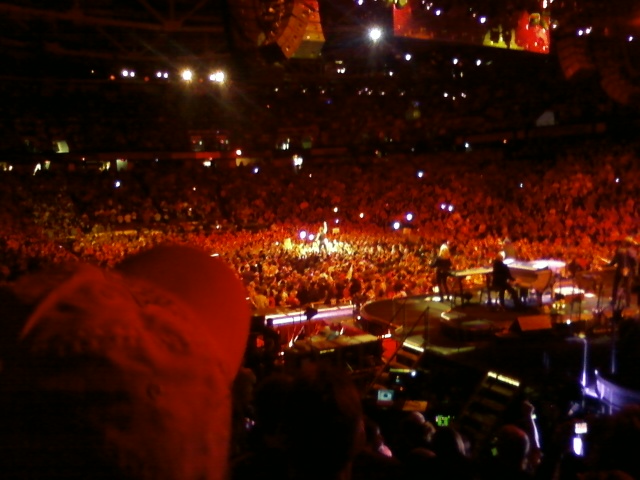
Last night, they finished tearing the last old concrete guts and bones from this historic place. On October 20, 2009, I was lucky enough to be on hand for Bruce Springsteen & The E-Street Band’s last-ever Spectrum show. In case you don’t know, Bruce is a Philly favorite, an adopted son from just across the river, and he and Billy Joel had their own banners in the rafters of the Spectrum for their record-setting streaks of consecutive sellout shows (still counting. The banners have been in the CoreState/First Union/Wachovia/Wells-Fargo Center for years, but Bruce’s was moved back for his last stand at the Showplace.)
The 10/20 show was historic by default: the last rock arena, the last rock star, the last time in Philly. The last time in the place where modern concert-going and giving started, the last time in the place where The Boss cut his teeth. Sitting in the Spectrum, you’re right down the street from all other kinds of American history. Throw in the themes of the Born In The USA album, which was played in its entirety, and you’ve got yourself a certain kind of seminar. In the context of the financial crisis, the wars, the Revolution, the loss of dear things, the loss of dear people, the loss of whole places, it was powerful to feel so obviously American and so absolutely not ironic. When the band opened with “The Price You Pay,” which they hadn’t been played live since 1981, the tone was set: recognition, celebration, sincerity, thanks. “Wrecking Ball,” a paean to the lost shrines of our youth, was exuberant even in its decidedly antifatalist fatalism:
Now when all this steel and these stories, they drift away to rust And all our youth and beauty, it’s been given to the dust And your game has been decided, and you’re burning the clock down And all our little victories and glories, have turned into parking lots When your best hopes and desires, are scattered through the wind And hard times come, hard times go Hard times come, hard times go And hard times come, hard times go Hard times come, hard times go Hard times come, hard times go Yeah just to come again
Bring on your wrecking ball Bring on your wrecking ball Come on and take your best shot, let me see what you’ve got Bring on your wrecking ball Bring on your wrecking ball (bring on your wrecking ball) Bring on your wrecking ball (bring on your wrecking ball) Take your best shot, let me see what you’ve got, bring on your wrecking ball
The view form our seats.
That this set would be a once-in-a-lifetime rock and roll moment was never really a question, but there are all kinds of emotional intangibles going on in settings like this. It wasn’t just Bruce’s last show at the Spectrum. It wasn’t just the last time the Spectrum would welcome Bruce or any of us home. It wasn’t just Clarence Clemmons’ last time ever in Philly as part of E-Street (be healthy, Big Man), and it wasn’t just the ghosts of 42 years piled to the ceiling. It was all of these things, but also the kind of joy that comes from impossible defiance and being in the company of thousands of strangers celebrating something immediately collective. That E-Street, the tightest band to ever grace the Earth, and Bruce, the greatest figure not named Elvis, were the evening’s spiritual directors meant the farewell ritual would be orchestrated perfectly. That these fans are passionate and savvy, that these songs are about them, meant something else entirely. This was rock and roll church in a very sacred sense. Afterward I texted one word and one word only: transcendent. There were even random acts of kindness. When Joe Torre and Donnie Baseball casually assumed regular-guy seats in the middle of the Phillies/Dodgers NLDS, Philly fans actually greeted them with warm applause and good-hearted jibes. Call that appreciation for a respected baseball man (Philadelphia knows its baseball and its baseball manners. Remember when we booed Brett Meyers for walking Griffey when Griffey was sitting at #599?), call it Brotherly Love. I call it everyone being in on what the night was all about. Grown men cried. Children laughed. Bruce slow-danced with his 90-year old mom. Quite simply, it was perfect.
Below are two videos from the night of the show. The first is a short clip of “The Price You Pay” taken on my camera phone. The second (not by me) is “Higher and Higher.” Given the angle of the later shot, it’s quite possible that two of the smiling, transfigured faces behind Bruce belong to me and my #1 Bromance respectively. Yep, I got to go to the best rock show ever with my best friend, and he’s also the one who orchestrated the logistics and made the whole thing happen. Seeing the concert of a lifetime with my life-long partner-in-crime, concert-going, and Meg Ryan movies was really the only way to do it. What? We also go see all the Apatow movies. Hmmm? You don’t remember how cute Meg Ryan was in 90s? So what if I cried when she died in City of Angels? You were right, Johnny Rzeznik, the world won’t understand. To Jonny my BFF, thanks again, brother. You’re the Nils Lofgren to my Steven Van Zandt. The Nic to my Cage. The Conan to my Andy Richter. The David Spade to my Chris Farley. The Ramon to my Vic.
There are lots of videos from 10/20 all over the web, but these two are significant to me:
Goodnight, friend. America just lost of piece of itself. Thanks for the memories.
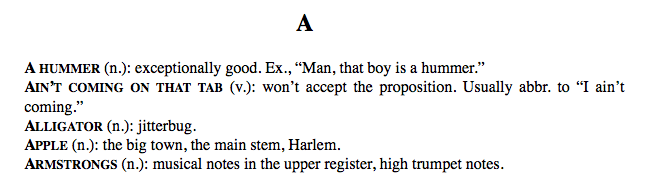
Some six years ago I compiled the first glossary of words, expressions, and the general patois employed by musicians and entertainers in New York’s teeming Harlem. That the general public agreed with me is amply evidenced by the fact that the present issue is the sixth edition since 1938 and is the official jive language reference book of the New York Public Library.
“Jive talk” is now an everyday part of the English language. Its usage is now accepted in the movies, on the stage, and in the song products of Tin Pan Alley. It is reasonable to assume that jive will find new avenues in such hitherto remote places as Australia, the South Pacific, North Africa, China, Italy, France, Sicily, and inevitably Germany and wherever our Armed Forces may serve.
I don’t want to lend the impression here that the many words contained in this edition are the figments of my imagination. They were gathered from every conceivable source. Many first saw the light of printer’s ink in Billy Rowe’s widely read column “The Notebook,” in the Pittsburgh Courier.
To the many persons who have contributed to this and the other editions, this volume is respectfully and gratefully dedicated.




 Chris Cocca