So I’ll Be Boycotting Amazon.com Because of the Sweatshop they Put Up in My Back Yard (How About You?)

It’s bad enough that 100 years later, no collective labor rights exist for people now working on the site of Bethlehem Steel.  Now we have an in-depth report from the Allentown Morning Call about conditions at the Amazon.com warehouses in Breinigsville that make the Lehigh Valley sound like Shenzhen.

Please read the whole thing here.  Below are some highlights and commentary.

Amazon’s priority and key competitive edge is quick delivery of products at low prices. Its Lehigh Valley location on Route 100 near Interstate 78 puts one-third of the population of the U.S. and Canada within a one-day haul. And the weak labor market helps keep employment costs down.

“We strive to offer our customers the lowest prices possible through low everyday product pricing and free shipping offers … and to improve our operating efficiencies so that we can continue to lower prices for our customers,” Amazon says about itself in documents filed with the U.S. Securities and Exchange Commission.

The situation highlights how companies like Amazon can wield their significant leverage over workers in the bleak job market, labor experts say. Large companies such as Amazon can minimize costs for benefits and raises by relying on temporary workers rather than having a larger permanent workforce, those experts say.

“They can get away with it because most workers will take whatever they can get with jobs few and far between,” said Catherine Ruckelshaus, legal co-director of the National Employment Law Project, an advocacy group for low-wage workers. “The temp worker is less likely to complain about it and less likely to push for their labor rights because they feel like they don’t have much pull or sway with the worksite employer.”

Amazon warehouse workers interviewed come from a variety of backgrounds, including construction, small business owners and some with years of experience at other warehouse and shipping operations. Several of them said it was their worst work experience ever.

The Lehigh Valley’s prime location is being leveraged against us.  Our community ( let alone our national economic depression and our own desire to work) is being exploited, and a firm called “Integrity” is key to the process.   Isn’t it peculiar how the world “Amazon” itself still conjures images of “jungle,” and how the quintessential literary indictment of bullshit like what’s happening in Breinigsville was called The Jungle?

Their accounts stand in sharp contrast to the “fun, fast-paced” atmosphere described in online help wanted ads for the Amazon warehouse. Amazon and ISS both said they take the safety of workers seriously, but declined to discuss specific concerns current and former employees voiced to The Morning Call. Both companies had three weeks to respond to multiple Morning Call inquiries for this story.

Integrity. Got that?

Goris, the Allentown resident who worked as a permanent Amazon employee, said high temperatures were handled differently at other warehouses in which he worked. For instance, loading dock doors on opposite sides of those warehouses were left open to let fresh air circulate and reduce the temperature when it got too hot, he said. When Amazon workers asked in meetings why this wasn’t done at the Amazon warehouse, managers said the company was worried about theft, Goris said.

“Imagine if it’s 98 degrees outside and you’re in a warehouse with every single dock door closed,” Goris said.

Computers monitored the heat index in the building and Amazon employees received notification about the heat index by email. Goris said one day the heat index, a measure that considers humidity, exceeded 110 degrees on the third floor.

“I remember going up there to check the location of an item,” Goris said. “I lasted two minutes, because I could not breathe up there.”

Allentown resident Robert Rivas, 38, said he left his permanent Amazon warehouse job after about 13 months to take another job. He said he intensified his job search in May after the warehouse started getting very hot.

“We got emails about the heat, and the heat index got to really outrageous numbers,” he said, recalling that the index during one of his shifts hit 114 degrees on the ground floor in the receiving area.

Rivas said he received Amazon email notifications at his work station when employees needed assistance due to heat-related symptoms. He estimated he received between 20 and 30 such emails within a two-hour period one day. Some people pushed themselves to work in the heat because they did not want to get disciplinary points, he said.

This is an 11-page story in the paper and 9-page story online.  You get this gist, but you need to read the whole thing if you haven’t already.

If Billy Joel could see us now.

Sixth Street Shelter Expansion: A Mission in Allentown, A Call to Faithful Engagement

I want to thank Scott Kraus of the Allentown Morning Call for his reportage on the Sixth Street Shelter expansion. Alan Jennings, Marsha Eichelberger, Tony Sundermeier, and I are quoted in Scott’s piece in yesterday’s edition.  Please read it here, and whether you’re near or far to the locales and missions we’re talking about in Allentown, consider how you might help this project or projects like it near you.

We’re not doing this because it’s a “mission project” and churches “should do mission.”  We’re doing this because we are learning that missional living is the Gospel. The church, any church, exists for mission, and mission doesn’t merely touch everything we do.  Mission, being missional, is how we are learning to see.


Push For Cleaner, More Efficient Cars Now (60 mpg, get ready for your close-up)

A piece I co-wrote with Megan Fitzpatrick from PennEnvironment is in today’s Allentown Morning Call.   The essay is not featured on the Call‘s website, so I’ll paste the most recent version I have (may differ from what was ultimately printed in editorial details) and share some pictures of the hard copy here:

With the summer vacation season in full swing, many Pennsylvanians find themselves longing to be outside enjoying everything the state has to offer. Memories of summers gone by are vivid as we daydream about upcoming getaways – to the mountains or shore, to IronPigs or Phillies baseball games, to visit family and friends, or even as we look forward to weekend activities.

Unfortunately, great memories and hopeful plans will be as far as some of us get. Feeling the hurt of high gas prices, unemployment, and the still-sluggish economy, many families have decided to scale down their summer vacation plans or opt for “stay-vacations.” But due to increasingly bad air quality and high gas prices, even our stay-vacations and local excursions may be sabotaged.

The people of Pennsylvania have had enough of the dire consequences of our continued dependence on oil. We’ve had enough of the price spikes, the air pollution, the catastrophic oil spills, and the global warming pollution that threaten our economy, our environment and our public health. And now, our oil dependence is even jeopardizing something as basic as the ability to enjoy our outdoor resources this summer.

Just two weeks ago, both South Mountain and Blue Mountain disappeared from sight on an Air Quality Action Day, blocked by a haze of ground-level ozone. The temporary absence of the Lehigh Valley’s defining physical features reminds us that we need to take bold steps towards cleaning up our air by cleaning up our cars and changing our transportation habits.

The longer we stay addicted to oil and the longer we fail to utilize opportunities offered by ride-sharing and transit, the worse these problems will get. The time has come to take bold national steps toward oil independence. Simply put, we can, and must, harness American ingenuity in the production of cars and trucks that will get us further on one gallon of gas.

PennEnvironment recently released a report that found that the average Pennsylvania family could save $452 in one summer if our cars and trucks met a standard of 60 miles per gallon—a standard that the Department of Transportation and EPA have deemed within our reach by 2025. While Pennsylvanians are expected to spend more than $4.8 billion at the gas pump this summer, meeting a 60 mpg standard would save over half that, while reducing oil consumption by 600 million gallons and cutting dangerous carbon dioxide pollution by 6 million metric tons.

We know that we can harness American ingenuity and use existing technology to make our cars and trucks much cleaner and more fuel efficient. Just this week, we were pleased to learn that higher demand for Mack’s line of near-zero emission trucks is expected to bring more jobs to the Lehigh Valley this summer. Additionally, over the next three years, more than a dozen electric vehicle models will be mass-produced in the United States. These new cars offer superior automotive performance while consuming no oil on most trips and producing no tailpipe pollution. And, these rides can be operated for less than three pennies per mile.


Recognizing that we have the technology to break our oil dependence, the Obama administration set standards for new cars and trucks built between 2012 and 2016 that will save billions of gallons of fuel. This, too, was an excellent start, but more must be done. The standards the administration is now developing for cars sold between 2017 and 2025 offer an excellent opportunity to do just that.

President Obama should move clean cars into the fast lane by issuing standards that ensure that the average new car and light truck meet a standard of 60 miles per gallon by 2025. He has every reason to do so—not only will it benefit Pennsylvanians at the pump, but it will protect our health and environment.
Americans work hard and deserve stable access to affordable transportation and a healthy natural environment. The Obama administration should push ahead with clean car standards that will make these benefits a reality. We’ll all be richer, and breathe easier, for it.

Megan Fitzpatrick is the Federal Field Associate with PennEnvironment, a citizen-based, non-profit environmental advocacy organization.

Chris Cocca is the Outreach Director for the Air Quality Partnership of Lehigh Valley-Berks, a public/private coalition of volunteers dedicated to improving air quality in Lehigh, Northampton, and Berks Counties.

In Allentown, Sustainabilty Can Be the New Cement, the New Silk, the New Steel. It Can Even Be the New Hess’s.

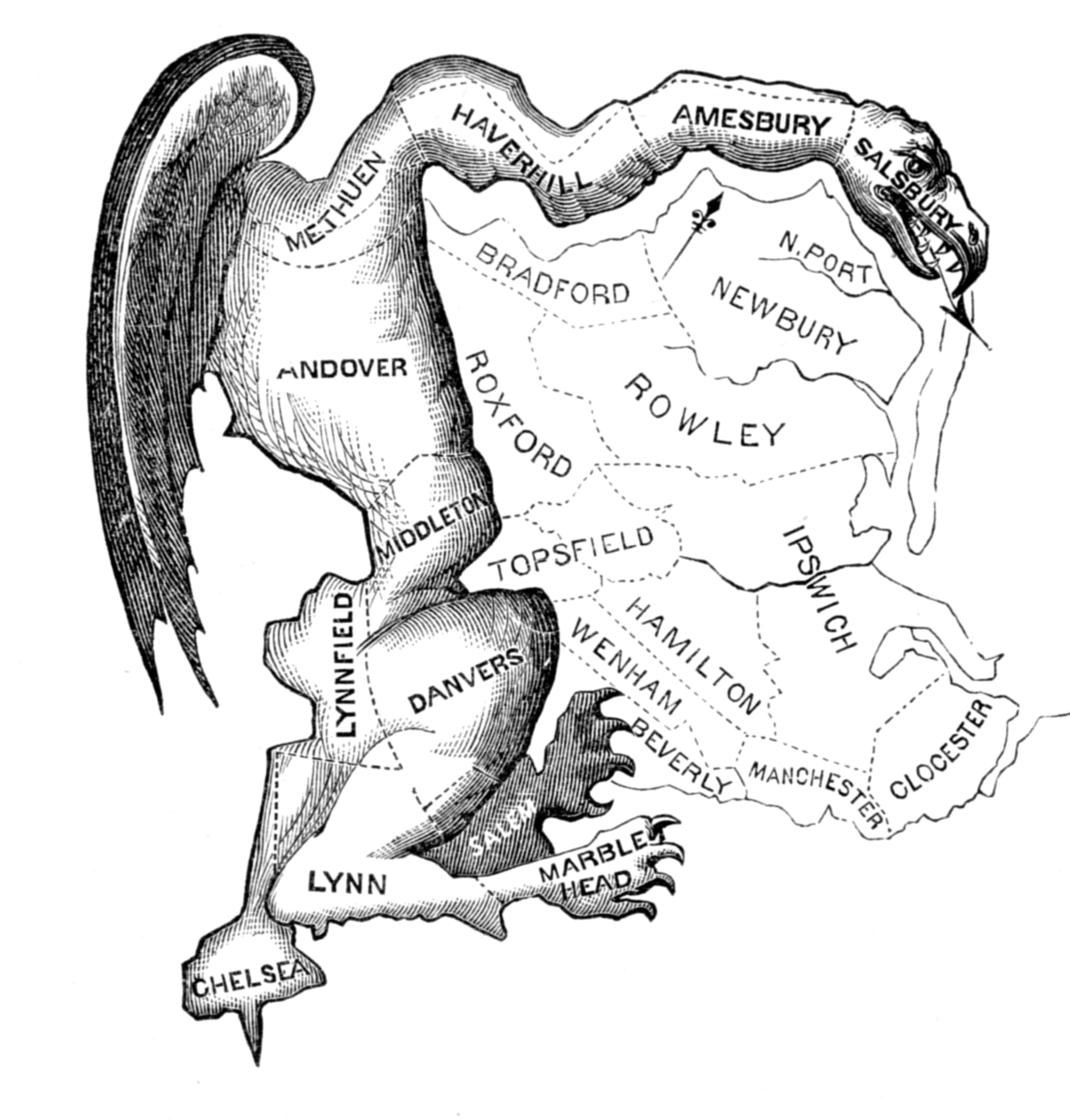
Totally a salamander.

If you were into civics as a kid, “gerrymandering” is one of the words you learned in 10th grade and still remember. You probably even remember the practice’s namesake, Elbridge Gerry, and that he endorsed the creation of oddly-shaped voting districts that favored his political party in the early days of the Republic.  The practice produced a cartographic chimera of sorts, the so-called Gerry-mander, and the practical side American political science began in earnest.  For all the time they must have spent outside, you’d think that early 19-century Americans would have known that salamanders don’t have wings but do have arms.

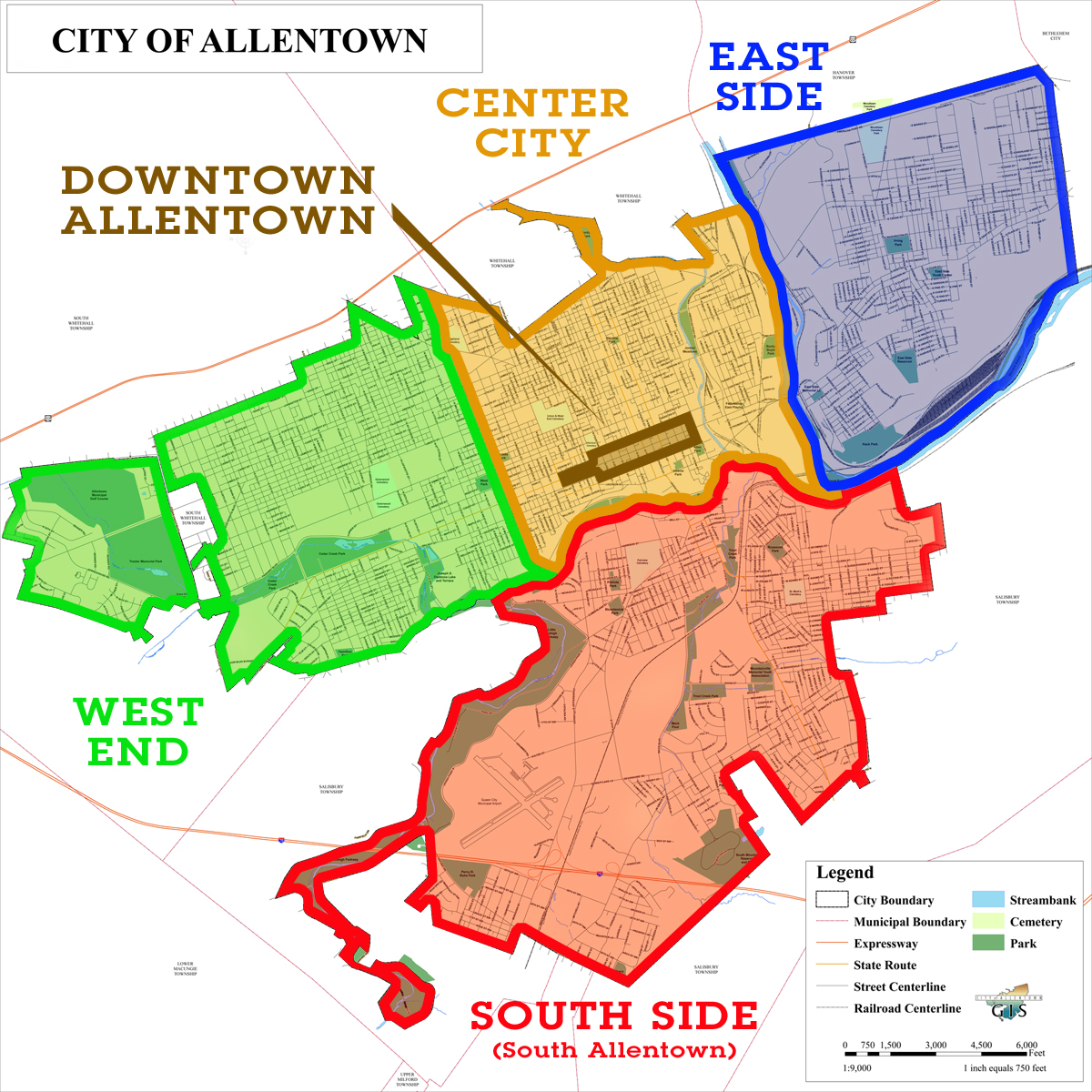
Today, I came across a map of Allentown that Damien Brown edited to show the city’s different sections (East Side, Center City, Downtown, South Side/South Allentown, and West End):

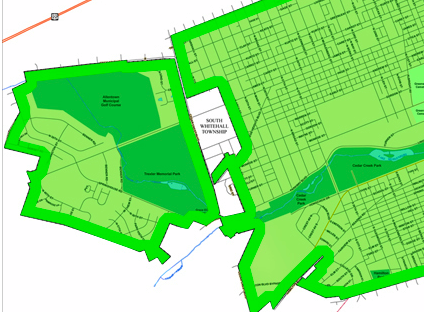
Now, if you live in Allentown, you know that a small pocket of South Whitehall Township (those white polygons) cuts into the West End on the east side of Cedar Crest Boulevard from Washington Street to Parkway.  A closer look:

What’s the story here? What political machinations are afoot??? Just the long-term visioneering of Allentown industrialist Gen. Harry C. Trexler, patron of the Allentown Parks System, the Golf Course, the Trexler Nature Preserve and lots of other things we take granted.  The space that is now Trexler Park was, before his death, a family summer estate in South Whitehall Township.  This land and the land immediately around it (including the Golf Course) only became part of the city because of Trexler’s work and generosity.

Longtime Lehigh Valley residents know most of this already. What I didn’t know: Trexler is probably also responsible for preserving the Lehigh Valley’s home-rule culture.  His mistrust of Philadelphian power (antagonistic as it was to the Lehigh Valley’s Pennsylvania Germans) led him to champion the development of a regionally-based economy.  It makes me stop and think: even as we recall Allentown’s decline from unique, mid-sized, industrial and commercial base of economic power to a city searching for a new identity and a sustainable economy of the future, if not for Trexler, the plus side of the Lehigh Valley’s history might not have happened at all.

In pioneers like Trexler and, later, the Rodale family, the Lehigh Valley has fine models for conservation and sustainable business.  Even though the national economy is groaning, it is also greening.  100 years ago, Trexler and others converted a vacant, run-down city lot into what we know today as West Park.  Leaders from all aspects of Allentown’s public life need to keep taking these cues and continue embracing the opportunities financial trouble brings.  If we need to build, we must (and can) build sustainably.  If we need to tear down, we can do it beautifully. I imagine a city that is increasingly walkable in all quarters, and one where junked lots and vacant parking lots become a patchwork of parks and public spaces.

No one knows how long the current economic crisis will continue.  What we do know is this:  the days of retail excess are over, and rising generations want walkable, bikable, beautiful urban spaces in which to live and work and spend.  We want sustainable, hyper-local options, we want good news for the city and we want to be part of that transition.

On a long enough timeline, chronically closed spaces will green themselves, but cities across the country are starting from scratch with new sustainable ethics and visions. Thankfully, we don’t have to start from square one.  If stakeholders are committed, our region, led by our cities, can be a national example of the new economy even it was once a beacon of the old.  And unlike silk or steel or cement or retail, sustainability is a business for all times and all seasons.

Rush Hour, Dutch Hour. 33% of All Trips in Utrecht are Made on Bikes (VIDEO)

Until today, the only thing I knew about Utrecht was that a treaty was signed there a long time ago.  Not quite as long ago, I was an ace at 11th grade European history, but have sadly since forgotten just what the Treaty of Utrecht ended.  Turns out it was that Europe-wide clusterfrock known to us now as the War of the Spanish Succession.  But, as a Pentecostal Irish bus driver once told me on a trip to the site of Michael Collins’ death, “that’s an awful lot of ugliness, and I think it’s time we get to forgivin’ each other just like the good Lord forgave us.”  Well said, friend.

Today, Utrecht is the fourth largest city in The (We’re Not All Holland) Netherlands.  And a third of their traffic takes place on bikes.  Transit accounts for most of the rest, and this is the beautiful, healthy, clean, safe result:

So I ask you:  How do we do it in the US?  Do we start in towns ravaged by natural disasters and rebuild them with these kinds of goals in mind?  Do we somehow incentivize cycling and mass transit at local, state, and federal levels of government?  Tax credits?  Insurance incentives?

Young Americans want to live in walkable, bikable cities and even walkable, bikeable suburbs. How do we push this growing desire, the increasing cost of gas, and the increasing concerns about emissions and obesity toward a real tipping point?   In the Lehigh Valley and beyond, Car-Free.org is a great organization currently working to bring like-minded folks together around these.  Check them out, buy a shirt, take a class.  If you don’t live in the area, that’s okay, too. I understand that our good friend Steve at Car-Free/CAT is more than willing to talk to you about starting a Car-Free.org chapter in your area.  If you’re a leader in a similar local or regional group, Steve wants to talk to you, too.

I want to see fewer cars, more transit, less emissions.  I want to see more bikes.  Don’t you?

Chris Cocca Is Wrong About Everything + Novels + Hess’s Department Store + Paul Ceglia and Facebook: Search Term/SEO Answer Bag #57

I’ll start this edition of the Search Term Answer Bag by admitting two things:

  • It’s not really, sequentially, #57.  That’s just its name.  Probably because I like ketchup.
  • I stole the whole idea from David Letterman’s old “CBS Mail Bag” routine.  “Letters, we get letters, we get lots and lots of letters! LETTERS!”

and a suspicion:

  • I am approximately one half of this blog’s audience who gets a kick out of this bit.  Good enough for me.

Now, on to the search terms!

First, my favorite:

chriscocca is wrong about everything?

Even here, I was only wrong half the time.

Classic.  There are a few other Chris Coccas out there in the world, so I won’t be big-headed enough to claim that this was a query about me as a matter of fact.  But for the sake of this post, we’ll go with it.

I appreciate that this was searched with a question mark and not a exclamation point or, even worse, a period. As far as an answer goes, I’m willing to say that I’m probably not wrong about every single thing, but we can’t really be sure.  I also think chriscoccaiswrongabouteverything would be a great name for a website not called The Daily Cocca, and it would be an excellent follow-up album to the still-on-hiatus uppityupalexvanderpoolera.

Searching for verbs and/or prepositions:

what to when you are almost finished a novel?

It’s unclear here whether the asker is almost finished reading or writing said novel. If reading, I’d say get ready to pick your next book. If writing, I’d say get ready to revise. That’s when the real writing happens.  If you’ve done that, and have met with good writers groups and gotten feedback you trust and then revised again and then again and are sure you manuscript is exactly what it should be, then I guess you start sending query letters to agents and try to start publishing excerpts.

A get a lot of hits from people looking for information about Hess’s Department Store.

Behind the South Mall in 2011. Image by Frank Tienstra.

And rightly so. It was an amazing place.  Today’s proper question:

when did hess’s dept store allentown pa remodel the front of the store

Sadly, I don’t know the answer to that, but I’m guessing it was before I was born (1980).  Can any Allentonians/Lehigh Vallians help me out here?  I’ve been getting a lot of hits from people looking for the famous rainbow-colored sugar from the Hess’s Patio Restaurant.  I know you used to be able to buy it at MusikFest, and I’m willing to bet you can find it on ebay if not at places like the Moravian Bookstore or the Lehigh County Heritage Center.  Sadly, I can’t be much help with those seeking strawberry pie recipes.  But I can share this post, with 30+ commentators sharing their favorite Hess’s memories. Really a special place. I can also share this bittersweet, recent image sent to me by Frank Tienstra. It’s one of the old Hess’s trucks still sitting behind the South Mall as of January.  Sad for anyone who knows what Hess’s was all about.

Lastly, a question about Facebook:

is facebook layout changing again for the summer 2011

I really don’t think so, but this could be one of the things I’m wrong about.  Mashable has some of the best coverage of social media developments: here’s the Facebook news aggregator-inator.   Soon, you may have better luck asking this guy:

Not Mark Zuckerberg

Never heard of Paul Ceglia?  He’s the chap that might (ooops) own half of Facebook.  So who knows?  Maybe Paul has a few design ideas stashed with all those old emails he keeps finding.  When I first heard about this case last year, I thought it was a long shot.  But the plot keeps thickening. When I try to imagine what might be the next big thing to come along and knock Facebook off the block, I have a pretty hard time.  But you know what?  It might just end up being Mark Zuckerberg.