Cool post from screenwriter Scott W. Smith. Scott shares a piece by Maureen Doud about 50s-starlet-turned-nun Dolores Hart, the subject of award-winning documentary “God Is The Bigger Elvis.” What a great and profound title!
“When I met Elvis, I met a very sweet and very courteous young man who jumped to his feet and said ‘Hello,’ and ‘ How do you do, Miss Dolores?’ I was very touched by his courtesy and honesty, and I thought immediately I would like this fellow.”
Dolores Hart
A spiritual documentary about a 73-year-old nun living in a rural Benedictine monastery/farm in Bethlehem, Connecticut might not seem like the easiest route to take to the Oscars, but it worked for God Is the Bigger Elvis—the story of former a Hollywood actress who once kissed Elvis Presley in a movie.
Tomorrow’s scripture readings/lessons in many churches will be these, brought together by the liturgical themes of Transfiguration Sunday. I was blessed to be part of conversation this week about the need even we postmoderns have to leave spaces where we experience the holy different from how we found them. In the story of the transfiguration, Jesus’ disciples long to build booths to mark what they’d experienced, or, perhaps, to provide shelter so they might stay in the presence of the transfigured Christ forever. During Sukkot in New York, some contemporary Jewish groups build temporary booths in Union Square, and if you’re like me, you can’t come up from the steps of the subway without wanting to linger and explore them. Throughout the Hebrew Bible, the Children of Israel build altars or monuments to mark the places where they encountered God, even in the middle of rivers.
Today was Whitney Houston’s funeral. I wasn’t able to watch it, but it prompted W.W. Norton to promote this book, which looks amazing. I want to judge Norton harshly for using an oblique reference to the service to promote their wares and their brand on Twitter, but I also know that sacred fire is confounding. Was Norton taking part in the kerygma today? I can’t say, but I can say that the Holy Ghost has done stranger things, even to me.
Christians around the world celebrated this past Friday as Epiphany, the traditional end of Christmastide on the 12th Day of Christmas. Emphases vary according to culture, theological tradition and custom, but the revelation of Jesus as the Son of God is a central theme of Epiphany.
Most Christians believe or center their spiritual lives around some variation of the basic Christian narrative: the “Good News” of the Gospel is that God seeks to reconcile humankind to Godself and to reclaim all of creation for creation’s good and for God’s eternal glory. To my theological ear, Christmas touches Easter in undeniable ways: the story of Christ’s birth (Incarnation) and the story of his passion are fundamentally about God going to the far places (becoming enfleshed and time-bound; dying) to reconcile everything and everyoneto Godself. Christ’s coming into history is the story of the unorthodox emigration of God from cosmos to poverty to death. The crux of Christianity, in any liturgical season, is the idea that a place at God’s table is being prepared not only for all who would seek it, but for all whom God seeks. Rahab’s service to the Hebrews in Jericho, Ruth’s faithful dedication to her mother-in-law, and their inclusion in Christ’s lineage by the Gospel writer Matthew shows that Christ’s birth, while wholly unique, is not unlike the progressive extension of covenant found throughout the Hebrew Bible. Neither is it something for Jewish or Christian people only. The birth of Christ is, the traditions assert, the coming of God into history, God’s putting on of flesh, vulnerability, rejection. The beginning of God’s own march toward death and undoing it.
It’s not by accident that the church follows the celebration of God’s coming to dwell among us with a season proclaiming the inclusion of all peoples in the good news of Christmas. Epiphany reminds us that this is, indeed, a good news that shall be to all people. Mary, Joseph, and Jesus greeted the visiting wise men who came following stars. Holy Hosts conjured before shepherds. The Archangel Gabriel came to a peasant girl in the backwater parts of a backwater province of the most powerful empire on Earth, uninvited. The Gospel of John begins by describing the coming of the light that never goes out, “the true light that gives light to everyone.” Matthew describes the alignment of genes that birthed God from the unlikely margins.
In the person of Jesus and in the spiritual lives of those who seek to follow after him, the Christian story is a story of movement. From heaven to earth, eternity to time, from Bethlehem to Egypt to Nazareth to Jerusalem. From the east, bearing gifts, and from a manger bearing good tidings of great joy for all people. From self-satisfied, complacent Christianity toward a suprachristian spirit of radical welcome, inclusion, and grace. From fear to love. From judgement to journey. From “am I my brother’s keeper?” to “love thy neighbor as thyself.” From a narrow politics of self-preservation and jingo to a public ethic of justice, from crushing those on the margin to crushing everything in us that keeps us from loving as God does. From the awe of Christmas to what it must mean, Epiphany’s radical welcome.
Paul Krugman Mellencamp has finally uttered the words. We’re in a Depression. His Sunday NYT piece, “Depression and Democracy,” is here.
Elsewhere, Leonard Cohen has shared about Depression and Depression:
LC: Well, you know, there’s depression and depression. What I mean by depression in my own case is that depression isn’t just the blues. It’s not just like I have a hangover in the weekend… the girl didn’t show up or something like that, it isn’t that. It’s not really depression, it’s a kind of mental violence which stops you from functioning properly from one moment to the next. You lose something somewhere and suddenly you’re gripped by a kind of angst of the heart and of the spirit…
– Leonard Cohen, French interview (trans. Nick Halliwell)
It’s hard to be hopeful about the world economic situation. But Cohen’s kind of depression — God, he’s right on, isn’t he, about there being different kinds? — the kind of mental violence, the kind that stops you from functioning properly from one moment to the next, the kind that grips you and won’t be shaken off without time and effort and help…maybe you see yourself in that. Unwanted thoughts, irrational compulsions, excessive guilt.
For years, I looked to Cohen’s quote and thought, well, shit, this is the condition of artist. I found out later that it’s also the condition of millions of people who, in addition to being sensitive, winsome, and artistic, also happen to not produce enough serotonin on their own. For many, such is the biology of general anxiety, OCD, and other depressions. If that’s you, please know there is help. If you don’t know if that’s you, please see a trusted physician and find out. A friend of mine said it best: “no one should have to suffer because of their biochemistry.” We’d never suggest a diabetic go without insulin. We’d never expect a diabetic without the right help to function in healthy ways, let alone thrive. Any physician worth her salt will tell you it’s the same with the way our brains process the presence or death of chemicals our bodies are making as best they can. Beloved, God has not given us the spirit of fear; but of power, and of love, and of a sound mind. A righteous mind.
In the relatively short course of my 31 years, I’ve learned quite a few things from John Cusack. Just now, via Twitter, he turned me on to a new piece by Cornel West in yesterday’s New York Times: Martin Luther King Jr. Would Want a Revolution, Not a Memorial .
About 95% of this resonated with me. I paused here:
“In concrete terms, this means…extensive community and media organizing; civil disobedience; and life and death confrontations with the powers that be. Like King, we need to put on our cemetery clothes and be coffin-ready for the next great democratic battle.”
Is being, in West’s words, “coffin-ready,” a condition for participation in this kind of revolution? It’s true we’re talking about life and death stakes: healthcare, poverty, justice, peace — every day, people live or die in this country and abroad because of policy decisions around these issues. People live and die because of campaign donations, kickbacks, deals. West is calling for civil disobedience while telling us, like King before him, that even the most civil of disobedience could get free people killed right here in America. That’s chilling, sobering, and believable, isn’t it?
West is a masterful communicator and rhetorician. For that reason, I wish he’d been more clear about those “life and death confrontations with the powers that be” required in the “next great democratic battle.” It’s clear to me that in West’s view, the threat of violent force in these struggles is from the side of established Power. I hope we’re all reading that the same way.
West notes:
“King’s response to our crisis can be put in one word: revolution. A revolution in our priorities, a re-evaluation of our values, a reinvigoration of our public life and a fundamental transformation of our way of thinking and living that promotes a transfer of power from oligarchs and plutocrats to everyday people and ordinary citizens.”
The 12th chapter of the Apostle Paul’s letter to Roman Christians in the first century CE deals with similar themes of transformative agency. In Pauline terms, the renewal of our minds transforms our inner lives an enables us to test and see the will of God in and for our communities. “Do not conformed to the pattern of this world,” Paul tells the Roman community, “but be transformed by the renewing of your mind. Then you will be able to test and approve what God’s will is—his good, pleasing and perfect will. ” The “pattern of the world” (also translated as “age”) in first century Rome was one of anti-Judaism at the highest imperial levels. Jewish Christians, who had established the city’s earliest Christian gatherings, had been exiled along with all other Jewish people by the Emperor Claudius, and by the time of Paul’s writing had only recently been able to return under Nero. Leadership tensions seem to have risen up between the returning Jewish Christians and the Gentile Christians who’d assumed responsibility for the community during the Jewish exile. In a larger historical context, the persecution of Jews in Alexandria as attested by Philo occurred just 20 years before the writing of this missive, and the persecution of Christians under Nero in Rome on the horizon. Issues of justice, access, and economics are pressing.
For Paul and West, the alternative to transformative renewal is continued conformity to dominant social paradigms, and it’s no coincidence that in both cases, the call is from these destructive patterns and to new ways of being, thinking, doing. West says “King weeps from his grave. He never confused substance with symbolism. He never conflated a flesh and blood sacrifice with a stone and mortar edifice. We rightly celebrate his substance and sacrifice because he loved us all so deeply. Let us not remain satisfied with symbolism because we too often fear the challenge he embraced.” Paul said “Therefore, I urge you, brothers and sisters, in view of God’s mercy, to offer your bodies as a living sacrifice, holy and pleasing to God—this is your true and proper worship.”
In his own way, Paul continually challenges the Church to be “coffin-ready.” We are to present ourselves as living sacrifices. To live, Paul says, “is Christ, and to die is gain.” (Philippians 1:21). “Dying to self” is one of the most revisited Christian tropes across denominations, precisely because it’s what we believe Christ modeled in his ministry and teaching. Dr. West, like Dr. King, draws from the deep well of Christian tradition, pulling succor from a source that has been used in other hands to poison.
What enables transformation? For Paul and West, the process beings somewhere near renewal. West calls us to re-evaluate, re-align, and re-prioritize. Paul says that the ability to so will come by the grace given to us, and that we might start on our end by reorienting ourselves towards others: “Do not think of yourself more highly than you ought, but rather think of yourself with sober judgment, in accordance with the faith God has distributed to each of you.” The Apostle prefaces this charge with an important recognition: “For by the grace given me I say to every one of you: Do not think of yourself more highly than you ought…” The reorientation of self vis-a-vis the Other, or what West calls “a fundamental transformation of our way of thinking and living,” follows grace. As Chapter 12 progresses, Paul claims that any giftedness any of us have is afforded to us only by God’s grace. It must also be true that the ability to be transformed by the renewing of the mind starts, itself, with grace, and it is grace that invites us to see and treat each other graciously.
Transformation and renewal, of our minds and of our bodies politic, start and end with the kind of good will we can’t earn. We must lean into already-present grace, and it’s only by grace that we begin to see past the end of our own lives and to locate grace in others. Grace, as Paul would have it, follows grace. “Twas grace,” the great American spiritual says, “that taught my heart to fear, and grace my fears reliev’d.” It is grace in us that sees grace in others. It is goodness in us that finds goodness in others. It is God in us who recognizes God in others, who makes us care about the lives and fates of others, who never stops trying to wash the word “others” from our renewal-needing, imperfectly transformed minds and points of view.
If grace is, like Paul suggests, the starting point for personal and communal transformation, how are we to live graciously in the midst of revolution, should it come? Paul offers a provisional ethic of life within the hostile empire of his day, to the very people in its center:
9 Love must be sincere. Hate what is evil; cling to what is good. 10 Be devoted to one another in love. Honor one another above yourselves. 11 Never be lacking in zeal, but keep your spiritual fervor, serving the Lord. 12 Be joyful in hope, patient in affliction, faithful in prayer. 13Share with the Lord’s people who are in need. Practice hospitality.
14 Bless those who persecute you; bless and do not curse. 15 Rejoice with those who rejoice; mourn with those who mourn. 16 Live in harmony with one another. Do not be proud, but be willing to associate with people of low position. Do not be conceited.
17 Do not repay anyone evil for evil. Be careful to do what is right in the eyes of everyone. 18 If it is possible, as far as it depends on you, live at peace with everyone. 19 Do not take revenge, my dear friends, but leave room for God’s wrath, for it is written: “It is mine to avenge; I will repay,” says the Lord. 20 On the contrary:
“If your enemy is hungry, feed him;
if he is thirsty, give him something to drink.
In doing this, you will heap burning coals on his head.”
21 Do not be overcome by evil, but overcome evil with good.
That’s a fairly civil, and maybe even holy, disobedience. It turns out that grace isn’t just the author and perfecter of our transformations, but is also the essential Christian ethic in crisis and upheaval. How fitting, then, that Romans 12 came up as a lectionary reading for millions of Christians across the world last Sunday and that in the days before and since, Christians from all perspectives and experiences have wrestled with it. I can’t know for sure that Romans 12 was part of Dr. West’s Christian practice Sunday past, but I’m glad John Cusack got me thinking about it.
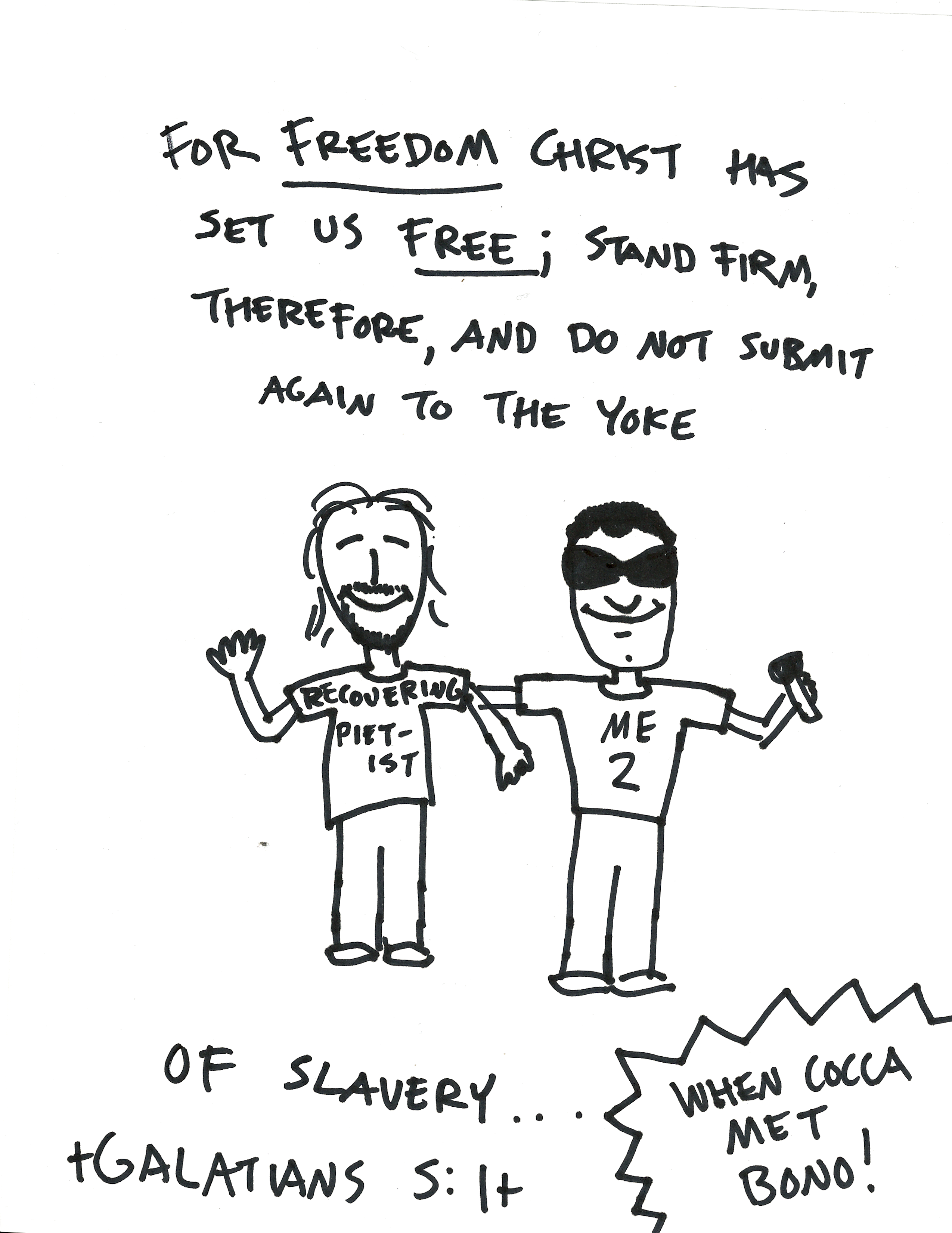
Thanks to my sister and F. Bil (future brother in-law), my wife and I got to go to the U2 concert in Philly on July 14. I have many thoughts, pictures, and reflections to share, and this post will be the first.
The show was great and, in a good way, exhausting. There was so much content beyond the music, and I found myself analyzing every bit of video, every factoid on the massive screen before the show, every partnering of song-choice, faith, hope, and activism. It was really, really great.
I’ll offer the cartoon below as my first bit of commentary.
I feel like I should say more, but I won’t. We can do that in the comments. Or when I get around to writing about the thin line between (oops, there I go. I said I wouldn’t say any more!)


 Chris Cocca