Rilke, Buber, and “God’s True Cloak”

The Poetic Metaphysics of I, Thou, and It

I’m publishing this on Substack soon, but I thought I’d post it here as well. I’m interested in your thoughts.

I learned this poem from Book of Hours about 20 years ago. At the time, I think the last things I’d sat down and intentionally memorized were fourth-grade/1989 bangers “We Didn’t Start the Fire” and “Another Day in Paradise.” (Don’t underestimate their effect on my moral formation).

Here’s Rilke (Macy and Barrows translation):

We must not portray you in king’s robes,
you drifting mist that brought forth the morning.

Once again from the old paintboxes
we take the same gold for scepter and crown
that has disguised you through the ages.

Piously we produce our images of you
till they stand around you like a thousand walls.
And when our hearts would simply open,
our fervent hands hide you.

Book of Hours, I 4

This poem, written in 1899, is often called “God’s True Cloak.”

Reading it now, I notice some things I’ve slightly misremembered.

I thought the second stanza was:

or take again from old paintboxes
the same gold for scepter and crown
that have defined you through the ages.

In the first instance, I’d wrongly remembered a continued deontology (what we must not do); instead, Rilke is describing what we do (and shouldn’t).

I had also thought “stand around you like a thousand walls” was “stand before you like a thousand walls,” but around is definitely better. I’d be interested in what any German speakers or readers make of the original text.

What really strikes me this time, though, is the interplay of you/thou and that in the opening lines. God is referred to as a you/thou (a personal, immanent presence with agency) twice; you in king’s robes, you drifting mist; as well as that (a force) rather than whom. Again, I’m not sure how this reads in Rilke’s German, but, as presented, it’s an elegant compression of God as thou (a God who is someone)and God as that (that which does something; in this case, brings forth the morning, but, in a bigger sense, grounds all being).

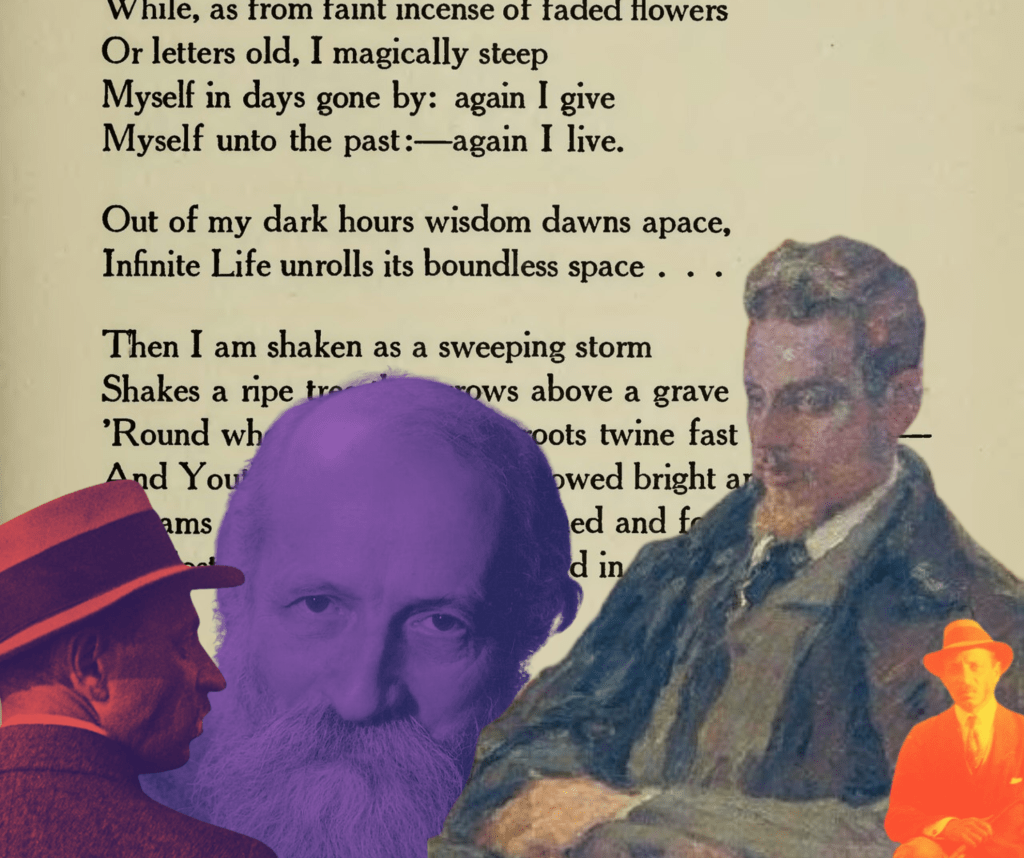
This brings us into conversation with Martin Buber. In I and Thou (Ich und Du, 1923, translated into English in 1937), Buber suggests that there are two primary lenses through which we process reality: I-It and I-Thou. I-It grounds and defines the self by difference from Other-as-object (I am Martin, that is a tree). I-Thou recognizes Other (even a tree) as presence and mutual foregrounding. For Buber, every move toward “You” is a move toward God, “the Eternal Thou.” Human life finds meaning through relationships (I-Thou) and grows more integrated in the move from seeing Other as It and understanding, experiencing, and affirming Other as Thou.

Buber certainly knew Rilke’s work and cited him elsewhere (though not, to my knowledge, in I and Thou). And while “God’s True Cloak” isn’t only about the I-Thou tension or the mystery of a God at once immanent and ontologically necessary, it does masterfully, beautifully — mystically — echo mystic traditions and anticipate key parts of Buber’s project.

Poetic brilliance is funny like that.

As for the cloak. It’s hard to not be reminded of the woman cured after touching Christ’s robe. Her instinct (“If I but touch his cloak, I will be made well”) suggests intuition: God is personal presence (walking dusty streets, wearing robes) and God grounds reality (the mist brings forth dawn, the ephemeral has power). Did she encounter the “hem of his garment” as Thou rather than It? For what it’s worth, he says her faith has healed her.
Buber and Brautigan

I have a theological degree, but that’s not what this post is about. And we can’t reduce what Buber is saying to a single line, however pithy. But it does remind me of Brautigan’s beautiful “I Was Trying to Describe You To Someone.” They’re sort of saying the same thing.

“When two people relate to each other authentically and humanly, God is the electricity that surges between them.”
Martin Buber

r_brautigan

On Rilke’s Birthday

In honor of your birthday, you brilliant, beautiful man.

We must not portray you in kings’ robes, you drifting mist that brought for the morning,

or take again from old paintboxes the same gold for scepter and crown that have disguised you through the ages.

Piously, we produce our images of you, till they stand before you like a thousand walls.

When our hearts would simply open, our fervent hands hide you.

“God’s True Cloak” <as I remember it>, Book of Hours.

Bartleby, the Carpenter; Bartleby the King of Pop: The Inevitability of Jesus and Michael Jackson

Michael Jackson died in 2009.  This post is from 2013. 

I enjoyed this recent post from Wandering Mirages about the eponymous hero (or something) of Herman Melville’s Bartleby, the Scrivener.   Wandering Mirages concludes that Bartleby is all things at once:

But, in the end, in the tragic and evasive end, the novella had proved itself to be anything but simple and he was none of this and all of this, of course. He was probably the essential human present in the most inscrutable of strangers, in the inner life of the other. He might also be the scion of capitalism, a representation of its many wonders, and an idle. early sacrifice at the altar of pacifism and non-violence. He was some mysterious combination of the heroic and the ironic, and the rest too, in all probability – of the incongruous and the inevitable. A Gandhi without an audience.

Just before Christmas, I was talking with a friend about Michael Jackson.  I’ve been trying to put into words exactly how it is that Michael Jackson’s later life and death were in certain ways inevitable: that somehow, Michael Jackson is precisely what we do to people in the pop age, the age of celebrity cults and ever-massive media.  (Ever-massive is incorrect, but I like the way it sounds.)  Michael Jackson is our Joker: he was formed by the dynamics of his family and then by the pathologies of the second half of the 20th century. We’re not entirely at fault:  the machinations have been moving since the printing press, since cuneiform.  But in another way, MJ died for our sins as much as his.  Everything odd or evil  about him was leavened with the grist of our corporate fascinations: in whiteness, in youth, in being thin, in being rich, in child stardom, in the facilities of fame, of fortune over health.  That he was born black and poor in 1958 in Gary, Indiana is essential: none as gifted or as tortured would emerge from white suburban basements. Jackson’s migration from black to white was, he said, genetic, but it was also an indictment of our racist predilections and expectations of goodness and beauty.  The man who transcended the color barrier on MTV and in popular music more than anyone before him was black, and we demanded greater whiteness.  He obliged.  Abused in youth and adolescence, this eighth child of the Jackson clan knew a thing about survival, keeping peace, being poor and not wanting to go back, about the weight of family needs and expectations.  Unlike our Bartleby, Michael did what he was told.  It killed him anyway.

Clearly, I’ve thought of Jackson as a kind of Christ figure for our repulsive age.  And Wandering Mirages reminds me that Bartleby may just as well have been The Carpenter, one who is all things to all people, one sacrificed like Jackson on the altar of what the old hymn calls God’s “children’s warring madness.”  If Bartleby was killed for his refusals (first to do as he was told, then to protect himself and his interests), so too was  Jesus.  While Bartleby may have been “the most essential human present in the most inscrutable of strangers,”  Jesus came, according to tradition, so that we might see God in one like us.  Fully human, he was treated as a stranger.   The mirror-Leonard Cohen.  And yet he is also, in my experience, a “mysterious combination of the heroic and the ironic, and the rest too, in all probability – of the incongruous and the inevitable.”

Michael Jackson was inevitable.  So was King.  So was Jesus.  Whether you believe he was from Nazareth or God or some mystic union of both, the incongruity of his life and message with the power values of the system in which he lived, the system in which we live, made his sacrifice inevitable, subversive, and, for those who find life in him, full of saving grace.

The deaths of Bartleby, King, and Jackson indict us all.  So too the death of Jesus.  But when Christians talk about his resurrection, I think we mean that there’s a point to unwarranted suffering, to refusing to compromise our core convictions about the economy of justice or the economy of God even in the face of our destruction.  This is the power of a flower in a rifle, of one lone citizen refusing to move before a procession of tanks.  Of a dying God refusing to come down from his cross, to call down all his angels, as it were.  This is holy irony, and a saving kind of subversion.

The God of Senses

Fight error with courage and kindness. Look around you and see the injustice that chains so many people. Take time for quiet prayer. Know your faith and let that knowledge burst into flame in your heart. (St. Anthony of Padua)

They say that knowledge born of experience is mechanical, but that knowledge born and consummated in the mind is scientific, while knowledge born of science and culminating in manual work is semi-mechanical. But to me it seems that all sciences are vain and full of errors that are not born of experience, mother of all certainty, and that are not tested by experience, that is to say, that do not at their origin, middle, or end pass through any of the five senses. . . .(Leonardo Da Vinci)


This scene from the 1995 movie starring Ben Kingsley as Moses.

Fight Error With Courage and Kindness

Fight error with courage and kindness. Look around you and see the injustice that chains so many people. Take time for quiet prayer. Know your faith and let that knowledge burst into flame in your heart. (St. Anthony of Padua)

They say that knowledge born of experience is mechanical, but that knowledge born and consummated in the mind is scientific, while knowledge born of science and culminating in manual work is semi-mechanical. But to me it seems that all sciences are vain and full of errors that are not born of experience, mother of all certainty, and that are not tested by experience, that is to say, that do not at their origin, middle, or end pass through any of the five senses. . . .(Leonardo Da Vinci)

This scene from the 1995 movie starring Ben Kingsley as Moses.