Springsteen and U2 as Liberation Theologians

Their day jobs as rock stars have made them fabulously wealthy.

That’s held against them by people who think the President’s net worth is a sign of his virtue.

But Springsteen and U2 are also liberation theologians. That might sound like an unhinged thing to say about 5 wealthy white men, but their origins on margins have never been far from their chief concerns or best work.

I suppose instead of calling them liberation theologians, I could say they’re Christians who understand a lot about what the message of Jesus really was.

I don’t know what they do with their wealth, and perhaps that’s a good conversation to have. But I do know what they do with their platform and their public witness.

For some, high ticket prices and half-a-billion-dollar catalogues are disqualifying planks in the eye, but again, most folks saying that don’t blush at the gutting of Medicaid, the defunding of schools, the evaporation of food stamps.

So, I mean, they’ve got some planks in their eyes, too, don’t you think?

I love this song from U2’s new Days of Ash EP.

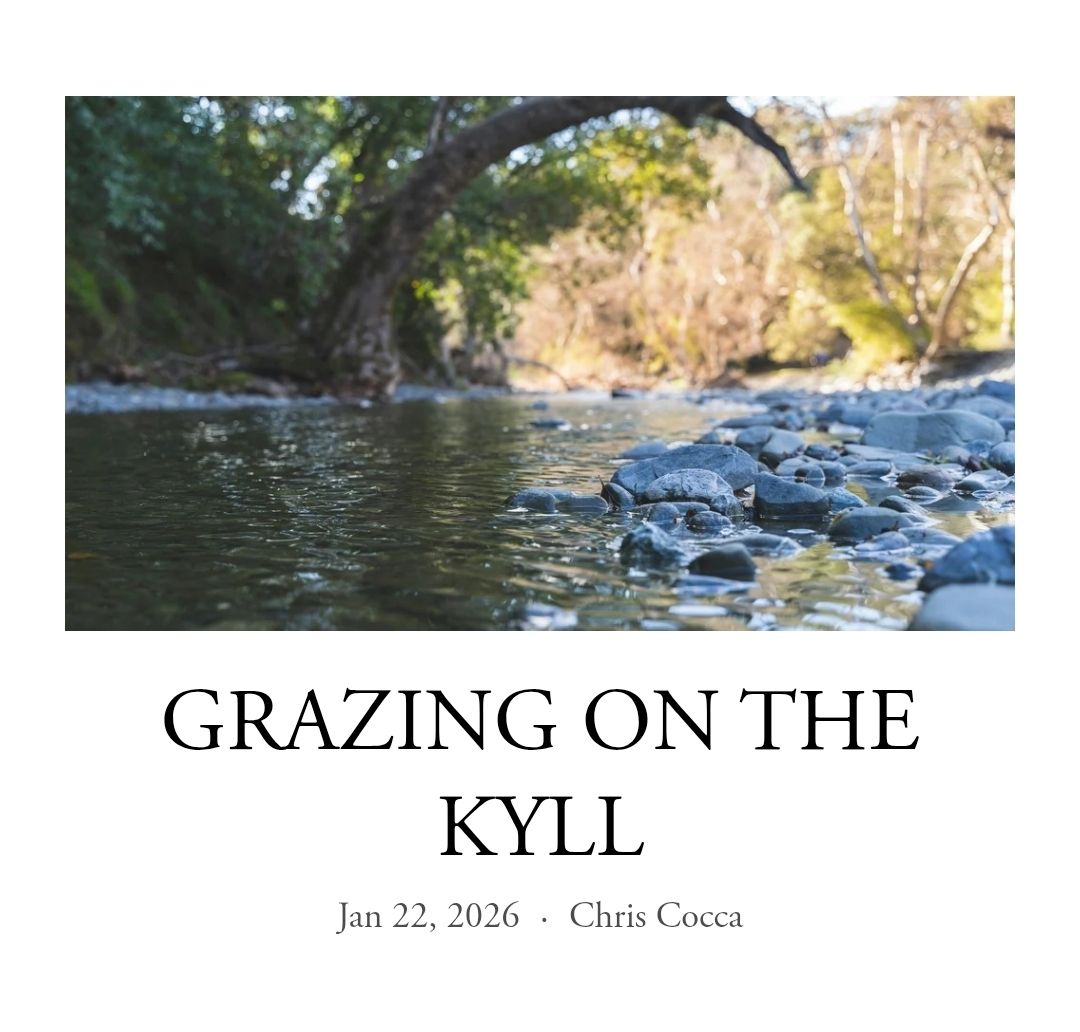
Just Published: “Grazing on the Kyll” at Earth & Altar

Many thanks to Earth & Altar and arts and culture editor Terry J. Stokes for thoughtfully engaging this piece and giving it a wonderful home.

“Grazing on the Kyll” is a sonnet in the Petrarchan or Italian model, inspired by recent reading and revisiting of formal structures. It opened up the writing of two other pieces, which I hope to place soon.

While I have never been of the opinion that there is only one way to write (and I don’t typically write formal verse), the challenge of the form was rewarding for me as a writer. I hope it will be rewarding for readers, too.

Read it here, and feel free to comment below!

The Gospel of Mark as Sudden Fiction

Sudden fiction is another term for flash fiction, but the two aren’t simply synonymous, at least not to my ear.  Don’t read too much into the title of this post.  I’m not making some argument that the Gospel of Mark ought to be thought of as fiction or non-fiction by modern definitions.  I’m talking about effect.   Where does the writer mean to take us, and why?  How do we know?

The Gospel of Mark is short, but it’s also very sudden.  Replete with “immediatelys,” the narrative is constantly moving.  Like a good short story, it feels meant to be read in one sitting.

I’ve just finished a sudden read in this manner.  My sudden thoughts follow.

In Mark, Jesus is concerned with telling anyone who will hear that the kingdom of God is at hand, the kingdom of God is here, and that this news is good.

Often, his message gains traction through healing and exorcisms (these may or may not be the same).   He is clearly opposed to entrenched religious systems and values, but not to the teachings of Israel’s prophets.  His je ne sais quoi  has precisely to do with his vision of God and God’s kingdom in the context of Rome’s empire, Herod’s puppet vassal, the Sanhedrin’s religious hegemony, the temple-merchants’ guild and the common-place fiefdom of first-century mores, beliefs, and expectations often beguiling his disciples or other parts of the general public.  Often, those outside his immediate circle understand him best.  He is arrested, tried, and crucified quickly.  He even dies quickly.  His tomb is found empty, and his followers are instructed by a heavenly presence to meet him, the Risen, in Galilee.  No big deal.  Biggest deal ever.

We shouldn’t be surprised.

Rollins, Zizek, Durruti, Tillich: Religion Deconstructed, Wisdom Demolished By Love

“History repeats itself, first as tragedy, then as farce.”  I had occasion to be reminded of that recently.  It comes from Marx and Engels, and Slavoj Zizek uses it as the title of a recent treatise.

In his affirmation of pyro-theology, Peter Rollins takes up Buenaventura Durruti’s claim that “the only church that illuminates is a burning church.”   Cross-search Durruti’s quote with Zizek and you get this, which basically encapsulates, beautifully, Rollins’ own project.  Hear Zizek:

For this reason, Christianity is anti-wisdom: wisdom tells us that our efforts are in vain, that everything ends in chaos, while Christianity madly insists on the impossible. Love, especially a Christian one, is definitely not wise. This is why Paul said: “I will destroy the wisdom of the wise” (“Sapientiam sapientum perdam,” as his saying is usually known in Latin). We should take the term “wisdom” literally here: it is wisdom (in the sense of “realistic” acceptance of the way things are) that Paul is challenging, not knowledge as such.

With regard to social order, this means that the authentic Christian tradition rejects the wisdom that the hierarchic order is our fate, that all attempts to mess with it and create another egalitarian order have to end up in destructive horror. Agape as political love means that unconditional, egalitarian love for one’s neighbour can serve as the foundation for a new order.

That Rollins takes Zizek (and Tillich) as major influences is clear, and I love the accessibility of Zizek’s piece in The New Statesman.  Rollins’ new book, The Idolatry of God, builds from ideas like these if this fantastic lecture is any indication.

This, plus mysticism is the Christian future.  I don’t see very many other ways forward, at least not very many that make sense, as Baptists say, to “us and the Holy Spirit.”

If Jonathan Fitzgerald is right that the New Sincerity is making a new, earnest morality possible, it’s also the case a that a New and Faithful Pluralism is helping more and more Christians explore themes like these, saved anew by the radical implications of a God bound by love over retributive justice.   Yes, please.
Until the Sea Shall Free Them

Reminds me of “Suzanne” by Leonard Cohen. Excerpt:

And Jesus was a sailor
When he walked upon the water
And he spent a long time watching
From his lonely wooden tower
And when he knew for certain
Only drowning men could see him
He said “All men will be sailors then
Until the sea shall free them”
But he himself was broken
Long before the sky would open
Forsaken, almost human
He sank beneath your wisdom like a stone
And you want to travel with him
And you want to travel blind
And you think maybe you’ll trust him
For he’s touched your perfect body with his mind.

Who’s Coming to Dinner?

And Jesus said “Give away your power.  Give away your wealth.  Believe in God.  Believe also in me.  Believe in people. Proclaim good news to the poor and justice to the oppressed.”   And they opened their homes to him: tax collectors, widows, men and women of little means, immigrants and foreigners and heathens. Homeless, Jesus lived and preached among them.  “Believe in people,” Jesus said, “believe in God.  Believe in me.”   Offered power, he refused it.  People sitting in high places were enraged but Jesus mounted no defense.  And he went to die without a protest, like a lamb lead to the slaughter.  And he continued to confound them.

Finding Faith and Losing Sleep

Because of important things happening where I  live, I’ve been thinking a lot about Christians who have relationships of trust with politically and economically powerful people of faith, and and how the former can best connect the later to community constituencies with far less (if any) access.  Certainly, Christians who operate across these spheres are called to be bridge-builders, but to build good bridges, I suspect we must know both shores of the chasm. It’s not enough for Christians of privilege to connect Christians of greater privilege with these constituencies by edict.  It seems to me that however well we know the rich, we’re called to know the poor better, to know the poor more.

In some senses, bridges and chasms are failures of language.   In Christ, we’re called into the bleed of Venn circles, to the realization that we’re all in this together.  Sometimes, that’s hard to remember.

This morning, I led the discussion in the Adult Education hours at church in place of the traveling John Franke.  I wanted to explore the relationships of Hebrew prophets to power and consider how best we, as Christians in Allentown called into the bleed, can be most faithful. Last night, I read this passage from Pete Rollins before bed.

Don’t read Pete Rollins before bed.   Do read Pete Rollins, though.  How does “Finding Faith” land for you?  I closed the early session by reading this story as a  devotion with this disclaimer:  “there’s no right or wrong way for it to land.  It kept me awake last night and I wanted to share it with you.”

And I want to share it with you.

http://books.google.com/books?id=osqghBtPbwAC&lpg=PA57&ots=cECBTP-miN&dq=Peter%20Rollins%20finding%20faith&pg=PA57&output=embed