Yesterday was Casimir Pulaski Day, which I know about because of the Sufjan Stevens song. Pulaski was a Polish noble and general who helped the American colonies win their independence from Great Britain by training and leading American soldiers throughout the Revolution. Pulaski died from wounds sustained during the Siege of Savannah, and is remembered today as a proto-typical Polish-American hero in many Polish-American communities. Though his holiday is mostly celebrated in Illinois, two years ago I discovered a connection between the Duke and the Lehigh Valley’s very own Bethlehem, PA.
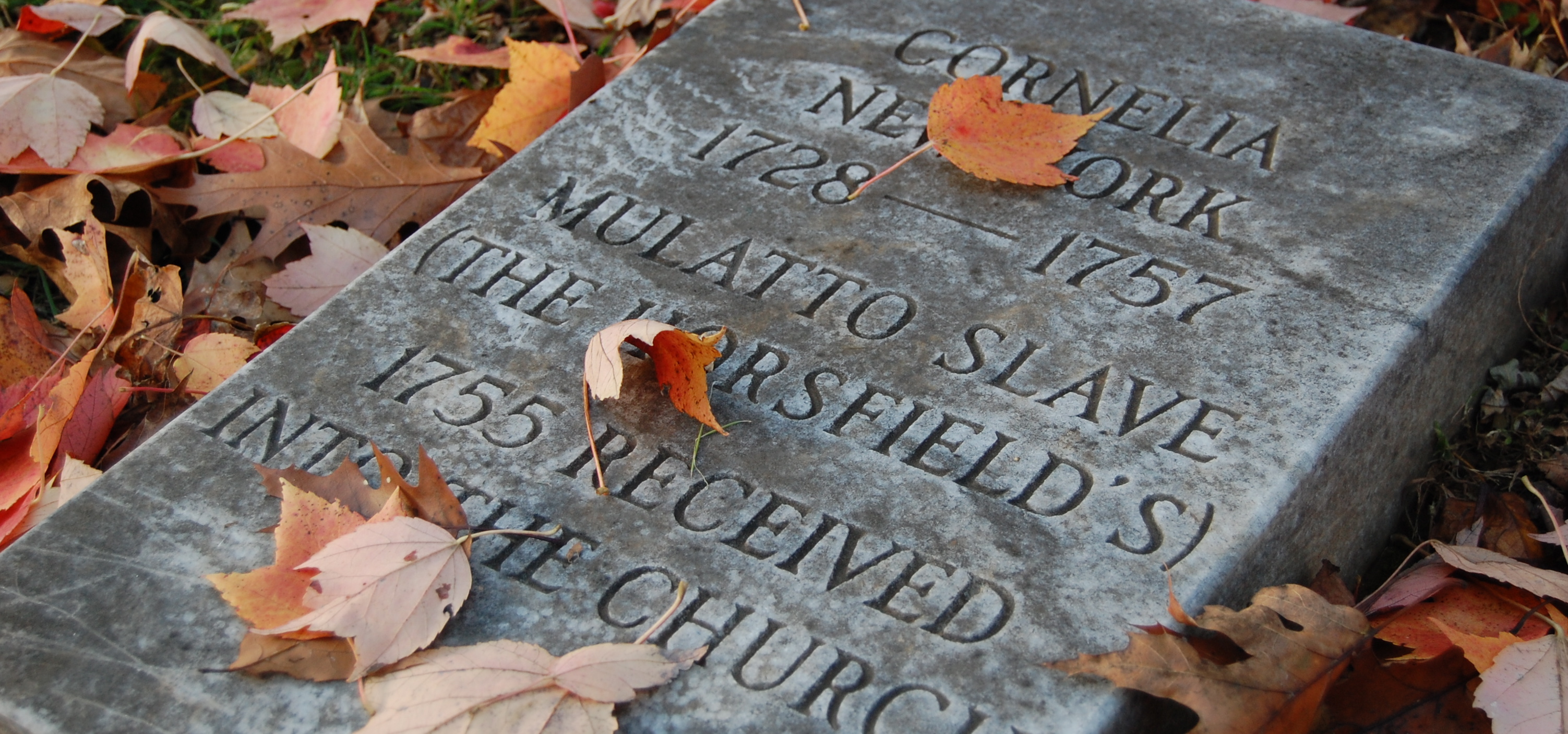
I was walking around the grounds of the old Moravian settlements in Bethlehem and come upon this grave in the historic Moravian Cemetery:
Reconciling the image of pacifist Moravians sewing banners meant for war is one thing. But Cornelia’s grave made me hot with rage and then it made me weep.
When I got home, I wrote the piece below. You need to know that Bethlehem, PA, was founded by pacifist Moravians (who were fleeing religious persecution) in 1741 and christened for its namesake on Christmas Eve.
CORNELIA
NEW YORK
1728-1757
MULATTO SLAVE
(THE HORSFIELD’S)
1755 RECEIVED INTO THE CHURCH
What scandal, these Moravians, these Peace Church nuns and friars rending martial banners? Duke Pulaski, their protector, marches to Savannah, is recalled in Illinois among the Polish and in the frontier psalter for his sword. How ancient, their Count’s mission, in its context on the Lehigh, infant, pre-incarnate by their Christmas City’s namesake — Bethlehem, Palestine?
Cornelia, theirs in life, (the Horsfields’), not her own or God’s, sewn in Pennsylvania with the city’s founding mythos. December 24, 17whatever. Theirs in death, the Horsfields, these Peace Church nuns and friars.
“Sometimes I can’t say the things I want to because it’s out of reach.
I am not able to say it, regardless of how hard I try. I stare blank
stares and feel like I have no mouth.Then the art in each of us starts
to speak through another. I hear it perfectly said and am satisfied,
relieved in a way, and when I hear it I laugh the laugh of bona fide
truth, obvious delight….It has taken me a half century to see we sing
the songs the other can’t sing – that we give each other the voice we
do not have of ourselves alone.”
I grew up reading comics in the 90s, but I tended to not be a huge fan of “huge guns and ammo packs” books. That’s nothing personal against Rob Liefeld, but Graphic Policy makes a really good point here.
Rob Liefeld went to Twitter to speak out about the recent school shooting. I guess we can ignore the drawing of Deadpool in the background shooting Skrulls and also Cable never shot a child, he just trained them to be soldiers.
Tomorrow’s scripture readings/lessons in many churches will be these, brought together by the liturgical themes of Transfiguration Sunday. I was blessed to be part of conversation this week about the need even we postmoderns have to leave spaces where we experience the holy different from how we found them. In the story of the transfiguration, Jesus’ disciples long to build booths to mark what they’d experienced, or, perhaps, to provide shelter so they might stay in the presence of the transfigured Christ forever. During Sukkot in New York, some contemporary Jewish groups build temporary booths in Union Square, and if you’re like me, you can’t come up from the steps of the subway without wanting to linger and explore them. Throughout the Hebrew Bible, the Children of Israel build altars or monuments to mark the places where they encountered God, even in the middle of rivers.
Today was Whitney Houston’s funeral. I wasn’t able to watch it, but it prompted W.W. Norton to promote this book, which looks amazing. I want to judge Norton harshly for using an oblique reference to the service to promote their wares and their brand on Twitter, but I also know that sacred fire is confounding. Was Norton taking part in the kerygma today? I can’t say, but I can say that the Holy Ghost has done stranger things, even to me.
I’ve been reading up on the fall-out over the Obama Administration’s decision not to exempt large Catholic employers (hospitals, colleges, social service agencies) from provisions in the new health care laws requiring that enterprises of their scale provide insurance that covers contraceptives.
You don’t have to agree with Humanae Vitaeto understand why the issue is important to people who believe, as a matter of religious conviction, that human life begins at fertilization. You don’t have to be a paranoid pro-lifer to connect the dots between a mandate about legal medicine (contraceptives) and a future mandate about legal practices (abortion). You don’t have to hate the President to seriously wonder when the other shoe will drop and your marquee universities and charities will be forced to fund abortions. Even if you have total antipathy for the Catholic church’s teachings or the wider pro-life movement, you can understand, if not empathize, with the anxieties and fears engulfing Catholic leaders and other pro-life people. If you are pro-life, you may or may not get involved in the debate about contraceptives, but you understand and worry about the larger implications of these mandates.
Now to lay some cards out on the table. I am pro-life, and I believe there are solid progressive arguments yet to be made for the legal protection of gestating human life. I also happen to believe that being pro-life requires a strong social witness for economic justice, racial equality, prerogatives of peace and a rejection of the death penalty. I’m not Catholic, but the seamless garment makes a lot of sense to me. Far too often, it has been ripped to shreds by leaders claiming a pro-life mantle on the issue of abortion only.
None of this means that I can muster up a cogent argument against the contraceptive mandate under current law. That’s not because I don’t cherish our religious freedom. It’s because I do, and because I recognize that the tendency we (religious and irreligious folk alike) have toward calling some things “secular” and “sacred” robs civil society of real pluralism and limits the ways we let ourselves come and reason together.
Freedom of religion is fundamentally about freedom of conscience and always has been. In our context now, it seems natural that a Catholic might appeal to freedom of religion when protesting a federal mandate about contraceptives or abortions. But what if I disagree with the ethics of abortion on purely humanist grounds? Or as a libertarian? In the popular practice of most juris prudence, I’m not protected the same way as a person claiming religious exemption. The Catholic, the humanist, and the libertarian are all appealing to freedom of conscience, but only the Catholic (or other “religious” protester) is seen as doing so from a place of perceived transcendent duty, obligation, and, yes, conscience.
Why should that be so?
Do we actually do a disservice to religious freedom when we maintain that its more precious than freedom of conscience? In the post-Enligthenment milieu of colonial America, the anti-establishment clause sought to the respect the consciences of Americans of all creeds and no creeds. But aren’t our secular values creeds unto themselves? And don’t we all, by virtue of paying taxes, fund things we otherwise oppose? Abortion and contraceptives are one example, but we all know people who believe that the mere existence of social safety nets is to blame for our rotten economy and blighted inner cities. If allowed, wouldn’t these acolytes of laissez-faire opt out of paying a certain percentage of their taxes? Of course they would. (By default, many do.)
In some instances we’ve developed models like conscientious objection. But when Carl Wilson stayed home from Vietnam, his didn’t get to say “give my taxes to anything but war.” If he’d been Amish, the question would be settled. But even Quakers, who generally oppose all war on religious grounds, fund those wars with their taxes, at least for now. Here libertarian arguments for as few taxes and as few programs as possible start to sound appealing. But if we extend the freedom of conscious logic from taxes to practice, we’d have to allow institutional racism if we’re aiming to be consistent. For a racist, freedom of conscience means that the government can’t prosecute racist employers for racist hiring practices. Abortion and war are life and death issues, to be sure, but so is prejudice.
So maybe consistency isn’t the answer. Maybe we’re looking for rational ways to serve two jealous masters: the free consciences of our people and the moral ends (again, as perceived by someone) of government. Note that even in the framing of the Bill of Rights, freedom of conscience is not given to those who would seek to establish a state religion or deny public assembly or prosecute peaceful protests and dissent. We’ve made value judgements from the beginning, and we always will.
I am pro-life, but that’s not the reason I think the White House will have to compromise on the value judgement they’ve made here. I think the federal mandate undermines the administration’s case precisely because it’s federal and precising because it’s binding without exception . Unlike similar laws in many states, there’s no way of opting out of the federal mandate that healthcare be provided by these large employers, so Catholic universities and hospitals 1) must provide healthcare and 2) cannot limit what healthcare their funds cover based on religious objection. Going into the Patient Protection and Affordable Care Act (Obamacare), “mandate” was the bogey-word, and now we’re seeing why. But there’s no real precedent for conscientious objection to this kind of law, partly because this kind of law hadn’t ever been passed at the federal level, and partly because we simply don’t allow most folks to opt out of these things over matters of conscience. But, amazingly, we make exceptions for religion, and because of that, religion suffers.
As much as I would love to push the line, in some ways, that religious freedom really is fundamentally different that freedom of conscience, I know that doing so actually makes all thoughtful freedom weaker in the end because it denies the truth that even atheists or scientific materialists imbue their Weltanschauung of choice with a transcendence they don’t talk about at cocktail parties. The framers of the Constitution knew this, even as they enshrined their own sense of universal Good into our founding. And without that liberal DNA, what? Monarchy? Tyranny? Our system is far from perfect and often far from fair. But we are challenged with the task of working these things out.
I’m inclined to say we’re left having to admit that freedom of conscience isn’t absolute, even in America, and never, ever has been. We know this in our gut, which is why people say “this is a freedom of religion issue” as if freedom of religion is somehow different from freedom of conscience. It’s why the Amish live in their separate peace, while other people of faith find ourselves in the sublime tension of Christ’s call to be in the world but just not of it. We are to render unto Caesar what is Caesar’s and trust God to work things out. But Jesus also calls us salt and light, and our public witness for the poor, the marginalized, the least powerful of these is a public duty of Christian faith. We rightly call companies with unjust working conditions and other harmful practices to task, and we rightly manifest a prophetic witness to the government. But in the end, if the tax is passed, we pay it. If the law is passed, we follow. But as much as we love law and order, Americans were born to throw off these kind of yokes. And so we work things out, and it takes time, and we screw up. And we thank God for the grace that covers our poor judgement, our ignorance and arrogance, our well-intentioned mistakes and ill-gained, ill-spent treasure.


 Chris Cocca