Evensong

Another early piece. This was published at elimae when Cooper Renner was the editor. It was a very good journal. This story is 100 words long.

Evensong

Thaddeus, age 3, set the Evensong in shallow water. Small waves rose and fell, and, retreating, carried Thad’s small ship further from the shore. Squealing and on pigeon toes Thaddeus retrieved it, and, safely back, he cast the tiny schooner headlong into the sea. His father’s strides were long and easy and for a moment Thad was sorry for the rival ocean and the fight he’d picked. His father bent low and pressed Thad to his chest and from tall grass on the bluffs above, they watched a red sun sink behind the green and Thad said, “Bring it back.”

The Doogie Howser Portion of the Evening

Doogie Howser was the first person I ever saw use a computer as a journal. Ricky from Silver Spoons was the first person I ever saw IMing with his crush.

Gains today: Quite a few words written. A few stories read.

I reread “A Clean, Well-Lighted Place” for the first time in many, many years. I must have been very young the last time, because I don’t remember it being so short. I also read “A Day’s Wait,” which, I mean, isn’t very good. You have to really be into the code hero and all of that to delve into the scholarship, and I’m just not that interested. I’m too old for that side of Hemingway, at least right now. I also read “The Killers,” and have decided that “Fifty Grand” is much better. Though I do like the sparse description of the lunch counter.

I also learned that George Saunders was a young Objectivist, which reminds me very much of Andrew Sullivan’s explanation of his youthful Thatcherism. I can relate to both of these experiences. I got into Rand because of a girl. There were weird tracts in the Rand books at the public library, and that could probably make for a decent story. Not right now, though.

I did get some good words down and out. But they were divided between two stories, and none went toward the story I planned on adding to today. So I feel a little scattered, but that’s okay, because the ideas are really coming. Depending on who you listen to, control is a myth or a must. The more you sort of whittle down, the more you tend to know which claim is most helpful in the moment.

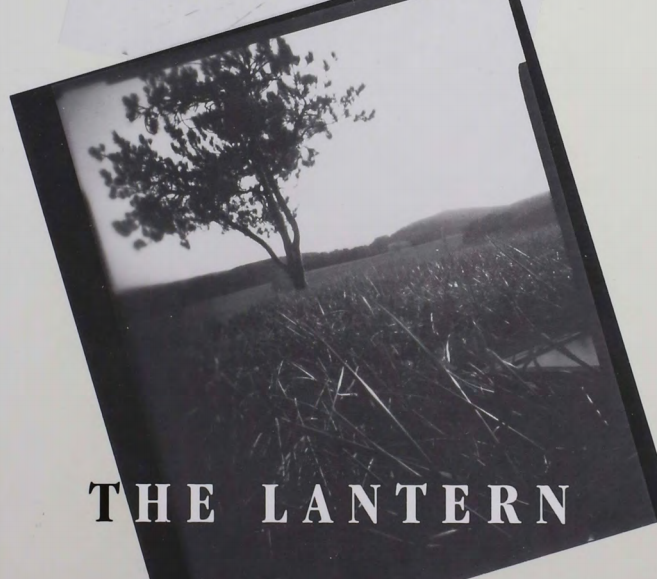
The Ursinus College Lantern, Fall, 1998

Earlier today, I shared a piece that I said was the first thing I had published in a print journal.

Later, I was working on a story partly set at a sort of proxy for my undergraduate alma mater.

When I came to campus in 1998, the website was in very basic html, and the college email ran on DOS (I think. It was text-based at any rate). 21 years later, there’s a fairly robust digital history of all kinds of things Ursinus.

I went down the rabbit hole.

Regarding the venue from this morning, what I should have said was it the first print journal run by people I didn’t know or go to school with to publish my creative work.

Of course, I hadn’t forgotten about the Lantern. Of course it was the first print journal to ever publish my creative work. (Alright, here again I’m wrong. In sixth grade, I was co-founder, co-editor, co-publisher, and staff writer for zine called ZAP! In middle school, we briefly considered relaunching as The Jolly Rancher, but it wasn’t meant to be.)

The Lantern piece, which you can find here, was written a few years before I got to Ursinus. I was about 16, broken-hearted, and listening to a shit-ton of Beck. That it was published alongside things written by 22-year-olds, and that it won the yearly prize for creative writing, has always meant a lot to me.

I Love You When You’re Pretty

This piece was published maybe 10 years ago at a venue that no longer exists. When I first started publishing short fiction, there were many new, experimental web journals. Many of them were very good. Many good ones still exist, but many are, as David Thomas might say, now ghost-towns.

This piece also appeared in the first edition of my chapbook, What Other People Heard When I Taught Myself to Speak. That manuscript is going through some new revisions with a second edition coming sometime in the spring.

I Love You When You’re Pretty

When you said hi, I didn’t see you in her fitted polka dots and your hair like a USO girl and your legs in heels. Everyone is beautiful in your grandma’s pictures but we dress with conscience now, buffing out your curves or the square cut of my shoulders with fair-trade cotton. What right do you have, anyway, in eye shadow and stockings, wearing lipstick I can only see close? What right do I have, now, to closeness, to feel like cigarettes won’t kill me and sex is not transaction? What right to be pretty? And to love you when you are?

The Crying of Lot 49 (No Post on Sundays)

Right you are, Harry!

As you may know (I pretend there are people following along), I have been reading The Crying of Lot 49. The post horn is a central image. Yesterday, I reported back that an extraterrestrial encounter with Billy Joel has made me question what Pynchon makes of the modern world. So much terrible, lying media (the muting of truth), and so much inconsequential media (the scholarly paper from 1975 I linked to is one example, this blog itself is another).

Entropy and synchronicity are central to the novel. The abstract to this piece on JStor suggests that Pynchon’s obsession (speaking of Synchronicity) with punning shows that Lot advances language as the only possible perpetual motion machine. Puns are necessarily synchronistic, and they generate all kinds of permutations without requiring more input:

Thomas Pynchon offers, in “The Crying of Lot 49” (1966) and other novels [Gravity’s Rainbow (1973), “Mason and Dixon” (1997)], the pun as an energy-generating alternative to entropy in its ability to multiply meanings, to proliferate “output” from a single source, a word, or an image. In Pynchon’s usage, the pun, even more than Maxwell’s Demon, defies the second law of thermodynamics: it actually creates energy, causing a word to do the work of several with minimal effort. A look into Pynchon’s Puritan past sounds the historical possibilities ofLot 49, suggesting that Pynchon’s puns reinscribe the sacred into the secular world, visiting a supernatural effect upon the world of physical laws to defy those laws and to create life out of the void.

I’d say that this whole enterprise requires more than minimal effort. Yes, these three posts have all come from variations on the words post and horn, but, inconsequential as they are, writing them was only possible because of my undergraduate studies, two advanced degrees (divinity, creative writing) and an obsessive, life-long romance with popular music. I mean, just because the inputs aren’t new doesn’t mean a hell of a lot (there, again, a pun) didn’t go into their acquisition.

Then again, if the point is that once you have acquired the needed inputs of language and culture, you can propagate a hell of a lot without going back to the well, then maybe. But Chapter 5 was a lot of work. A lot of new work. The reading itself, I mean.

I’m also reading Humboldt’s Gift by Saul Bellow. I understand most of Humboldt’s increasingly pedantic obsessions, and relate to them, only because I’ve been educated in an adjacent world. And look, to extend the Lot image, I’m not trying to toot my own horn (no post on Sundays). I’m able to do what I do because of a long story of generational struggle and sacrifice.

But what do I do? What are any of us doing? I said these posts are inconsequential, and they are. How many tens of thousands (Saul has thousands, David his tens of thousands) of people are on these delivery systems, heavily educated, desperately trying to unmute? We think blogs and tweets give us a voice, but they don’t. Not really. What’s the sound of one hand clapping? Of a tree falling in an empty wood? Put your ear next to your keyboard and you’ll know.

But still, we can’t just do nothing. Doing nothing just won’t do. There is too damn much invested in all of this. There is too much invested in you. There are too many miracles, too many traumas, too many things have gone into the making of you to do nothing. One option is interpretation, putting some kind of frame to the collision of worlds (remembering that a pun is a collision of words, expectations). As we learn in Chapter 5:

“You know what a miracle is. Not what Bakunin said. But another world’s intrusion into this one. Most of the time we coexist peacefully, but when we do touch there’s cataclysm.

In other words, behold the hurricane and try to find meaning in its wake.

I wrote this on Saturday but scheduled it for Sunday, mostly because I posted once already on Saturday, but also because I wanted to make a Harry Potter joke. People like wizards because we all want to believe that if we get the words right, something will happen.

This being Sunday, we could talk about Pynchon’s religious imagery, and, again, about the collision of worlds and words. We could talk about our writerly catechisms, our largely muted efforts at mediating the process of flesh becoming word. We could talk about the irony of voice-to-text, of “ones and zeros, twinned” and so on. It’s all there in Pynchon, in Milton, etc.

There, for now, you have it.

In Dreams (The Crying of Lot 49)

I’ve been looking forward to finishing The Crying of Lot 49.

I’m not someone who cares very much about being hooked by intriguing plots. One of my favorite books, The Sun Also Rises, is mostly about people going to cafes.

The Crying of Lot 49 spends four chapters piquing my interest in a potentially sensational plot, but chapter 5 is a slog. Shame on me.

The chapter is partly a dream sequence, but it gets to be too much. I start suspecting that I’m about to be had, and that this plot, now that it’s something I care about, is not going to pay off. You’ve got me very, very interested in the promise of some centuries-spanning conspiracy about who controls the mail (of all things), and then you grind things to a halt by building deftly crafted nods on looping city bus routes into something so off-puttingly ponderous that I wonder if I’ve just finished the book 50 pages before it’s over because, I mean, come on.

But the effect is brilliant in a very precise way. See, the first four chapters of the book are quick. They’re not quick in the sense of slight or spurious, but what I mean is that they move. Chapter 5 does not. It slows everything down. It distorts time. It’s a morass that takes far too long to get through. It’s an incredible trick, and I’m certain it’s intentional. It’s very much like sleeping and very much like dreaming. It’s a slog, and it’s too much, but it’s annoyingly well-done.

Something I’ll take with me from this particular dream is the idea that miracles are the intrusion of one world into another:

“You know what a miracle is. Not what Bakunin said. But another world’s intrusion into this one. Most of the time we coexist peacefully, but when we do touch there’s cataclysm.

This is Milton. This is the Gospels of Mark and John. This is true.

Milton’s Nativity Ode is all about the intrusion of heaven into history and the breaking of temporal strictures and the fleeing of the idols in the presence of eternity. John talks about the Word becoming flesh. For Mark, everything is immediate, everything has equal weight (the weight of exceeding urgency), and everything is coming and everything is here.

Speaking of miracles. Roy Orbison:

(A follow-up post…post!…here).