Ed Koch and the Afterlife of FDR

Edward I. Koch, mayor of New York City, sports...
not a recent photo.

Christopher Cocca

Ed Koch has a very interesting piece up on RealClearPolitics.  I’m not going to get into the Israel-Palestine debate in this post, but I did want to point out Koch’s religious eclecticism on matters of the hereafter.  I’m not in the business of opining on the eternal fate of people, but I do sympathize with the religious and legislative impulse behind Koch’s placement of FDR in the not-quite-sweet by and by.  Certainly, it feels icky when civic leaders speculate about these kinds of things.  On the other hand, like the Sinead O’Connor piece I posted yesterday, Koch’s essay captures a public figure in raw struggles around faith, life, death, justice, and forgiveness.  You need to know, before reading the excerpt below, that Koch has just described newly-found evidence of FDR’s less than progressive attitude toward the fate of Jewish professionals living in a newly liberated North Africa following World War II.  I’ll also mention that I remember learning about FDR’s rather crass sentiments toward the Jewish members of his own administration in high school.  Yes, I went to high school in the 90’s, but I doubt this was a case of revisionism.  On to Koch:

I appreciate FDR’s contributions to the survival of our country. At the same time, I have never forgiven him for his refusal to grant haven to the 937 Jewish passengers on the SS St. Louis, who after fleeing Nazi Germany had been turned away from Cuba and hovered off the coast of Florida. The passengers were returned to Europe, and many were ultimately murdered in the Nazi concentration camps before World War II ended. I have said that I believe he is not in heaven, but in purgatory, being punished for his abandonment of the Jews. The concept of purgatory is Catholic. I am a secular Jew, but I am a believer in God and the hereafter, and I like this Catholic concept. The Casablanca document reinforces my conviction that President Roosevelt was, at heart, not particularly sympathetic to the plight of the Jews.

I’m not sharing this piece to stir up a big debate about FDR’s eternal reward.  But I am very interested in and sympathetic to the way Koch rather nonchalantly identifies himself religiously in the excerpt above. “The concept of purgatory is Catholic.  I am a secular Jew, but I am a believer in God and the hereafter, and I like this Catholic concept.”  Period.  I don’t relish the thought of anyone being stuck in purgatory, but I love Koch’s honesty about spiritual beliefs he has chosen, some informed, indelibly, by his inherited Jewishness, others by the pluralistic settings of successive communities and constituencies.

Here and there, I’ve described myself as an eclectic or even provisional Christian.  Even though I am a protestant, traditions from across the wider Christian experience appeal to me in various ways, as does a whole lot of secular philosophy.  This sort of up-front religious navigation strikes me as honest and compelling in ways that weren’t readily accessible to the pilgrims of other eras.
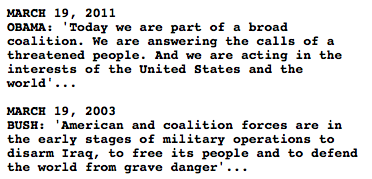
 

Libya, Afghanistan, Iraq; Qoheleth, Pacifism, Action.

Look, I don’t think Iraq and Libya are the same situation or have identical sets of circumstances.  I do think that the only legal rationale for either action is the pretty standard assumption that once your regime starts killing civilians, your regime loses the sheen and protection of an observed sovereignty among the nations.  It’s the closest thing to international common law we have.

Related:  Does it feel to anyone else like as soon as President Obama took office the media stopped reporting very much about Iraq?  Everyone keeps saying Afghanistan has become Obama’s war, but you just don’t hear very much about Iraq, or about protests and calls to hasten the official end of our presence there.  You hear bits and pieces, you hear reports, but it’s not like it was.  I don’t have anything else to say about that, really.

In my heart, I feel like striking military targets in Libya to impede government forces from killing people is a good thing, but let’s not forget that the Libyan resistance is not unarmed.  They’re underarmed, to be sure (there’s no Bill of Rights in Libya), and yes, the government fired first.  The sham regime lost any lingering claim to sovereignty it had that day, which was weeks ago.  It’s simply just the case today that in attacking Libya now, we’re not only protecting peaceful protesters. We’re also aiding an armed resistance.  The armed resistance is acting in response to its unjust treatment by the regime in the only way that makes any rational sense.

I know a lot of people who believe in total pacifism.  People who believe that nations and oppressed groups can collectively turn the other cheek when their civil disobedience is met with murder as a matter of national political policy.  Most of these people are Americans who will never really have to worry about choosing between ideology/Anabaptist piety and protecting their families from agents of the government.  Some of these people tell me that the cross is God’s sign that violence is not overcome by violence, and most (not all) of these people live in relative safety. At any rate, we Americans, we French, we British, most of us, anyway, have the absolute privilege of being morally and spiritually vexed.  People living through it need to do just that, and they need our prayers, our support, our solidarity.  Figure out what that means for you.  Then do it.

Some Political Sequiturs: Your Extreme Pocket Guide To Political Philosophy

Aristotle Ethica Nicomachea page 1
Aristotle dedicated his most important ethical treatise to his son.
None of the following thoughts originated with me.  I’m just helping curate.
  • Fiscal responsibility is a progressive position.
  • Conservative, liberal, progressive, radical…these are labels powerful people use to keep people with most interests in common apart.  In reality, most voters have no interest in this kind of politics, no use for these kind of names, no time for these games, waning patience for these kind of political “ethics.”
  • Members of the middle class tend to identify with the upper class because they see upward mobility as reachable and good.  That’s fine, except when it keeps us from also identifying with the economic underclass from which most of us came, part of which most of us could still easily be, and to which we have human, civic, moral and spiritual responsibilities, as they have also to us.  As we all have to each other.
  • Prudence is not a reactionary or cautious position.  It’s knowing the good and know how to bring it about and then doing it. (Aristotle)
  • We have more similarities than differences.
  • Citizens of different nations have more in common with each other than they do with their own ruling classes.
  • Information wants to be free, and so do people.
  • We hold these truths to be self-evident, that all men are created equal, that they are endowed by their Creator with certain unalienable Rights, that among these are Life, Liberty and the pursuit of Happiness. — That to secure these rights, Governments are instituted among Men, deriving their just powers from the consent of the governed….

The End of the Cold War as Summated by “Brands of the World”

When deep space exploration ramps up, it’ll be the corporations that name everything: the IBM Stellar Sphere, the Microsoft Galaxy, Planet Starbucks. – Fight Club

We all know that companies (and specifically, the economic polices set forth by mercantilism) played a huge part in the founding of European America.  It’s probably safe to assume with The Narrator that when they run out of stadiums, giant companies will, indeed, have a hand in naming the stars in the next push of industrial expansion.  Behold, friends, The Facebook Nebula.

There’s a reason “branding” has become such a ubiquitous noun-verb in recent years, and it’s obviously tied to our increasing consumption of dynamic visual media.  In a nifty meta-critical move, sites like Brand New and Brands of the World help we consumerist natives remember our lives in corporate logos even as they help curate (you knew it was coming) good and bad design features from which emerging and veteran creatives can draw inspiration or caution.

I’m working on a new infographic for the blog that I hope to put up later today.  During my research, I was struck by the succinct political history implicit in what’s going on here:

Put your shoe on, Nikita.


Considered in light of the grist-milling  Soviet system, “designer: unknown” and “contributor: unknown” become rather chilling political statements.  “Status: Obsolete” heralds the world we still live in:  Soviet weapons and technology still unaccounted for, Soviet scientists still off the grid, regional economies still shaky, but also millions and millions of people more free; in some places, truly, in others by comparison and in degree.  Imperfect, even dangerous as all of this is, we’re reminded again and again that people cognizant of their dignity as human beings will rise to demand that dignity recognized, that sovereignty civilly reckoned with if not yet fully honored.

The CCCP’s obsolescence was as far from inevitable as is the rise of true freedom in Russia even now.  Consider all that remains to be seen as revolution moves through North Africa and possibly beyond.  We have seen freedom ramp up, and if and when it coalesces into free societies and governments, it will be the people that name everything: Free Egypt, Free Tunisia, Free Libya.  Free Iran. What might these emerging societies teach us about our own bondage to the Dutch West India Companies of our day, and to entrenched political attitudes that keep us from the business of prudent, engaged, informed civil life? Might this be the end of the world as we know it?  Let’s hope.


Martian Starbucks by firexbrat via Flickr.