Jay Trucker: Axl Rose, Marketing Genius

Axl Rose toy
Where's your shady-looking likness, Mr. Hudson? It's not a doll! It's an AXTION FIGURE!

Because you demanded it, and because he can deconstruct the the dystopian visions of George Orwell with one half of of his hefty brain and Sheryl Crow with the other, The Daily Cocca is proud to present a new guest post from our good friend, Jay “Mr. Thursday Morning” Trucker!  When not singing Journey songs in biker bars, Jay teaches, writes, and composes hilarious Facebook update statuses as if twitter never happened.  Please do join me in welcoming him back the program. -Ed.

Axl Rose, Marketing Genius
by Jay Trucker, The Daily Cocca

In 1994, Aerosmith and Guns N’ Roses were in the latter stages of their relevance.  G N’ R were still releasing videos from the Illusions albums and putting out a record of covers, and Aerosmith continued their late 80s renaissance into a second decade with 7x platinum Get A Grip. Meanwhile, I was a young lad still anxiously awaiting the growth spurt that would forever prove  elusive.   It wasn’t exactly cool to love these unabashed rock stars while my fellow fourteen-year-olds were mourning the death of Kurt Cobain and pondering the fate of his mopey peers like Eddie Vedder, but I was steadfast.

Here is an exhaustive list of things I was sure of in 1994:

I would never understand women
I would always love Guns ‘n’ Roses
I would always love Aerosmith.

Two out of three ain’t bad, kid.  You see, while Aerosmith may have had a more productive couple of decades (if  we take the word “productive”  to refer to an organism, institution, or collective that produces things),  Axl’s sociopathic and often bizarrely reclusive behavior has allowed the Guns name to age in a much more respectable way than has brand Aerosmith.

For the unitiated, here is a brief timeline for the original lineups of both  bands since ’94:

Guns N’ Roses Aerosmith
1994: Release “Sympathy for the Devil” single; Slash calls this “the sound of a band breaking up” 1994: Release greatest hits album Big Ones, make boatloads of cash
1996: Break up 1997: Release Nine Lives, which includes lame double entrende single “Pink”
1998: Release “Don’t Wanna Miss A Thing” on Armageddon soundtrack [rock credibility exits stage left]
2001: Perform at Superbowl XXXV with Britney Spears, N’Sync
2001: Release Just Push Play, world shrugs
2002: Release Oh, Yeah, greatest hits double disc, make boatloads of cash
2004: Release blues cover album Honkin’ On  Bobo. Global reaction: “eh”
2006: Release aptly titled greatest hits album Devil’s Got a New Disguise, make boatloads of cash
2010: Egyptian President Mubarak: “I will step down if Aerosmith threatens to release another album”

While Aerosmith has toured nearly every year during the last fifteen years, Axl’s bizarro Guns has only executed a single successful tour of the U.S., in 2006.  While touring, Aerosmith has enthusiastically shilled for the latest repackaging of their greatest hits album.  As the above list indicates, Aerosmith has released more greatest hits records than records of new material during this period, which is probably at least in part due to their recognizing that no one needs to hear a new Glenn Ballard-written Aerosmith record.  Unfortunately, as the recent regime change in Egypt would indicate, Aerosmith is, in fact, planning to release their first record of new material in a decade sometime this year.
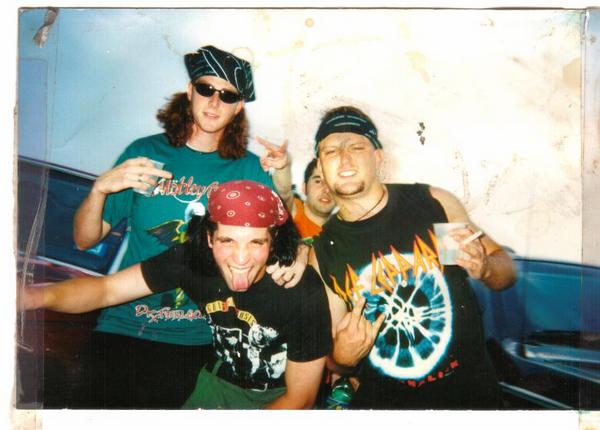
Later, Jay would wonder if the relationship between his love of G N' R and his inablity to understand women wasn't, in fact, causual.

Meanwhile, when he wasn’t standing on the roof of his mansion with a hose fighting off California wild fires (http://www.roadrunnerrecords.com/blabbermouth.net/news.aspx?mode=Article&newsitemID=85524), Axl was suing his own record company to keep them from releasing Guns N’ Roses’ Greatest Hits (http://www.tfproject.org/tfp/tilted-music/49290-geffen-records-prevails-over-axl-rose-lawsuit.html). In a a 2004 statement that can only be described as equal parts gutsy and insane, Rose claimed that the Guns N’ Roses Greatest Hits release would take attention away from Chinese Democracy.

Chinese Democracy was released four and a half years after the suit.

Eddie Vedder plays a solo acoustic set followi...
Who ever thought Eddie Vedder would grow up to be Jeff Bridges? Talk about a late bloomer. By the transivite property of Lebowski couture, you're still totally rad, Edward.

Herein lies the Genius of W. Axl Rose, nonmusical edition.  Guns N’ Roses is not one of those punk rock bands destined to keep the same sound and tour every couple of years with only their graying hairs and protruding stomachs demarcating the passage of time.  I mean, they’re not the Circle Jerks.  They’re freaking Guns N’ Roses.  They were making videos with dolphins and supermodels set to soaring piano arrangments while the “cool” thing to do was stare at your shoes while whispering verses and shouting choruses.

G N’ R comes from the “bigger is better” rock ideal, not the punk/grunge “less is more” aesthetic.  In this way, they are a lot like Aerosmith.   Thus, had they remained in the spotlight, they could have easily traded on their hard rock past, put out a few radio friendly shmaltz ballads, retooled a greatest hits package every few years, and made oodles of cash with deteriorating performances at amphitheaters and arenas year-round. In other words, they could have become Aerosmith or, even worse, Motley Crue.

TV Guide #2318 (Cover Variation)
yes, Jay. But you're forgetting that after G N' R broke up, Slash actually ended up with the Steelers for a time via the contraction draft of '96.

In fact, in the hands of lesser, more  top-hatted hands, Guns would have no doubt become the same self-parodying pantomime of themselves that Aerosmith and the Crue are today.  Slash has sold his likeness to so many lame-rod pop musicians and video games, even he can’t keep count.  But when he gutted the last bits of his reputation on stage with the Black Eyed Peas this year, I couldn’t help but think back to Aerosmith’s nauseating 2001 Super Bowl performance, when they shared the stage with rock ‘n’ roll titans Britney Spears and N ‘Sync.

As Slash tried desperately to strike a cool rock pose next to an awkwardly gyrating Fergie, I thought to myself, that could have been all of G N’ R up there wearing Light Bright outfits and standing next to will.i.am, Fergie, and the other two dudes.

That could have been Axl, Duff, and company singing a country song  to one of their re-claimed daughters on the soundtrack to one of the worst Ben Affleck moves of all time.

That could have been G N’ R singing goofball pop songs about women’s private parts.

That could have been Axl judging sixteen-year-old singers on a past-its-prime TV karaoke contest.

But for the grace of God.

Instead, Axl, who long ago bought out the Guns name, has guarded it like a rich guy guarding his mansion from a forest fire.  The musicians he has chosen to work with recently have names like Buckethead and Bumblefoot.  They may play the same songs as classic Guns, but no one will mistake them for Slash and Duff clones.  And with the exception of a 2002 VMA gaffe, in which a bloaty Axl huffed around Radio City while a giddy Jimmy Fallon and the world gasped in horror, Axl has avoided the spotlight like the plague.  When he finally put out Chinese Democracy after a seventeen year wait, Axl unilaterally decided his record company wasn’t supporting the album enough.  He has subsequently avoided all efforts to promote it himself, including all state-side interview requests and tours.  Does that suck for fans? Maybe, but what hurts more, the lack of Axl or the embarrassing omnipresence of Steve Tyler and Slash?

In keeping his and the band’s profile low key and touring only very sporadically with a cast of characters who look like aliens, Axl has accomplished what only former nemesis Kurt Cobain has similarly been able to achieve  When most people think of G N’ R today, they think of G N’ R no later than 1994.  Axl has divorced himself and his band from Slash, who defaces only himself when he parades around picking up contract work like a poor guy in a Slash costume.  Today’s Guns are something different.  They are a protooled, faceless entity with an enigmatic lead singer.  G N’ R today are to classic G N’ R what the Foo Fighters are to Nirvana. They sprung from Guns N’ Roses, but they cannot damage the iconic stature of classic Guns any more than a Foo Fighters record can hurt the lasting reputation of Nirvana.

And Axl didn’t even have to die to keep his reputation in tact.

Postscript:  I thought this blog fitting for my esteemed former co-dj’s domain because of our shared love of all things Axl.  I wouldn’t defend his choice in Long Island-bred, Lehigh Valley-loving rock pianists with the same fervor.

Also, in 2001, I wrote an essay about Axl Rose, The American Icon, for my ENGL 200 Advanced Expository Writing class.  It was, admittedly, not my best work.  So if you’re out there, Prof. Martinez, I would like to resubmit my essay. Sorry it’s 10 years late.

Jay Trucker teaches writing at the Community College of Baltimore County and studies Sociology and Education at the University of Maryland Baltimore County.  He occasionally writes about the Baltimore Orioles for WNST.net and nightlife for the Baltimore Sun blogs.

Saying Goodbye to America’s Showplace

Well they blew up the Chicken Man in Philly last night
you know they blew up his house, too.
-Bruce Springsteen

I hate seeing things I loved as a kid get torn down or paved over.  Green space in Lehigh and Montgomery Counties, PA, for example.  The cornfields behind my old neighborhood mowed down for overvalued McMansions that block the fireworks from three cities on the 4th of July.  More recently, Veteran’s Stadium.  Now, finally, the Spectrum.

America's Showplace

You might not know this, but the Spectrum invented the concept of arena as rock show apogee.  Without it, Bruce Springsteen would, quite literally, not have been possible.  Opened in 1967, the Spectrum was the first of its kind, “America’s Showplace.”  The Sixers and Flyers won championships there.  I saw Dr. J play there, and Charles Barkley.  I held a Hulk Rules sign and swore the Red and Yellow pointed right at me from the ring in post-win celebration.  I saw Shawn Michaels roll Marty Janetty over while the seeds of their inevitable feud were being sewn.

Bruce Springsteen and hundreds (thousands?) of others got their first big-venue gigs at the Spectrum, due in part to Philadelphia’s legendary support of rock radio and working-class talent.  Sure, there were old-time concert halls and places like Madison Square Garden, but the Spectrum was the first indoor sports facility to have been specifically built with popular music shows also in mind. It was the first premier arena of the rock era.  As such, it was the place to be seen and heard, and like Esther Smith would say, it was right here in my own back yard.

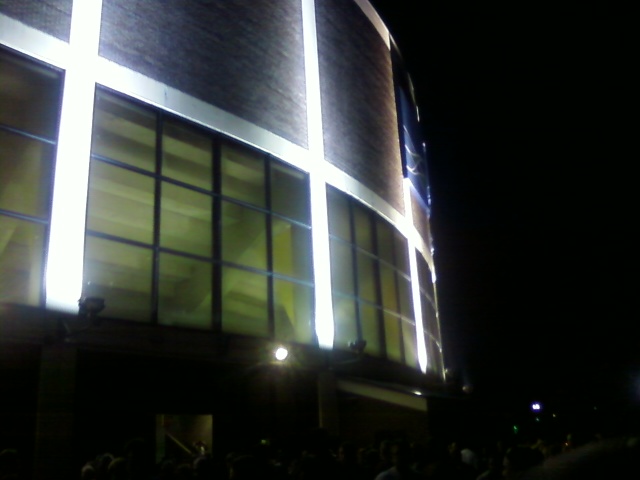
Last night, they finished tearing the last old concrete guts and bones from this historic place.  On October 20, 2009, I was lucky enough to be on hand for Bruce Springsteen & The E-Street Band’s last-ever Spectrum show.  In case you don’t know, Bruce is a Philly favorite, an adopted son from just across the river, and he and Billy Joel had their own banners in the rafters of the Spectrum for their record-setting streaks of consecutive sellout shows (still counting.  The banners have been in the CoreState/First Union/Wachovia/Wells-Fargo Center for years, but Bruce’s was moved back for his last stand at the Showplace.)

The 10/20 show was historic by default: the last rock arena, the last rock star, the last time in Philly.  The last time in the place where modern concert-going and giving started, the last time in the place where The Boss cut his teeth.  Sitting in the Spectrum, you’re right down the street from all other kinds of American history.  Throw in the themes of the Born In The USA album, which was played in its entirety, and you’ve got yourself a certain kind of seminar.  In the context of the financial crisis, the wars, the Revolution, the loss of dear things, the loss of dear people, the loss of whole places, it was powerful to feel so obviously American and so absolutely not ironic.  When the band opened with “The Price You Pay,” which they hadn’t been played live since 1981, the tone was set:  recognition, celebration, sincerity, thanks.  “Wrecking Ball,” a paean to the lost shrines of our youth, was exuberant even in its decidedly antifatalist fatalism:

Now when all this steel and these stories, they drift away to rust
And all our youth and beauty, it’s been given to the dust
And your game has been decided, and you’re burning the clock down
And all our little victories and glories, have turned into parking lots
When your best hopes and desires, are scattered through the wind
And hard times come, hard times go
Hard times come, hard times go
And hard times come, hard times go
Hard times come, hard times go
Yeah just to come again

Bring on your wrecking ball
Come on and take your best shot, let me see what you’ve got
Bring on your wrecking ball
Bring on your wrecking ball (bring on your wrecking ball)
Take your best shot, let me see what you’ve got, bring on your wrecking ball

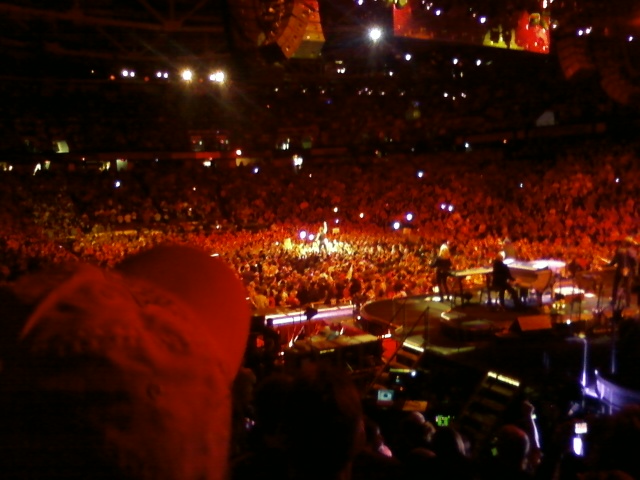
The view form our seats.

That this set would be a once-in-a-lifetime rock and roll moment was never really a question, but there are all kinds of emotional intangibles going on in settings like this.  It wasn’t just Bruce’s last show at the Spectrum.  It wasn’t just the last time the Spectrum would welcome Bruce or any of us home.  It wasn’t just Clarence Clemmons’ last time ever in Philly as part of E-Street (be healthy, Big Man), and it wasn’t just the ghosts of 42 years piled to the ceiling.  It was all of these things, but also the kind of joy that comes from impossible defiance and being in the company of thousands of strangers celebrating something immediately collective. That E-Street, the tightest band to ever grace the Earth, and Bruce, the greatest figure not named Elvis, were the evening’s spiritual directors meant the farewell ritual would be orchestrated perfectly.  That these fans are passionate and savvy, that these songs are about them, meant something else entirely.  This was rock and roll church in a very sacred sense. Afterward I texted one word and one word only: transcendent.  There were even random acts of kindness. When Joe Torre and Donnie Baseball casually assumed regular-guy seats in the middle of the Phillies/Dodgers NLDS, Philly fans actually greeted them with warm applause and good-hearted jibes.  Call that appreciation for a respected baseball man (Philadelphia knows its baseball and its baseball manners. Remember when we booed Brett Meyers for walking Griffey when Griffey was sitting at #599?), call it Brotherly Love.  I call it everyone being in on what the night was all about.  Grown men cried.  Children laughed. Bruce slow-danced with his 90-year old mom.  Quite simply, it was perfect.

Below are two videos from the night of the show.  The first is a short clip of “The Price You Pay” taken on my camera phone.  The second (not by me) is “Higher and Higher.” Given the angle of the later shot, it’s quite possible that two of the smiling, transfigured faces behind Bruce belong to me and my #1 Bromance respectively.  Yep, I got to go to the best rock show ever with my best friend, and he’s also the one who orchestrated the logistics and made the whole thing happen.  Seeing the concert of a lifetime with my life-long partner-in-crime, concert-going, and Meg Ryan movies was really the only way to do it.  What?  We also go see all the Apatow movies.  Hmmm? You don’t remember how cute Meg Ryan was in 90s?  So what if I cried when she died in City of Angels?  You were right, Johnny Rzeznik, the world won’t understand.  To Jonny my BFF, thanks again, brother. You’re the Nils Lofgren to my Steven Van Zandt.  The Nic to my Cage.  The Conan to my Andy Richter.  The David Spade to my Chris Farley.  The Ramon to my Vic.

There are lots of videos from 10/20 all over the web, but these two are significant to me:

Goodnight, friend.  America just lost of piece of itself. Thanks for the memories.

Hard Speil and Hi-De-Ho: Cab Calloway’s Hepster’s Dictionary

From the introduction to the 1940 edition:

Some six years ago I compiled the first glossary of words, expressions, and the general patois employed by musicians and entertainers in New York’s teeming Harlem. That the general public agreed with me is amply evidenced by the fact that the present issue is the sixth edition since 1938 and is the official jive language reference book of the New York Public Library.

“Jive talk” is now an everyday part of the English language. Its usage is now accepted in the movies, on the stage, and in the song products of Tin Pan Alley. It is reasonable to assume that jive will find new avenues in such hitherto remote places as Australia, the South Pacific, North Africa, China, Italy, France, Sicily, and inevitably Germany and wherever our Armed Forces may serve.

I don’t want to lend the impression here that the many words contained in this edition are the figments of my imagination. They were gathered from every conceivable source. Many first saw the light of printer’s ink in Billy Rowe’s widely read column “The Notebook,” in the Pittsburgh Courier.

To the many persons who have contributed to this and the other editions, this volume is respectfully and gratefully dedicated.

—Cab Calloway

Read the dictionary here.

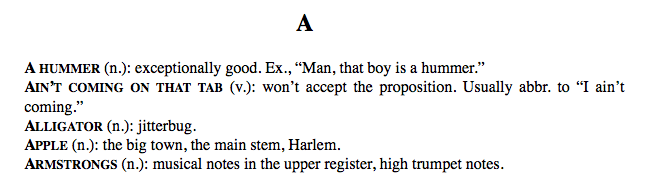
A sample from the A section:

Trucker’s Back: Pop Rocks! One Man’s Cover Song Garbage and Gold (Part II)

Our distinguished guest.

Last Thursday, I had the distinct pleasure of bringing you Part One of an excellent Guest Post by my good friend Jay Trucker.  In Thursday’s edition of “Pop Rocks! One Man’s Cover Song Garbage and Gold,”  Jay took out the trash like Sid Phillips circa Toy Story 3. (Anyone else catch that cameo? It’s totally him).  Today, we have the Hotness.

Pop Rocks! One Man’s Cover Song Garbage and Gold (Part II)
by Jay Trucker, special to The Grizzly The Daily Cocca

Cover songs are forever. My guess is that the second song ever performed was a cover of the first. Some of these cover songs are inspired, many are horrifying. Artists who cover well-known songs are disadvantaged in that they are immediately judged against the original, though the instant recognition of a popular cover song often paves the way for radio play and concert sing-alongs. The best covers may pay tribute or put a new stamp on an old standard. The worst are soul-crushing cash-ins. Here are just a few of my personal favorites and least favorites. Feel free to add your own. But for the sake of my sanity, try not to defend Sheryl Crow.

Part II: The Gold

Heart – “Love Reign O’er Me”http://www.youtube.com/watch?v=cQhAipNH0lM

The other Townshend Act.

This is my Johhny Cash “Hurt.”  That is, this is the cover in which I really liked the original, then fell in love with the cover and couldn’t even listen to the original without contempt any longer.

The Who may have been relatively embarrassing geezers at last year’s Super Bowl, but when I saw them in ’02, Roger Daltry still had the pipes to nail the “looooooooooovvvveeeeeee” crescendo as if his drummer and bassist were alive.  Then Ann Wilson had to come and just crush the whole thing.  Wilson’s voice adds a depth to the entire song that makes Daltry look like an imposter in comparison.

Nancy Wilson in May 2010.
In case you weren't already jealous of Cameron Crowe.

Sister Nancy Wilson tosses in just enough guitar feedback to keep the rock ahead of the classical in this version, and she can pull off hard rock posturing better than Pete Townshend these days.  But make no mistake about it—this song makes the list because of Ann’s voice.  She sells the feeling of the song as if she wrote it, and when the mixing board gives her a hand at the end, pushing the finale into the stratosphere, we’re all the better for it.  Catch Heart live and you’ll know what I’m talking about.

Disturbed – “Land of Confusion” http://www.youtube.com/watch?v=u6KXgjLqSTg

Nothing will ever terrify a child of the 80s the way Genesis’ “Land of Confusion” did.  With its deranged Reagan puppets that looked just enough like the actual Reagans to frighten pre-pubescents, “Land of Confusion” would be memorable even if the song weren’t.  And I’m still not sure why puppet Genesis is funny whereas puppet Reagans probably sent more kids into their parents rooms at night than the bogey man and Freddy Kreuger combined.

Disturbed, not a band one would typically consider subtle, succeed in their rendition by simply amplifying the heavy guitar licks of the original, which in turn makes the dystopic lyrics stand out more.  It helps that, unlike many of least favorite cover nominees, Distrurbed was not forced to heteronormatize the song by changing any he/she pronouns.  After all, this world “we” live in, and both man and woman will one day be subjected to the great flood the way the puppet Reagans were in ’86.

Disturbed singer David Draiman gives his typical tortured pet performance on “Land of Confusion,” barking through each line like a dog running to the end of a leash.  I’m sure this is enough to make many Phil Collins fans unhappy.  To be sure, Drummond’s growl scat is plenty annoying, especially when he’s offering the kind of mad at your dad garbage that Distrurbed often deals in, but when he adds asides like “ooh-ah-ah-ah-ah” or, as in “Land of Confusion,” “nyah-ah-ah” it kind of sounds like he’s possibly, maybe, just a little bit, making a gag of his over-the-top angsty rottweiler act.

He is joking, right?  Kind of?

Jeffrey Gaines – “In Your Eyes” http://www.youtube.com/watch?v=o7WtavVdBCk

Did someone say "prom"?

The history of “In Your Eyes,” at least, according to Wikipedia, says a lot about the song. Written by Peter Gabriel, the song was first released in 1986, then again in 1989 after it was featured in the movie Say Anything. Gaines recorded a stripped down version as a B side in 1992, then re-released two different versions of it in 2001. Herein lies the strength of the song, especially Gaines’ version—its timelessness. For this ballad about a guy who sees churches in eyeballs, Gabriel abandoned the giddiness that made 80s hits like “Sledgehammer” and “Shock the Monkey” a lot of fun, replacing it with heart-felt lyrics that are just complicated enough to not scream prom song. The original has some world music instrumentation and African yodeling (that exists, right?), which Gaines’ cover does not. See, this is the type of song that thrives on acoustic interpretation. Minus the bits of Toto-sounding keyboard and backup dancers, Gaines’ take lets his voice and the basics of the song do all the work. He proves that “In Your Eyes” does not need world music or exotic stage shows to succeed; its greatest asset is the core of the song itself.

Gaines stopped by my dear old alma mater while touring the college circuit back in ’98, and my then-roommate went to the show, hanging around afterwards just to get Gaines’ autograph for some girl he had an unrequited crush on. That night, I mistook his nightstand for the men’s room, spraying his Jeffrey Gaines autographed poster with recycled Natty Light. Sorry, Tom.

Best Bad Cover

Guns ‘n’ Roses –  “Sympathy for the Devil” http://www.youtube.com/watch?v=d6UsdiJldmo

In the interest of full disclosure, I am an unabashed GnR diehard.  But I like their version of the Stones’ “Sympathy for the Devil” much more than their more revered covers like “Live and Let Die” and “Knockin’ on Heaven’s Door.”

Singing "Salt of the Earth." Irony on lines one, two, AND three, Professor Trucker.

What makes this surprising is that the band itself hates this cover.  Recorded for 1994’s Interview With a Vampire soundtrack, “Sympathy” is the last song released by Axl, Slash, Duff, and co.  The band hated each other so much at this point, they couldn’t even be in the studio together when they recorded it.  Slash said his own rendition of “Sympathy” (ok, his band’s; rumor is Slash’s guitar solo was redubbed by Axl loyalist Paul Huge) sounds like a band breaking up.

But that’s kind of cool, in its own way.  A band of junkies covers a song by an older band of junkies featuring Satan as narrator.  I’d say there’s a game of one-upmanship going on here, and Guns may have just topped the Stones in debauched sinfulness.  Take that one to heart, Keith and Mick.

Oh yeah, and Mick Jagger never could sing.  So there’s that.

Honorable Mention

Ugly Kid Joe – “Cats in the Cradle”

Not sure which list this belongs on, but it deserves mention.

Jay Trucker teaches writing at the Community College of Baltimore County and studies Sociology and Education at the University of Maryland Baltimore County.  He occasionally writes about the Baltimore Orioles for WNST.net and nightlife for the Baltimore Sun blogs.

Jay, I can’t thank you enough for this fantastic double-feature.  It’s a huge treat for readers of The Daily Cocca and an ever bigger treat for me.  Folks, give Monster Truck some love in the comments so he comes back and see us soon.  I bet he’d even take some requests. Oh, and Jay? nWo 4 Life.

Some Random Thoughts About Music

Buddy Holly in concert
The coolest.

When I was 16, I heard Gibby Haynes say the music scene needed a new punk moment and he hoped it was Beck.  For one or two summers, it was (FEZtival ’97, I’m thinking of you).  But then people my age graduated and started file-swapping and before you knew it, the Philadelphia region was the largest market in the nation without an alternative rock radio format.  Mourning the death of high school preset king Y100 (“why? Because it’s good, that’s why!” said Noel Gallagher in my favorite station ID) I thought Gibby never got his wish: I didn’t seen any  rejection of pop excess at the last decade’s end and a commercial reset.  I didn’t see what I imagined the Clash did as the 70s waned or what coalesced as Nirvana circa 1990.  As the 9’s tipped to the aughts like gasoline meters, boy bands roared back from their late 80’s exile, pop ceased being a meaningful qualifier when placed before the word music, metal ceased meaning anything when preceded by nu and grunge rather cynically faked a revival.  This isn’t a full recounting, “American Pie”-style, of that era’s musical history, but eventually I came to realize that the punk moment had indeed come, that it was about distribution and choice.  And hip-hop.  And Wilco.  But I can’t get into all of that now.  I have an MFA thesis to write.  And Sufjan Stevens.

I’ve been thinking lately that if the current global economic crisis is as game-changing as was the Depression, and if rock ‘n’ roll was birthed by a nascent youth culture cutting the tension of economic crisis, a few wars, and  a war-fueled recovery, perhaps we’re about to see a whole new set of transforming creative moments like the 50s and 60s in Lubbock and Memphis and Detroit and Liverpool, like London and the Bronx circa 1976.  Like wherever Kayne West was ten years ago.  The art coming up out of those places drew from common pools, there’s a shared musical history, sure, between blues and rock and gospel and hip hip and punk, but there’s more to it than rightly cherished source code. These explosive movements came each in their own ways from conflict, from the merging of cultures, and, at their best, from a widening sense of neighbor and diminishing definitions of Other.  I’m not saying music sets everything right, but there’s a reason the Clash covering Bobby Fuller is sublime, not ironic. There’s a reason Johnny Cash doing “Hurt” is better than Trent Reznor, there’s a reason everyone bought Thriller, that the Gaslight Anthem sing about Miles Davis, that the Fugees cover Don McLean and Don McLean covers Buddy Holly.  That everyone covers Bob Dylan and Leonard Cohen, that Teddy Riley samples Bill Withers, that everyone loves the Beatles and the Temptations.  There’s a reason I’m getting carried away.

This post started with the intention of getting into a discussion about books, but I’m going to table that for a few hours.  Yesterday was the 52nd anniversary of the deaths of Buddy Holly, Ritchie Valens, and the Big Bopper.  It happened 21 years before I was born, but it still makes me sad.  Here’s to the last train for the coast.

Special thanks to Jay Trucker for his Guest Post from yesterday.  Looking forward to Part II on Monday.

And to all a good night.

Top Three Songs for Sunday Morning

Happy Sunday.  This was going to be another video blog, but I don’t want to go crazy.  Top Three Songs for Sunday Morning:

3. “Sunday Morning Birds (Singin’ Hallelujah)” by Pajaro Sunrise

2. “Sunday Morning” by the Velvet Underground

1. “Sunday Mornin’ Comin’ Down” by Kris Kristofferson

Top # 1 Band Name Inspired by a Kris Kristofferson lyric:
My Cleanest Dirty Shirt (hypothetical, but I call it).

Have a happy, fruitful, blessed, restful Sunday.