Is Jon Bon Jovi the Key to the Supercommittee Tax Compromise? (This Is Not the FarmAid You’re Looking For)

James Coburn in Charade2
If only.

Maybe so.

As The Hill notes today:

A leading Senate conservative is taking aim at tax breaks that he says amount to welfare for millionaires, a line of critique that usually comes from liberal Democrats.

Sen. Tom Coburn (R-Okla.) released a report detailing special tax breaks for wealthy income earners that could give members of the supercommittee common ground for raising tax revenues.

And just who are these welfare millionaires? Oil executives and bankers, every last one of them, right? Well, not exactly. From The Daily Caller:

Wealthy celebrities including Bruce Springsteen, Jon Bon Jovi, Quincy Jones and Ted Turner have received federal subsidies, according to “Subsidies of the Rich and Famous,” a new report from the office of Oklahoma Republican Senator Tom Coburn.

The Government Accountability Office (GAO) identified several individuals receiving farm payments “whose professions had nothing to do with farming or agricultur[e],” says the report. These individuals include real-estate developer Maurice Wilder, a “part-owner of a professional sports franchise [who] received total of more than $200,000 in farm program payments in 2003, 2004, 2005, and 2006.”

The report also says millionaires Jon Bon Jovi, Bruce Springsteen and Ted Turner have collected farm subsidies.

“These individuals include Scottie Pippen and Ted Turner, respectively. Millionaires also receive state tax breaks on farm land. For example, Jon Bon Jovi paid property taxes of only $100 last year on his extensive real estate holdings in New Jersey that he uses to raise bees. At the same time, Bruce Springsteen received farm subsidies because he leases his property to an organic farmer,” the report explains.

Oh, super-rich artists.  I respect and admire your endeavors in sustainable agriculture, horticulture, apiculture and so on.  We need better ways forward with regard to farming practices and safe food supplies.  But subsidies for millionaire gentlemen farmers?  We, the working poor and middle class, paying for Bon Jovi’s bees? If there’s an Occupy New Jersey, maybe they can move it on over to JBJ’s Bees of Glory Apiary Prototype Community of Tomorrow.

Let’s keep railing at Wall Street and Congress, but let’s also rail at people who identify with the working poor and middle class on one level, have made zillions of dollars doing so, and whose agribusiness is being paid for by those same working people.  Talk about double and triple taxation.  We buy their music, go to their shows, and help fund their farms with our taxes?  And the they is people like Bon Jovi or, even more incongruously, Bruce Springsteen?  How can this be?  Bruce, listen to Nebraska again and get back to us.
Jon Bon Jovi on stage live at Dublin May 2006.
Apiarist.

Disclaimer:  I don’t own so much as a Bon Jovi single.  But I’ve seen them in concert (and they were awesome, so there).   Bruce Springsteen is one of my favorite artists of all time.  Brucie, baby, I expect you to fix this.  Let’s get you on up to Capitol Hill for some hearings where you’ll say things like, “yeah, man, I don’t need that subsidy stuff.  Save that for the real working farmers.  Shit.”

Thanks, Boss.

Electric Juxtapostion: “I Was Trying To Describe You To Someone” and “City of Electric Light” by Richard Brautigan and Chad VanGaalen

I came across Brautigan’s story on Flickr. It made me think right away of Chad VanGaalen’s beautiful song.  Begging your pardon as I channel my inner teaching assistant: What do you make of this juxtaposition? Different crafts and media, both discovered and shared on the internet, both hewn here in bits of data and binary code.  Are these pieces complimentary or contrary? Which one speaks to you more? Is one enriched by its presentation with the other?  Are both? I should point out that the video was made by a fan.  The scan of Brautigan’s story was, too.

r_brautigan

Dear Music Industry: I Can Draw Diagonal Lines, Too

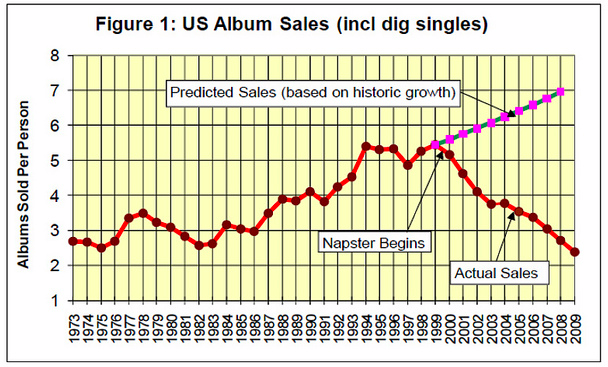
Okay, so the music industry is suing LimeWire. Sue away, Lars Ulrich, sue away. You should, I guess.  But you have to admit that this image, supposedly showing how much dough the biz has lost since the creation of Napster, is pretty convenient:

Isn’t it amazing that projected sales based on historic growth show none of the, er, historical plateauing you expect from any healthy graph and in fact see as having occurred here many times pre-Napsters and then NEVER AGAIN IF NAPSTER HADN’T HAPPENED.

Please.

Guess what, MusicTown?  Even if Generation Y hadn’t happened, and even if the youngest members of Generation X kept buying music instead of (okay) stealing it in college, the economic still would have gone in the crapper at least twice since then.  You’re not really saying that incing Napster early would have stopped the dotcom bubble burst or the downturn after 9/11 or the mortgage crisis, are you?

And remember how you abandoned all the Baby Boomers once you got your hands on their kids’ allowance?  Remember how you stopped producing Adult Contemporary, remember how you colluded with radio stations and sales tracking companies?  Remember how you gave us post-grunge? You’re saying that would not have happened?  Are you saying MTV and Vh1 would have kept showing your ready-made commercials instead of banking easy cash from reality shows and nostalgia trips (which ironically tended to feature the very artists you’d stopped promoting)?  For real?

Music Industry, you can do so much better than this.  Throw in some downward trends to make this graph realistic. I’m disappointed in you, frankly.

Napster or no Napster, there’s no way I buy seven albums this year, friends.  Radio is free, dynamic, and serendipitous.  I do iTunes, but almost only when I have gift cards. Last album I bought?  Neil Young Live at Massey Hall (digital download).  Before that?  No Line on the Horizon, physical copy.  Both were excellent choices and lived up to the album mystique.  But I knew that beforehand. Buying albums from new acts is, like, seriously committing.  I don’t know.  Though now that I think of it, I did buy a Taize album for someone for Christmas, and that was a good call.

Sales graph shenanigans aside, what do you think?  Are albums (even digital ones) obsolete?  Has Steve Jobs (not Napster) really killed the music business like His Royal Joveness says?

Sad 90s Music Roundup or “Whatever Happened To Alternative Pop?”

it was probably nothing like this.

I graduated from high school in 1998 and made the excellent choice of working at BestBuy that summer.  My domain was the media department, and my duties included farming CDs (I love doing that.  I started doing it at stores I didn’t even work at), helping customers make not-sucky choices (I added that to my job description), catching would-be shoplifters (the best), stocking shelves, and looking stuff up on the DOS databases. I was also expected to try to sell monster cables to people buying new media equipment and service protection plans for PlayStations.  I was better at the other stuff.

All of this is important for a few reasons:

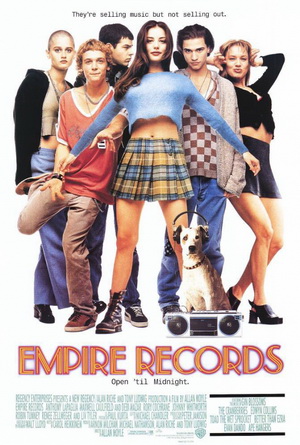
Working at BestBuy was like what I imagine working at Empire Records would have been like if those meddling kids hadn’t convinced Joe (that really is Anthony LaPaglia, by the way) to damn the man.  At BestBuy, all the Ethan Embrys worked in media and all the Renee Zellewegers worked the registers.  We had polo shirts and BHAGs and talked about shrink.   My immediate supers, which were team leaders directly below the department manager, were in their mid-twenties, which made them world-wary and wise.  One was a Zeppelin freak, the other was bound to name his first son Sid Barrett.  DVDs were very new and DVD players were very expensive.  Where were the Liv Tylers, you ask?  Grow up, dear reader.  There’s no Liv Tyler.

Some really good music came out that summer, much of which we listened to for hours on end via the Turn On The Fun Summer Sampler.

I got to buy the biggest microfridge ever made on the cheap because of my employee discount.  To the gentleman who had that item reserved and never came for it, we did try to call you.  300 feet of rope later, my best friend and I sailed that thing down Rt 22 West in one of the more harrowing transports of our lives.  I’ll be honest, it may have been 300 yards.  If you think you can’t load two microfridges into one 12-year-old Tempo, think again, friend.  Think again.

That second point, as you may have guessed, is the one we’ll be exploring today via a round-up of archived posts from 2009 about 90s music and 90s awesome.  (I doubt you could have guessed anything after the word via, so I hope you like your surprise. I made it just for you.  If you hate it I can take it back, or make another out of tears.)

The Roundup:

Speaking of tears, here’s one of my favorite post titles ever:  How Not To Be Sad About the 90s.  The impetus for that one was that someone really did make their way to this blog by searching that term.  Bear in mind that this post is 2-and-half years old, written well before I learned to stop worrying and love the blog.  Also before I lightened up about a lot of things.  Turning 30 is now like what growing a mustache was in the 70s.

Everything to Everyone
Exactly.

Maybe I Just Like Sad 90s One-Or-Two Hitters is a post about whatever happened to alternative pop in the Top 40. I remastered this one a bit before re-releasing.

Sad (Great) 90s Songs, Part II is a follow-up to above, mostly because I’d finally figured out what the third song in the sad (great) BestBuy song trilogy was.

Oh, and don’t let anyone fool you.  I still can’t watch that Flys video without losing my mind about how the 2000s turned out.  Still, one thing I’ve learned since writing these old posts is that sometimes, you really can pick up with people right where you left off, and that sometimes, old contexts aren’t as important or as fleeting as what you keep on doing.