Mark Cuban, Occupy Wall Street, and Your Predatory Student Loans

Mark Cuban
This man is the only person making sense.

I’m one of those people who tends to love Mark Cuban.  I love that he’s outspoken, I love that he takes risks, and I love that he’s a goofball who often acts, like my grandfather might have said, “like he doesn’t know what to do with himself.”   In short, Mark Cuban is good for America.

Last week, Cuban posted “soapbox advice” to the Occupy movement.   He talks about the evils of Wall Street, the lie that companies act in the best interest of their shareholders and other things you’d expect from a corporate (I’m sorry) maverick.  He makes a lot of great points, my favorite of which is his stance on student loans:

3.  Limit the Size of Student Loans to $2,000 per year

Crazy ? Maybe, maybe not.  What happened to the price of homes when the mortgage loan bubble popped ? They plummeted. If the size of student loans are capped at a low level, you know what will happen to the price of going to a college or  university ? It will plummet.  Colleges and universities will have to completely rethink what they are, what purpose they serve and who their customers will be. Will some go out of business ? Absolutely. That is real world. Will the quality of education suffer ? Given that TAs will still work for cheap, I doubt it.

Now some might argue that limiting student loans will limit the ability of lower income students to go to better schools. I say nonsense on two fronts. The only thing that allowing students to graduate with 50k , 80k or even more debt  does is assure they will stay low income for a long, long time after they graduate ! The 2nd improvement will be that smart students will find the schools that adapt to the new rules and offer the best education they can afford. Just as they do now, but without loading up on debt.

The beauty of capitalism is that people like me will figure out new and better ways to create and operate for profit universities that educate as well or better as today’s state institutions, AND I have no doubt that the state colleges and universities will figure out how to adapt to the new world of limited student loans as well.

Finally, the impact on the overall economy will be ENORMOUS. There is more student loan debt than credit card debt outstanding today. By relieving this burden at graduation, students will be able to participate in the economy

Okay, so we need to think more fully about the real issue of getting more low-income students into the nation’s best schools.  I agree that Mark’s not really there on that.  But you know what?  Schools like Princeton (Princeton!) are starting to give need-based breaks to students at levels never expected, in some cases forgiving the bulk of tuition out the outset.  They’re not doing it because the market or the government is making them.  They’re doing it because they are progressive, and because they can afford to.  I mean seriously, why should I go to a Michigan State, as great as it is, if I can go to a Princeton for (close to) free?

The bigger question:  why is no one but Mark Cuban talking about the outlandish cost of government and the outlandish ease with which one can secure outlandish student loan debt as anything other than an academic bubble?  That’s exactly what it is.  Worse, many, many of the folks who took out those loans banking on the kind of employment degrees from prestigious universities used to guarantee are currently unemployed.  Why?  Because the economy sucks, for one, and because everyone and their brother has an advanced degree these days.   The market is over-saturated with overqualified, over-debted talent.   We’re talking about an entire double-bound generation getting screwed on both ends of the equation.  Should everyone have known better and not taken out those loans?  Maybe.  Should all of the people whose homes were foreclosed have known better?  Saying yes to one of those questions is saying yes to both.

Let’s go ahead and say yes to both.  That doesn’t negate the predatory practices of commercial real estate lending during the housing bubble, and it doesn’t get student loan providers, including, ahem, the FEDERAL GOVERNMENT, off the hook, either.  Demonize the bankers till the cows come home, hang effigies of bad mortgage writers in Zaccotti Park, but don’t forget the role that cynical, opportunistic lending to aspiring students (we’re talking about 18-year-olds here, in many cases) who geeked out enough on the American dream to go to college in the first place play. Let’s not forget the indefensible tuition charged by many colleges, either.  In some cases, these institutions offer loan forgiveness for people in public service or low-income community-building vocations.  As a divinity school student, I spent a lot of time thinking about forgiveness, and it seems to me that we, the double-bound, aren’t the ones who need to be forgiven.

Mark, let’s burst the academic bubble.  Presidential candidates, what say you?
This Is Not Recovery: Reading the Economic Indicators of Place

For at least the past five years, most of the new commercial development I’ve seen with my own two eyes has been the frenzied building of shiny new banks and drug stores. This has everything to do with the credit bubble, aging populations, strengthened lobbies, and thickening anxieties. And of course, we ought to be anxious. But there’s something not quite right about this tandem proliferation, is there? Something not quite right about the idea that as banks continue to prosper, even in the worst economy most (if not all) of us have lived through, so too do pharmaceutical companies. The less money we have, the less health care we have, the more anxious we are because of these things and countless others, the more, it seems, we spend on medicine. This is anecdotal, yes, but someone ought to look into the relationships between Big Pharma and Big Money. There’s absolutely something there.

In the past few weeks I’ve seen a new business trend. “We Buy Gold” and “Cash For Gold” stores popping up where suburban notaries, sub shops, and dry cleaners used to be. The economic indicators of place tell me, friends, that this is not recovery. This is not a healthy middle class. But the banks bank on, and the drug stores keep building. Now a new class of opportunist arrives, producing nothing. I like Pawn Stars just as much as the next guy (I really do), but we’re quickly becoming a nation of emergency liquidators prime for the picking. This isn’t recovery, and it’s not justice, either.

Oh, justice. No, the spread of proxy pawn shops to the suburbs doesn’t feel like you in your purest Form, but there’s a poetic justice here, a kind of irony: the struggle the middle class is facing is no news to the poor, to our cities, to our always-disenfranchised. But now it’s here for everybody else. Everyone without big pensions, bailouts, or golden parachutes. Everyone with a mortgage, a car payment, tuition. Almost everyone I know.

Keith Olbermann Just Took Me To Church or The Phantom Trillion

In the 90’s, Keith Olbermann was part of a flawless thing called SportsCenter. Even though the political commentary and overall style he’s developed since then isn’t everyone’s cup of tea, this Special Comment from the July 11th edition of Countdown is essential viewing for anyone who cares about the justice issues tied to humanity’s basic failures of compassion, empathy, and care.

“Face it,” Oblermann says, “we do not take care of one another. Not we as in progressives, not we as in Americans, not we as in the West. We as in a species.”

If we’re being honest, we know that Olbermann is right. And even though he’s not saying anything particularly new, the bluntness of the charge is just a little jarring, even in the context of waning hope in hoped-for change. We, the People, do not take care of one another. It’s no wonder that They, our leaders, do no better.

And what about another set of “we’s?” We the stewards of the planet,we the image-bearers of God? What about we who believe loftly things about the the Holy? For Christians, what about that we called the Body of Christ? I read a ten-year old stat estimating the global income of organized Christianity (churches, denominations, and parachurch ministries) hovers around $270 billion annually. I’ve read elsewhere that the yearly global income for Christian individuals (the compensation they get from having jobs) is $10 trillion. Extend the tradition of a 10 percent tithe from each of these groups toward eradicating poverty, and you’d do it in a year. We’re talking about $1,027,000,000,000. Don’t know what $1 trillion can buy? Look here and here. One Trillion Dollars can purchase all the homes that foreclosed in 2007 and 2008 or pay the rent for every US renter for 3 years. Universal preschool for all American 3 and 4 year olds? No problem! That only costs $35 billion. American Christians could pay that themselves.

But my 1 trillion number (see Ron Sider’s Rich Christians In an Age of Hunger) represents a global tithe, so let’s consider global implications. According to VisualEconomics, access to clean water for everyone on the planet now without it only costs $8.84 billion. That’s with a B. Christendom has $1 trillion, with a T, to play with every year. Clean water, then? Fine. What, Christians? You want to sponsor a million kids through Children International for a year? That’s just south of $300 million (with an M). No problem, Church! One new home at $175,000 a pop for each one lost in Katrina? You’re thinking bigger, but that’s only $48 billion. You’ve got $1 trillion and change to spend every year (plus the other $9 trillion you’ll use for basic needs, creature comforts (in developed countries), and, in some contexts, unprincipled extravagance). You could feed everyone, clothe everyone, give everyone access to water, heal the land, clean the water, and clean the air in perpetuity. Talk about an endowment. Oh, and you could send kids to school, heal diseases, and bring animals back from the brink of extinction. You could (and would) eliminate the root causes of war. Or you could keep trusting the bulk of the money you give away (via taxes) to people who keep finding new reasons to make war so vital.

The Church could end poverty, scarcity, sickness, and famine without a dime from the rest of the world. Obviously, that doesn’t mean it should do so by some centralized economic fiat. The last thing anyone needs is a megalith, even one as diverse and nuanced the global church really is, setting this kind of agenda. Noting that the Church could foot the bill for the saving of the planet doesn’t mean that the Church is otherwise equipped to do so, and it doesn’t even mean that something called “the Church” exists in any sort of organizationally connected way across the world. We may (and I do) believe in the mystical Body of Christ, but can you imagine the impossibility of mobilizing every Christian group under some sort of prime directive?

Then again, that’s what Jesus did by giving the Great Commission and promising the Holy Spirit. Perhaps if all Christians understood the economic power they possess and the practical implications of loving one’s neighbor as oneself, this phantom trillion would find its way to points of need. Perhaps if the Church was busy consciously investing even 10 percent of its annual income to overcome the systems that breed injustice, hate, and other things we still call sin, Jesus’ talk of the Kingdom of God being here even now would make a hell of a lot more practical sense.

Brennan Manning has said that one of the biggest causes of atheism with reference to Christianity are “Christians who acknowledge Jesus with their lips and walk out the door and deny Him by their lifestyle. That,” Manning says, “is what an unbelieving world simply finds unbelievable.” I’d go even further and suggest that the conformity of so many Christians to the status-values of consumption, possession, and unsustainability is also one of the biggest enablers of global scarcity and the atrocities that come with it. Faced with the kind of evil that flourishes where hope and charity do not, perhaps the oft-repeated “Where is God in this?” isn’t quite the question. Consider this instead: “Oh, God, where are the Christians? Where were the fraction of their resources that could have stopped this in the first place?”

Yes, I’m claiming scandal as a member of the movement. I’m appealing to classic Christian expectations of ourselves. I’m not saying the Church must act because all other faiths or governments have failed. I’m saying the Church must act because it has failed to be the Church. We’re good at giving time and talent, but what is it about the way we’ve spent our treasure that allows inequity and scarcity to run and reign so freely? Do we have a misplaced trust in the structures of church government and Christian organizations? Or are we, paraphrasing Jesus, seeing where our hearts don’t lie in the faces of all those who will die before this post is finished because we’ve finally let them?

Help us, Lord.

Yes, much of the phantom trillion gets used in responsible ways by good people towards precisely the things I’m talking about. But what if global Christianity were led from the margins (even as Jesus led)? What if we recast the idea of tithe as a fraction of our treasure given back to God in the world and not our institutions? What if we empowered charity: water to complete its mission? The enraging thing about that proposition is that we could really do it. And we aren’t. Not in intentional, global ways. Often not with the recognition that the outright care of other people is the Gospel. What if we helped WorldVision, Compassion International and other groups with scant administrative footprints put themselves out of business? Nothing would make them happier! What if we used our economic clout to be a global force against genocide in Darfur and Burma? What if we empowered local Christians and other people of good will already working in those places in system-changing ways? And what if the Holy Spirit helped us?
Even without a moratorium on traditional patterns of giving, and even recognizing that our poorest sisters and brothers can’t often give something as concrete as money, the rich Christians in the industrial world could raise a second trillion every year without denying themselves or their churches very much of anything. So far, we haven’t, and that’s the even greater greater scandal.

Help us, Lord.

In Allentown, Sustainabilty Can Be the New Cement, the New Silk, the New Steel. It Can Even Be the New Hess’s.

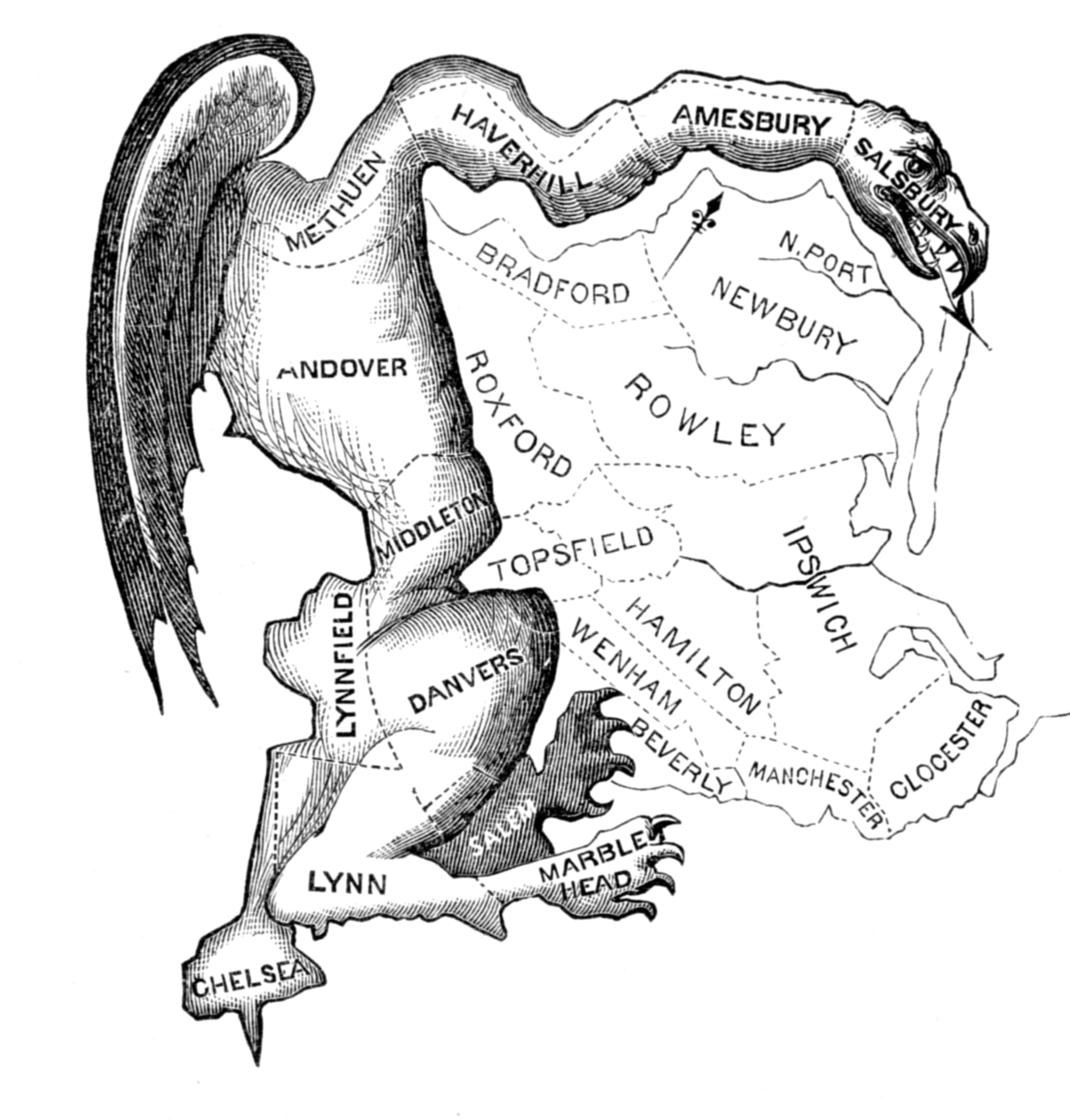
Totally a salamander.

If you were into civics as a kid, “gerrymandering” is one of the words you learned in 10th grade and still remember. You probably even remember the practice’s namesake, Elbridge Gerry, and that he endorsed the creation of oddly-shaped voting districts that favored his political party in the early days of the Republic.  The practice produced a cartographic chimera of sorts, the so-called Gerry-mander, and the practical side American political science began in earnest.  For all the time they must have spent outside, you’d think that early 19-century Americans would have known that salamanders don’t have wings but do have arms.

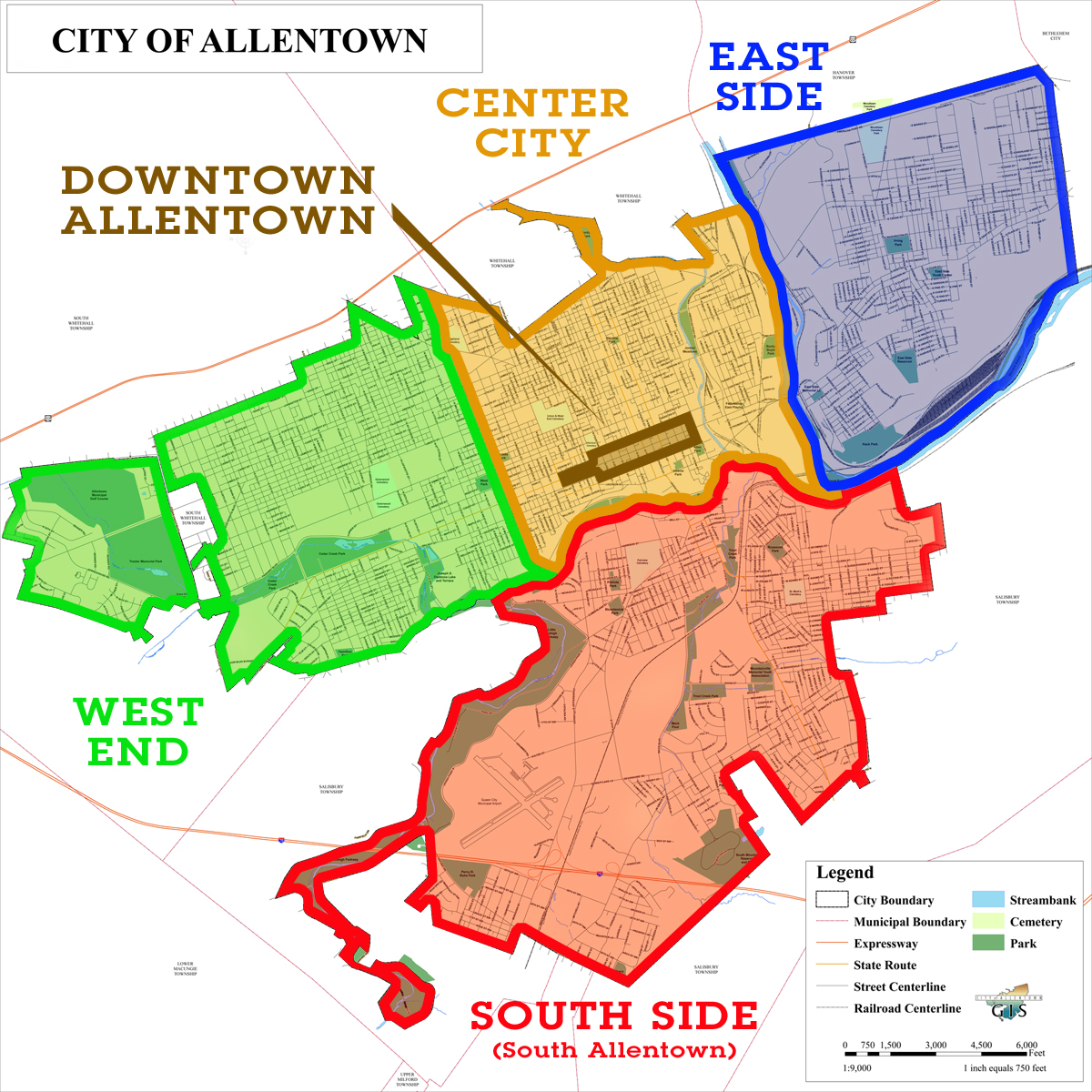
Today, I came across a map of Allentown that Damien Brown edited to show the city’s different sections (East Side, Center City, Downtown, South Side/South Allentown, and West End):

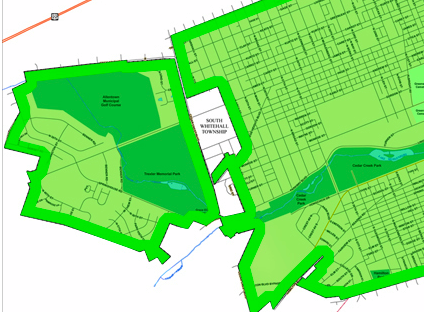
Now, if you live in Allentown, you know that a small pocket of South Whitehall Township (those white polygons) cuts into the West End on the east side of Cedar Crest Boulevard from Washington Street to Parkway.  A closer look:

What’s the story here? What political machinations are afoot??? Just the long-term visioneering of Allentown industrialist Gen. Harry C. Trexler, patron of the Allentown Parks System, the Golf Course, the Trexler Nature Preserve and lots of other things we take granted.  The space that is now Trexler Park was, before his death, a family summer estate in South Whitehall Township.  This land and the land immediately around it (including the Golf Course) only became part of the city because of Trexler’s work and generosity.

Longtime Lehigh Valley residents know most of this already. What I didn’t know: Trexler is probably also responsible for preserving the Lehigh Valley’s home-rule culture.  His mistrust of Philadelphian power (antagonistic as it was to the Lehigh Valley’s Pennsylvania Germans) led him to champion the development of a regionally-based economy.  It makes me stop and think: even as we recall Allentown’s decline from unique, mid-sized, industrial and commercial base of economic power to a city searching for a new identity and a sustainable economy of the future, if not for Trexler, the plus side of the Lehigh Valley’s history might not have happened at all.

In pioneers like Trexler and, later, the Rodale family, the Lehigh Valley has fine models for conservation and sustainable business.  Even though the national economy is groaning, it is also greening.  100 years ago, Trexler and others converted a vacant, run-down city lot into what we know today as West Park.  Leaders from all aspects of Allentown’s public life need to keep taking these cues and continue embracing the opportunities financial trouble brings.  If we need to build, we must (and can) build sustainably.  If we need to tear down, we can do it beautifully. I imagine a city that is increasingly walkable in all quarters, and one where junked lots and vacant parking lots become a patchwork of parks and public spaces.

No one knows how long the current economic crisis will continue.  What we do know is this:  the days of retail excess are over, and rising generations want walkable, bikable, beautiful urban spaces in which to live and work and spend.  We want sustainable, hyper-local options, we want good news for the city and we want to be part of that transition.

On a long enough timeline, chronically closed spaces will green themselves, but cities across the country are starting from scratch with new sustainable ethics and visions. Thankfully, we don’t have to start from square one.  If stakeholders are committed, our region, led by our cities, can be a national example of the new economy even it was once a beacon of the old.  And unlike silk or steel or cement or retail, sustainability is a business for all times and all seasons.

Beat Your Strip Malls Into Greenspace: A Suggestion for Failing Suburban Markets

vacant Revco Heritage Square
Image by iwasteela via Flickr

I used to work for a mutual fund company, but I’d never say I’m an expert on the economy.  If you want to wax nostalgic with me about a time when money markets were paying more than .01 percent, I can handle that.  If you want to talk about Series 6 and Series 63 licensing exams, I’m sorely out of date.  That said, I retain the basics, and I happened to leave the industry just as everything started to crumble.

I say “started” because everything’s still crumbling.  I’m no Amartya Sen, but we Americans have the long historical memory of the Great Depression always at our backs, and while most of us don’t really understand everything that’s been going wrong, our gut index is pretty savvy.  We know when times are bad and we know when they’re not getting any better.

In the mid and late 70s, just before I was born, there was an energy crisis, a high Misery Index, inflation, bad geopolitical situations and, so I’m told by the media and everyone over 50, a prevailing and understandable emotional malaise.  People were worried, afraid, out of work,  strapped.

In 2011, the gut index tells a similar story.  We know, deep down, that we’re still in an energy crisis and will be until renewable fuel becomes a nationwide efficiency and standard.  The Misery Index is officially back in political discourse.  The economy is abysmal, the world stage is a mess (with some hopeful things still happening), and people are worried, afraid, out of work, busted.

Once upon a time, when main street was “white washed windows and vacant stores,” we had the luxury of telling ourselves that even if our mid-sized industrial cities failed, the wealth of the burgeoning suburbs would save us.   Fail our cities did, and so grew the suburbs, over green space, agricultural space, water tables, cemeteries.  So grew our commuter corridors, our pollution emissions, our traffic patterns, and BMIs.

Take a look around your local suburban strip mall.  Witness all the empty store fronts.  Consider all the tier two stories at your local mall.  If your gut’s like mine, it’s telling you things are getting worse.

I’m not an alarmist, but it seems patently obvious to me that the era of suburban mercantilism is over.  And, like most forms of mercantilism, the suburban boom of the last 20 years was, itself, a bubble.  On the frontier line of our industrial cities, townships had wide open space to develop and overdevelop.  The businesses leaving our strip malls like they once left our downtowns are never coming back, that is, there will never again be the faux demand for that many grocery stories, hair cutteries, pet shops, Subways, and Chinese buffets.  We simply don’t need that many Wal-Marts or Targets or Sears.

What to do now with these vacant spaces?

Knock a few walls down and mix open space in with surviving retail.  Plant flowers, get benches.  Make butterfly gardens and bike racks.  Young people drive the economy, and young people like being outside.  We like having access to options.  We’d love to sit in the grass with our kids while our spouses run errands elsewhere on the strip.  We like eating outside, learning outside, shopping outside.  Tell us that your micro-greens in the suburbs are part of your commitment to sustainability, and even if we don’t believe you, we’ll use them.  What goes better next to a Petsmart than a dog park?  Why not put tables and chairs and umbrellas between Subway and the pizza place?  How about some of those lawn games hipsters love?  Maybe a fountain or two.

One of the things our suburban communities lack is access to open, common spaces at commerce centers.  Target being close enough to drive to from soccer practice isn’t what I mean.  I mean walkability and multipurpose.  Micro-greens could bring these opportunities.  Kids could paint murals and the real estate companies could compete for most beautiful, creative, or sustainable patch.  There could be concerts and readings and rallies and ecological learning stations.  There could be weather monitors and air quality sensors.  There could be meetings and speeches from leaders.  There could be questions.  And all of the sudden I’m talking about sustainability in much larger terms.  I’m talking about art and culture and civics, all of those other things not commonly associated with our suburban places, and I’m talking about doing them out in the open, in front of people as a way of engagement, ecology and economic innovation.

My gut index says many, many people are more likely to patronize a multipurpose complex like the kind I’m describing than the same old depressing vacant strip malls.  My gut says people want creative solutions, more fresh air, more green grace and more synchronicity.  In short, we want better options than the failed strip mall aesthetic, and we want to be able to access our disparate goods quickly and efficiently.  Beat those vacant spaces into open ones.  If you unbuild it, they will come.

Infographic: Blockbuster For Sale, How Netflix is Like NATO

Blockbuster went up for sale today.  For a while now, I’ve been seeing some funny hacked-by-bankruptcy Blockbuster signs as embattled locations have had neither reason nor resource to change old lights or fix broken letters.

My favorite of these is one that simply says BLOC.  It’s not that the rest of the letters are burned out. It’s just that there are no other letter letters left on that half of the storefront.  I’ve been making the joke for a while that this must make Netflix like NATO.

Because I have other things to do, and because it was a lot of fun, I decided to sum up this thesis in a nifty infographic.  This is my first attempt at an infographic, and I only used public domain/fair use images and iWeb. It’s sort of a hack all the way around.  I put it together earlier today before I knew Blockbuster was officially for sale, so the timing seems right to share.  And please, share and share alike if you dig it.