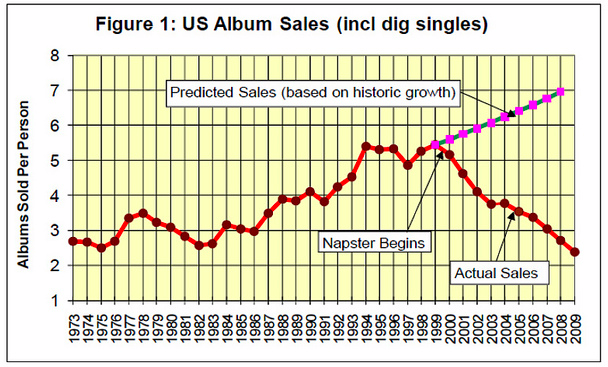
Okay, so the music industry is suing LimeWire. Sue away, Lars Ulrich, sue away. You should, I guess. But you have to admit that this image, supposedly showing how much dough the biz has lost since the creation of Napster, is pretty convenient:
Isn’t it amazing that projected sales based on historic growth show none of the, er, historical plateauing you expect from any healthy graph and in fact see as having occurred here many times pre-Napsters and then NEVER AGAIN IF NAPSTER HADN’T HAPPENED.
Please.
Guess what, MusicTown? Even if Generation Y hadn’t happened, and even if the youngest members of Generation X kept buying music instead of (okay) stealing it in college, the economic still would have gone in the crapper at least twice since then. You’re not really saying that incing Napster early would have stopped the dotcom bubble burst or the downturn after 9/11 or the mortgage crisis, are you?
And remember how you abandoned all the Baby Boomers once you got your hands on their kids’ allowance? Remember how you stopped producing Adult Contemporary, remember how you colluded with radio stations and sales tracking companies? Remember how you gave us post-grunge? You’re saying that would not have happened? Are you saying MTV and Vh1 would have kept showing your ready-made commercials instead of banking easy cash from reality shows and nostalgia trips (which ironically tended to feature the very artists you’d stopped promoting)? For real?
Music Industry, you can do so much better than this. Throw in some downward trends to make this graph realistic. I’m disappointed in you, frankly.
Napster or no Napster, there’s no way I buy seven albums this year, friends. Radio is free, dynamic, and serendipitous. I do iTunes, but almost only when I have gift cards. Last album I bought? Neil Young Live at Massey Hall (digital download). Before that? No Line on the Horizon, physical copy. Both were excellent choices and lived up to the album mystique. But I knew that beforehand. Buying albums from new acts is, like, seriously committing. I don’t know. Though now that I think of it, I did buy a Taize album for someone for Christmas, and that was a good call.
Sales graph shenanigans aside, what do you think? Are albums (even digital ones) obsolete? Has Steve Jobs (not Napster) really killed the music business like His Royal Joveness says?
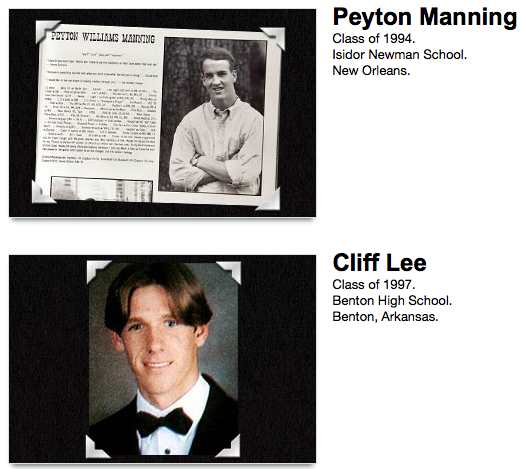
This image is via Yahoo!Sports. Peyton Manning, you look exactly the same. Cliff Lee, how is it possible that you were a teenager at precisely the same time I was? It’s not that you look old now…it’s just that you’re so talented, I assume you’ve been pitching since the dead-ball era.
Should we be so blessed as to reach them in good health, it turns out our 80’s might be our most righteous years. It may seem counter-intuitive, but I totally get it: the older I get, the more I suspect I’ll enjoy getting even older, as long as I’m able to stay healthy. That said, I totally wanted this to be an article about why THE 80’s were awesome. Alas. But the good news is that if the decades of our lives match up, sweetness-wise, with the decades of the late 20th and early 21st centuries (um, yeah!), then all of us late Gen Xers (I’ll just call us the 96-99ers) will have an even better time in our 90’s (which will be the 70’s). The bad news doesn’t start rolling in until our 100’s, because let’s face it, the 2000s kind of sucked. Our 20s kind of sucked. We got a crap decade to be 20somethings in, but it happens. The good news is that in our 3os, that is, now, we’ll do the ethical, artistic, and socially responsible equivalents of all of those life-affirming-in-the-1930s-sketchy things the expats did. Which means, if my math is right, our 110s will be our new 30s. And since 30 is the new 20, and because of advancements in technology, we’ll actually start to age backwards like Jonathan Winters on Mork and Mindy or Cindy Crawford in real life. I could handle that.
But yeah. I love getting older. I loved turning 30. 31 feels even better. 40 still sounds depressing, but doesn’t 50 sound so full of vim and vigor? That’s when you start defying expectations instead of living into them. 50 is hardcore. I don’t know how old Terry O’Quinn is, but John Locke is my role model for being 50. And, you know, my dad. I mean, my dad’s also a good role model for being 50. (Terry O’Quinn is not my dad).
Here’s the thing. Older people are smarter than younger people. It’s just freaking true. Not about everything, not in every situation, not all across the universe. But 7 times out of ten? I think so. Sure, sure, you have a fancy degree and a smart phone, friend, but they have these intangibles called experience and perspective. It’s mostly true. It’s truish. Get a haircut, hippie.
Three Pillars Trading Company is a client of mine. I’m producing blog articles for this fair-trade, sustainable import business, and from time to time, I’ll be sharing pieces of them here. My first post at Three Pillars is about the disgusting conditions that factory workers in Shenzhen, China endure while they put together our computers and hand-held devices. Yes, as fellow Apple fanboy Mike Daisey exposes, even our MacBooks and iPhones.
An excerpt:
Monologist and raconteur Mike Daisey recently spent hundreds of hours exploring the treatment of industrial workers in the Shenzhen region of China. His findings are nothing short of chilling, and he’s taking to the stage (and Internet) to get the message out. Mike makes the stunningly simple observation that while most justice-minded people work very hard to integrate their ethics and consumer choices when buying socks and sneakers, very few of us ever really stop think about the fabrication and delivery chains that produce our favorite hand-held devices.
Continue reading here. Whatever you do, be sure to click through and watch the video interviews TechCrunch conducts with Daisey. They’ll make you angry, sad, and sick. The fact that people like Mike Daisey exist might also make you feel some hope. As I’ve said before, if I ever link to anything I’ve been paid to produce, I’ll say so. That’s the case here, but, as you might know, I only take jobs from organizations I can get behind. It would be great if you surfed from here to my cool new client, but much more important to me and to Three Pillars is that you please, please, please hear what Mike Daisey has to say. In fact, here’s a direct link right to the TechCrunch article with three video segments. They are worth your time.
As for Three Pillars, one of the chief goals of their blog is to provide a place of interest and information gathering around the the kinds of issues that people interested in fair-trade goods are likely to also care about. If you do make your way there, I know the Three Pillars folks would appreciate any feedback or comments you might have about how to make the blogging experience on their site all it can be. My job is strictly on the content side and I get to pick the issues I blog about there. If you have suggestions, please let me know.
While we’re on the subject of sustainability, and since I used “hell” in the title (that’s just a figure of speech, Rob Bell), I’ll also say this: after watching Daisey speak, I’m seriously worried about the state of the Western soul. Most of us don’t know that a company as seemingly with it as Apple is party to the things happening in Shenzen. We get great products for low Western prices, but at an unknown human cost to people with even less access to power than most of our own unemployed homeless.
I’ll be honest. This makes me feel like shit. Since I read Karl Rahner in div school (Savvy Sister, are you a fan of his? I am.), I’ve always thought his take on original sin made the most sense: everyday, we’re part of sinful, evil systems that we don’t even know about. Doing something as simple as buying a banana (let alone an gallon of gas or an iPod) might end up supporting unspeakable evil. The same goes for your retirement funds. Unless you’re in a socially aware mutual fund, chances are your IRAs are funding weapons and Chinese petro companies with dirty hands in Darfur. Shit, when I worked in finance, even the so-called “socially responsible funds” invested in Big Pharmaceuticals and Big Banks because after taking out cigarette makers, arms makers, gambling companies, pornographers and environmentally destructive firms, Banking and Medicine were the only two industries left. If you want a brief rundown on how powerful those industries are, consider if this is true where you live like it is here: most of the most consistent new construction going on prior to the banking crisis and even after was and is for new banks and new drugstores. I’m not saying prescription drugs aren’t legit or that there’s something wrong with taking medicine as directed, but we all know that on the R&D and supply ends, opportunity for corporate abuse is rife. I don’t think I need to say anything at all about banks and financial institutions. You know where I’m going.
Where does all this bullshit evil come from in the first place? I know the following:
everyone we meet is fighting a great war.
Karl Barth, (Karl Rahner’s Protestant Number) said that evil is the aggregation of humankind’s repeated choice of Das Nichtige (very basically: choosing “Not God” (aka “Nothingness”) instead of God, who is life) played out in history. He’s not very far from Rahner here when it comes down to it: Evil is a given, and it gets amplified as we continue to choose it (or, finally, participate it in unknowingly because it’s so entrenched). Its the manifestation of everything that isn’t God, actualized by aggregate choices and non-choices framed by the earlier actions of others (which, in fact, may not have been truly free choices, given #1).
be kind, because (see #1).
Crunch.
A dear friend of mine, wry with a sort of common-sense Pennsylvania German-Lutheran fatalism would say this leaves us pretty screwed. But I’m not so sure about that in the end. Shortly after I got out of the mutual fund industry, another friend of mine with many years in the retirement-planning business told me that it was impossible to invest with your conscience. As you might expect, I disagree. You probably do, too. Whether you’re a person a faith or simply a person of faithful ethics, you already know that voting with your dollars, so to speak, requires certain sacrifices. I’m due for a phone upgrade this month. Oh, how I want an iPhone. But maybe I won’t get anything. I know the phone I would have bought will still be made in shit-hole conditions and will still be sold. I know it will be the best looking chunk of original sin on the market. How funny that it’s made by a company who’s logo is a piece of bitten fruit. Well, not funny ha ha. Funny strange. Actually, not so funny at all.
This is another dip in the old search-query-that-brought-someone-here-mailbag. This question is honest and simple, and I spent a good part of my mid-20s trying to figure it out. Here’s what I came up with:
Generation Y.
Yes. Everyone who was just becoming a teenager as the 90s wore down, I’m talking about you. This is what happened:
Your boomer parents gave you a lot of disposable cash for no good reason.
You spent it on Britney Spears, boy bands, and clothing that wasn’t ironically cool (that is, clothing that cost more than $4.)
You did not spend it on Oasis or Nada Surf or Harvey Danger. You did not spend it on The Flys or New Radicals. You absolutely did not spend it on REM. You also didn’t didn’t spend it on AOR or Adult Contemporary (goodbye, that whole genre). No New Bohemians, no Mazzy Star. Good bye John Mellencamp. It’s been fun, John Secada. Peace out, Tonic, Gin Blossoms, Dishwalla, Joan Osbourne, Black Lab.
Hello, TLR.
Hello, all delighted teensters with your expendable non-work-related dollars. Hello, Generation Bigger Than The Baby Boom. Hello, malleable taste-makers, hello.
Goodbye, alternative radio formats. Goodbye, Y-100. Goodbye, you last hangers on of Generation X, you would-be Cusacks. Goodbye, Empire Records.
Blockbuster went up for sale today. For a while now, I’ve been seeing some funny hacked-by-bankruptcy Blockbuster signs as embattled locations have had neither reason nor resource to change old lights or fix broken letters.
My favorite of these is one that simply says BLOC. It’s not that the rest of the letters are burned out. It’s just that there are no other letter letters left on that half of the storefront. I’ve been making the joke for a while that this must make Netflix like NATO.
Because I have other things to do, and because it was a lot of fun, I decided to sum up this thesis in a nifty infographic. This is my first attempt at an infographic, and I only used public domain/fair use images and iWeb. It’s sort of a hack all the way around. I put it together earlier today before I knew Blockbuster was officially for sale, so the timing seems right to share. And please, share and share alike if you dig it.





 Chris Cocca