Alan Jennings and CACLV are Fired Up for 2012 and So Am I

Read Alan’s latest post on the CACLV blog here.


I’m proud that First Presbyterian Church is a major partner in the effort to expand capacity at the Sixth Street Shelter by 25%.  In my vocation as Director of Mission at First Pres, I can see the enthusiasm for this project bubbling over for the volunteers and staff who are about to unleash our part of the overall campaign with incredible passion, dedication, and faith.


I’m also sensing a great para-movement about to emerge this year for the regional homeless population that will bless the great work being done by CACLV, the Conference of Churches, St. Paul’s Lutheran and others.  Make no mistake: traditional sources of funding for much-needed programs are more hard-pressed now than ever (evidenced by this NYT piece from last week focusing on how federal cuts to Community Development Block Grants are hurting Allentown), but our non-government institutions have a bigger role to play in the New Generative Economy than we’ve often been led to believe.  Faith communities are such institutions, and people of faith will be called on to extend the re-prioritization demanded by Christmas into the new year and beyond.

Stay tuned, friends.


New Sinkhole the Latest Plea from Allentown’s Degraded Infrastructure

Read the story here.

Some important highlights as they relate to the health of our community. Emphases added:

The 6-inch cast-iron water main is 107 years old, said Rick Dougherty, the city’s chief supervisor of water distribution.

“We’ve replaced a lot of the mains in the area over the years,” Dougherty said.

Allentown is fighting aging infrastructure throughout the city, as cast-iron pipelines and water mains from the turn of the century begin to degrade. A 12-inch cast-iron gas distribution line dating to 1928 is the prime suspect in the Feb. 9 explosion that killed five people and leveled half a city block in Allentown.

And although some gas and water pipes are replaced every year, it’s a daunting and costly task — with one gas pipeline safety group estimating the expense at $1 million for each mile.


I think most city residents rightly suspect that the gas and water lines beneath us need to be replaced. $1 million a mile? Fine. The new arena, which I support with a few reservations, will cost $159 million. UGI has something like 79 miles of gas line under the city, the degradation of which was a known issue 20 years ago. Yes, the cost of upgrades will be passed on to consumers without some kind of other chunk of money (ours anyway) earmarked to offset it.  How many miles of water piping need to be replaced?  Whatever it is, let’s do it.

It’s a good thing we’re in line for a hefty Community Development Block Grant.  Ooops.

In the meantime, the new sinkhole, which formed over the last 36 hours or so, is becoming national news:

The $9 Million Amazon Boycott and Priceless Found Irony

An Amazon box on top of a box from the once globally famous, now defunct iconic Allentown retail brand. Found irony.

Speaking of the New Generative Economy (see previous post), donating clean water, trees, construction funds or socks (or buying fair trade items at local stores) works another kind of grace: it takes business away from companies who produce things in unjust conditions overseas and companies who package and ship them in unjust conditions right here in Pennsylvania.  Spencer Soper, the journalist who first broke the Amazon news, reports that almost 13,000 people have signed an online pledge to boycott Amazon via DC-based advocacy group American Rights at Work.

Soper’s new piece notes that 13,ooo people might equate to something like $9 million in sales.  Even if that’s only a drop in Amazon’s global bucket, imagine what that same $9 million could do, even when broken into pieces, for fair trade retailers and generative charities.

Here’ s the ARW open letter to Jeff Bezos, which you can sign and send online.

A Tale of Two Headlines and the New Generative Economy

I don’t typically buy USA Today, but I did yesterday because of this front-page feature about people giving the gift of clean water for Christmas. You may remember that this year, First Presbyterian Church of Allentown took part in the Advent Conspiracy and encouraged people to buy fair trade gifts or to donate to a few important causes in honor of loved ones instead of buying things for people who already have so much. The donation options at FPCA were:

  • Sixth Street Shelter expansion campaign (Allentown)
  • living gifts for a village in Malawi with whom our church has a connection
  • Gifts/socks/sneakers for Roosevelt Community School (Allentown)
  • Living Water International

This was a very successful campaign, and it was wonderful to see the national movement get the front-page treatment in USA Today. I noticed that today’s edition of that paper included this front-page headline: “Holiday Sales Numbers Fail to Dazzle.”

Welcome to the beginnings of the New Generative Economy.

I’m not happy that retailers are hurting, but I am happy that for all of the misery, the global economic crisis might yield some generative good.  When we have less money to spend, we realize how little we need.  Then we start to think about how so many people don’t even have that much.  Since we’re already going to spend less money on stuff, it’s easier to give more resources where they can do the most good.  Giving cash gifts to good organizations in honor of others blesses everyone.  Overheads have probably never been lower, and you can use resources like Charity Navigator to see where your money’s best spent.

If you have the money and the inclination to buy physical gifts in addition to this kind of giving, your local Ten Thousand Villages retailers have beautiful fair trade items hand-crafted by artisans from all over the developing world.

Going to the MATS for Air Quality in Pennsylvania (and Look For Me in the Morning Call Next Week)

Jon Geeting has a cost/benefit quote from Paul Krugman about the new Mercury and Air Toxins Standards (MATS) announced by EPA this week, and some thoughts about the GenOn issue here in our backyard.

As I commented on Jon’s blog:

Jon, thanks for posting on this.  In my capacity as Outreach Director for the Air Quality Partnership of Lehigh Valley – Berks, I have [a] piece running on related issues in the forthcoming Tuesday, Dec 27 edition of The Morning Call.

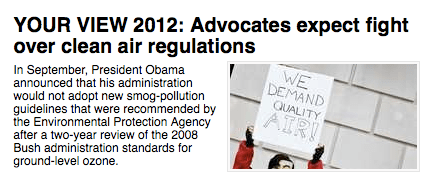
We’re applauding the president for the new MATS (Mercury and Toxins Standard), but we’re still looking for leadership on the new Ozone standards EPA proposed, based on the best available science, this past year.  In September, the President disappointed everyone by failing to enact these standards, leaving 2008 Bush guidelines in place that have been widely derided by the scientific community and advocacy groups.

Some of these groups have been pushing hard for GenOn to be forced to clean up sooner than the three year window that now seems to be codified.  My personal preference would be for a quicker total clean up.   Clean air is a fundamental legal right of all residents of the Commonwealth (Section 27 of the PA Constitution).  Krugman is right about the health benefits and cost/benefit of MATS, even as President Obama was wrong about the negative economic impact of better Ozone standards.  It makes one wonder why MATS got greenlit and responsible Ozone standards got punted to a presumptive second Obama term.

As you’ll see in Tuesday’s piece, “political realities” aren’t a good answer on the Ozone failure.  Check out what the President’s frenemies at the American Lung Association had to say about it.  They’re very pleased with the President this week about MATS, and they should be.   But my primary charge as a representative of the Air Quality Partnership is to advocate for and educate about ways we can reduce smog-causing ozone pollution and the production of deadly soot (often called particulate matter).   Mr. Obama, why, exactly, were the crucial updates to the Bush standards (so widely scorned in the progressive community) abandoned without a fight?  Why did you cede the cost/benefit narrative on better ozone protection when the science (and economics) were clearly in the favor of protecting public health?