Found years ago (not by me) in Google Books:
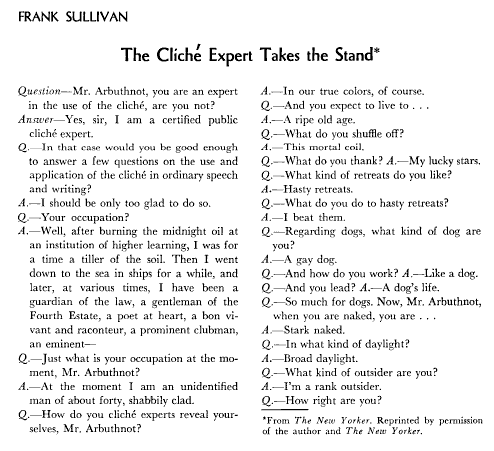
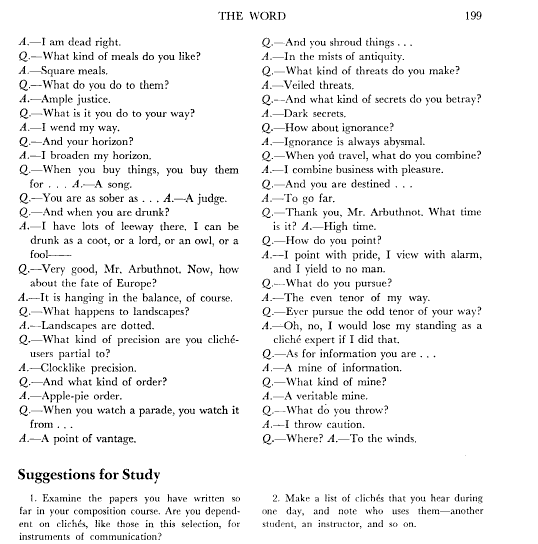
Make sure you check out the Suggestions for Study.
Found years ago (not by me) in Google Books:
Make sure you check out the Suggestions for Study.
This is from some time ago (early 2015).
Last week, before I knew she was the new face of Celine (also, before I knew was Celine was), I shared Joan Didion’s “At the Dam.” I was taught this essay, and I teach it. Not because Joan Didion is fashionable at the moment, but because it’s really good.
Flavorwire’s Elisabeth Donnelly has an interesting piece up today trying to take the pulse of the growing Didion-as-icon trend. Donnelly quotes Haley Mlotek in what feels like an especially prescient observation:
As she puts it, citing Joan Didion as your idol says that:
…we’re cool, that we’re educated, that if we are not young and white and slender and well-dressed and disaffected and sad and committed to the art of writing as an arduous and soul-sucking process that must be endured yet Instagrammed simultaneously, then we will be, at least, as close as possible to those identifiers even if it kills us.
Fair? True?
We’ve also been doing this with Leonard Cohen. Citing him as your idol signals different things, but the desire to look back and hold up great talents in their later years is nothing new. We do it, of course, with Betty White. We probably would have done it with Bill Cosby. I for one am not sure why we don’t do it with Dick Van Dyke or Marianne Faithful.
Head’s up: New York Magazine, a mere four hours ago, has issued a warning that loving Joan Didion is a trap.
Literature Map says:
What else do readers of [any other famous author] read? The closer two writers are, the more likely someone will like both of them. Click on any name to travel along.
Did it map you right?
I found this poem by accident one spring a few years ago. You should read it. Here.

This links to the sections focusing on 500-1000 A.D, but I bet you can’t stop there.
A good and very practical demonstration on what the ear wants from the late Gary Provost:
“This sentence has five words. Here are five more words. Five-word sentences are fine. But several together become monotonous. Listen to what is happening. The writing is getting boring. The sound of it drones. It’s like a stuck record. The ear demands some variety. Now listen. I vary the sentence length, and I create music. Music. The writing sings. It has a pleasant rhythm, a lilt, a harmony. I use short sentences. And I use sentences of medium length. And sometimes when I am certain the reader is rested, I will engage him with a sentence of considerable length, a sentence that burns with energy and builds with all the impetus of a crescendo, the roll of the drums, the crash of the cymbals–sounds that say listen to this, it is important.
So write with a combination of short, medium, and long sentences. Create a sound that pleases the reader’s ear. Don’t just write words. Write music.”
Not that I’m measuring my life out in coffee-spoons or anything, but, for context, this was posted in 2015:
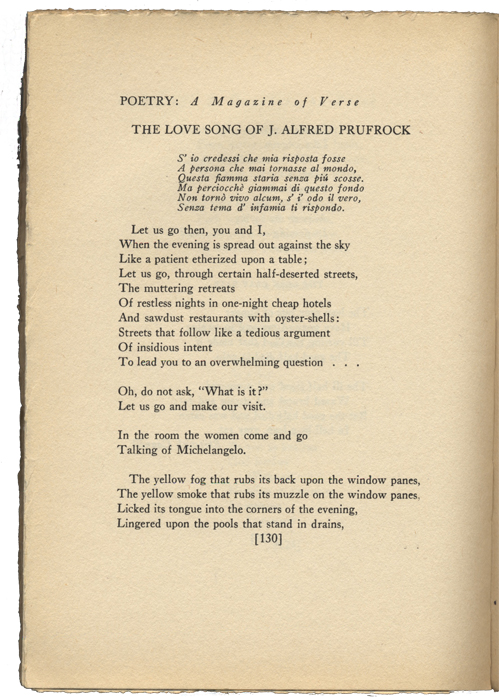
Prufrock turns 100 this year, T.S. Eliot 122. Read it here. Read it now.
 Chris Cocca