Evensong

Another early piece. This was published at elimae when Cooper Renner was the editor. It was a very good journal. This story is 100 words long.

Evensong

Thaddeus, age 3, set the Evensong in shallow water. Small waves rose and fell, and, retreating, carried Thad’s small ship further from the shore. Squealing and on pigeon toes Thaddeus retrieved it, and, safely back, he cast the tiny schooner headlong into the sea. His father’s strides were long and easy and for a moment Thad was sorry for the rival ocean and the fight he’d picked. His father bent low and pressed Thad to his chest and from tall grass on the bluffs above, they watched a red sun sink behind the green and Thad said, “Bring it back.”

The Doogie Howser Portion of the Evening

Doogie Howser was the first person I ever saw use a computer as a journal. Ricky from Silver Spoons was the first person I ever saw IMing with his crush.

Gains today: Quite a few words written. A few stories read.

I reread “A Clean, Well-Lighted Place” for the first time in many, many years. I must have been very young the last time, because I don’t remember it being so short. I also read “A Day’s Wait,” which, I mean, isn’t very good. You have to really be into the code hero and all of that to delve into the scholarship, and I’m just not that interested. I’m too old for that side of Hemingway, at least right now. I also read “The Killers,” and have decided that “Fifty Grand” is much better. Though I do like the sparse description of the lunch counter.

I also learned that George Saunders was a young Objectivist, which reminds me very much of Andrew Sullivan’s explanation of his youthful Thatcherism. I can relate to both of these experiences. I got into Rand because of a girl. There were weird tracts in the Rand books at the public library, and that could probably make for a decent story. Not right now, though.

I did get some good words down and out. But they were divided between two stories, and none went toward the story I planned on adding to today. So I feel a little scattered, but that’s okay, because the ideas are really coming. Depending on who you listen to, control is a myth or a must. The more you sort of whittle down, the more you tend to know which claim is most helpful in the moment.

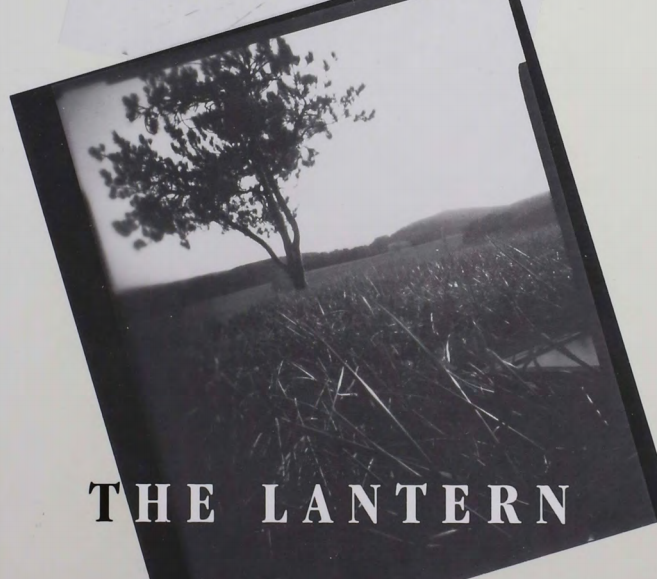
The Ursinus College Lantern, Fall, 1998

Earlier today, I shared a piece that I said was the first thing I had published in a print journal.

Later, I was working on a story partly set at a sort of proxy for my undergraduate alma mater.

When I came to campus in 1998, the website was in very basic html, and the college email ran on DOS (I think. It was text-based at any rate). 21 years later, there’s a fairly robust digital history of all kinds of things Ursinus.

I went down the rabbit hole.

Regarding the venue from this morning, what I should have said was it the first print journal run by people I didn’t know or go to school with to publish my creative work.

Of course, I hadn’t forgotten about the Lantern. Of course it was the first print journal to ever publish my creative work. (Alright, here again I’m wrong. In sixth grade, I was co-founder, co-editor, co-publisher, and staff writer for zine called ZAP! In middle school, we briefly considered relaunching as The Jolly Rancher, but it wasn’t meant to be.)

The Lantern piece, which you can find here, was written a few years before I got to Ursinus. I was about 16, broken-hearted, and listening to a shit-ton of Beck. That it was published alongside things written by 22-year-olds, and that it won the yearly prize for creative writing, has always meant a lot to me.

I Love You When You’re Pretty

This piece was published maybe 10 years ago at a venue that no longer exists. When I first started publishing short fiction, there were many new, experimental web journals. Many of them were very good. Many good ones still exist, but many are, as David Thomas might say, now ghost-towns.

This piece also appeared in the first edition of my chapbook, What Other People Heard When I Taught Myself to Speak. That manuscript is going through some new revisions with a second edition coming sometime in the spring.

I Love You When You’re Pretty

When you said hi, I didn’t see you in her fitted polka dots and your hair like a USO girl and your legs in heels. Everyone is beautiful in your grandma’s pictures but we dress with conscience now, buffing out your curves or the square cut of my shoulders with fair-trade cotton. What right do you have, anyway, in eye shadow and stockings, wearing lipstick I can only see close? What right do I have, now, to closeness, to feel like cigarettes won’t kill me and sex is not transaction? What right to be pretty? And to love you when you are?

Liam in London

But as a Mancunian whose teens were set to a soundtrack of Oasis, Liam could have come out and played Wonderwall on his iPhone and I’d still think he was the coolest man alive. 

That’s a great line from Stefan Kyriazis.

As a Pennsylvanian whose teens were set to the same three albums, I know what he means.

There’s no real American analogue to Oasis. By convention, I should have been listening to Nirvana for a few years already when Oasis got to American top 40. And, I mean, I was, because it was impossible not to. But I’ll just be honest. Nirvana always seemed too privileged.

Oasis was swaggering, life-affirming, sneeringly ironic but also really, truly earnest. Liam packed about a million miles into what he did with the simplest of things (namely, vowels). Show me another frontman who, standing still with his hands clasped behind his back, could electrify hundreds of thousands of people.