The first Hall & Oates song I remember is “Maneater.” It was 4-year-old me’s absolute jam.
This gem, though:
The first Hall & Oates song I remember is “Maneater.” It was 4-year-old me’s absolute jam.
This gem, though:
It feels weird to tweet and write and talk about fiction and poetry and pretty much everything right now.
Thinking about what makes “right now” different from “last week” makes me realize again that the mere fact that I’m not constantly pushing uphill against systemic, entrenched hatreds and injustices means I’m already privileged. It means that the way I’m able to move in the world is also one of the constant calls lulling me to forgetfulness and ignorance of this fact.
I don’t come here to post answers or suppose that I have them. I come here thinking out loud. Even that’s a privilege.
Burger King is going back to its former logo. Smart branding move for all kinds of reasons, not the least of which is the chain’s need to keep differentiating itself from industry leader McDonald’s and perpetual internet-winner Wendy’s.
Here’s what I think is interesting. My kids, who were born well after Burger King dropped its classic branding, have always thought the 1999-2020 BK logo looked like a frying pan full of eggs.
They’re absolutely right. I’d never seen it because I knew what the logo was supposed to be.
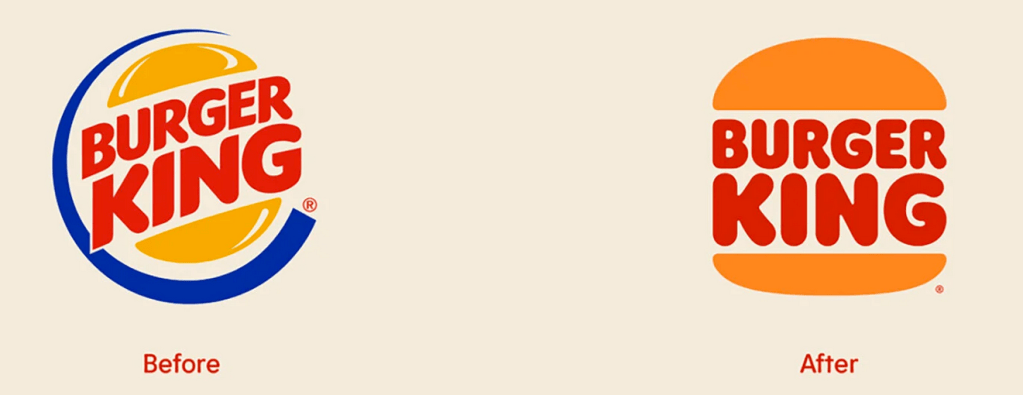
Context really matters.
Yes, this is a logo for a giant corporation that sells mostly shitty food, but it’s a good reminder for artists, writers…anyone who is trying to communicate something to someone else.
Is what I have to say clear? Is what I have to say true? How do I know? What contexts have I assumed are understood, shared, taken for granted? What social constructs have I mistaken for objective frames and lenses?
On one hand, “perception is reality” can be a lazy excuse for all kinds of willful ignorance. On the other hand, if the things we have to say matter, it matters enough to do the best we can with them. Perhaps more to the point: we don’t know what we don’t know until we make the decision to learn about the world beyond our native settings.
Would you believe I’d never heard of James Baldwin before college? It’s true, and I went to well-funded public schools (that also happened to be predominantly white, and by a lot). I don’t think we were asked to read anything by Black writers except for (maybe) The Color Purple and a few lines of Langston Hughes. Worse: school kids in the 80s and 90s, at least in my experience, were meant to intuit that anything resembling racial injustice had been conquered by 1970. That’s probably something most of the adults in our lives wanted to believe themselves.
It’s been a long time since I was in school. I don’t know if we do a better job now or not. I do know that budgets in struggling districts continue to be slashed, that music programs are cut, gym programs are cut, the school district I went to is richer now, than ever, and the city schools a mile away have a fraction of those resources. I know that conservatives like to say that in America, we’re granted equal opportunity, not equal outcomes. I know that only half of that statement is true.
I wish I could say that the events of January 6 seemed surreal to me. Sadly, they were predictable (and predicted). What maybe does feel surreal: trying to go about my normal course of business in this moment. Nothing I do seems serious enough, almost everything I do seems very trivial. And I’m a person who benefits from a great deal of privilege. Maybe you are, too. If so, think about your frames and lenses. Think about the fact that there are many things we’re just not seeing. Many points of reference and perspectives we don’t have. Think about how we were taught to take up space, demand attention; think about how the insurrectionists were treated and how they would have been treated had they been mostly brown or Black.
I’m not saying Burger King’s branding language is some kind of metaphor. But there are an effing lot of Burger Kings. There are an effing lot of us (myself included) who need to unlearn an awful lot of shit.
“Like all of you, I watched as a gang—organized, violent and mad they’d lost an election—laid siege to the United States Capitol,” she continued. “They set up gallows. They proudly waved the traitorous flag of the Confederacy through the halls. They desecrated the center of American government. And once authorities finally gained control of the situation, these rioters and gang members were led out of the building not in handcuffs, but free to carry on with their days.”
“What if these rioters had looked like the folks who go to Ebenezer Baptist Church every Sunday? What would have been different?”
“I think we all know the answer. This summer’s Black Lives Matter protests were an overwhelmingly peaceful movement—our nation’s largest demonstrations ever, bringing together people of every race and class and encouraging millions to re-examine their own assumptions and behavior,” Obama wrote. “And yet, in city after city, day after day, we saw peaceful protestors met with brute force. We saw cracked skulls and mass arrests, law enforcement pepper spraying its way through a peaceful demonstration for a presidential photo op.”
You can read Michelle Obama’s full statement on Instagram.
I originally posted “To Statecraft Embalmed” by Marianne Moore on December 22.
I’m posting it again.
Many necromancers were revealed yesterday. They commune with and conjure death, plague, hatred, racism, avarice, craven self-interest, every kind of bigotry. They worship power and lust after despots.
They trade fear for violence in satchels marked “ashes” and “beauty.”
An early work, and I love it. “To Statecraft Embalmed” starts with an image that might just as easily refer to a certain (current) political figure:
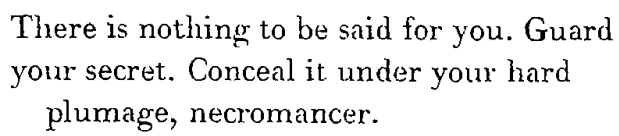
The only version of the full text I can find online isn’t formatted exactly how piece is presented in her Collected Works, a volume I seem to have misplaced precisely as I sat down to write this post.
The whole thing reads to me as uncanny prophesy, hard plumage and all.
Yesterday I read all of The Fire Next Time by James Baldwin and about a third of My Antonia by Willa Cather. I have read a good deal more of the Cather today.
The Baldwin is, of course, very brilliant. There’s not real space here to unwind my thoughts about it. And perhaps my thoughts and words about it aren’t needed. Everything I think of seems too little, and also too self-centered and too big and too presumptuous. Which does not get me off the hook.
As for the Cather. I started this book years ago but couldn’t make it stick. That has nothing to do with Cather and much to do with my personality and obsessive ticks and sins of omission. I am older now, and hopefully wiser, and more disciplined. I love this book, and I can tell that I will miss it, and its people, when I finish. It reminds me on one level of the Laura Ingalls Wilder books my grandmother read to me when I was very small: the descriptions of frontier life, the harsh winters, the sod houses on the plains. It also reminds me how very close, in a real sense, my grandmother (born in the 20s) was to this kind of life. She was raised in town, but spent time with her cousins on their homestead with their heavy work and homemade toys and pig bladder balloons. I remember very vividly the story about the doll frozen in the puddle in the field. I remember very vividly my Grammy reading to me about the houses on the prairie, and the comic strips in our paper, which she called the funnies, and I remember her stories of the Depression, her impressions, later, of things like segregation. I think about James Baldwin saying that the writer’s task is to excavate the experience of the people that produced them, and about Robert Antoni’s idea that what so many of us are doing, across cultures, is preserving and re-telling our grandmother’s stories. That is very often what I’m doing. And it started with her determination that I should be read to, and that there were certain things that I should know, that certain things were good and certain things were not worth gretzing over.
I have not read Laura Ingalls Wilder ever on my own. 1983, 1984 are not so far back as I would have thought they’d be by now. Grammy’s voice and warmth still very much surround me. I am fortunate and grateful.

 Chris Cocca