I refuse to believe the #blackfriday message that everything I was grateful for on Thursday is suddenly no longer enough.
Year: 2011
What About Liam?

Kohl’s is squarely in the High Flying Birds camp.
Manny Pacquiao Speaks to a Butterfly in California
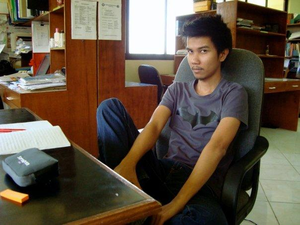
It’s not every day that one of my wonderful friends gets a short story printed in a major publication. But it is today.
I met John Bengan in our MFA program at The New School, and he is part of a cadre of writers I feel especially close to and whose work I particularly admire.
Today, his fantastic vernacular story, “Manny Pacquiao Speaks to a Butterfly in California,” was published in the Philippines Free Press, his native country’s longest-running newsweekly.
This is very, very exciting on many levels, not the least of which being how good the story was the first time I read it in an amazing seminar led by Robert Antoni and how great it remains. John, we are all very, very proud of this success!
How I Learned to Stop Worrying and Love the Phantoms

The Daily Cocca is proud to welcome Eric Sylvester back to our guest-blogger chair. Because all signs point to a proposed minor league hockey arena in downtown Allentown becoming the new home of the former Philadelphia Phantoms, I asked for Eric’s take on the team. Eric’s my go-to hockey guy, and with good reason.
Eric asked if he could write a piece about the 2004-2005 season, a time when big league hockey was locked out and a talented, neglected AHL team took the professional sport, and its near-professional fans across the country, on a wild, redemptive ride. Why is any of this important to me or to Allentown hockey in 2013? On a personal level, Eric’s a peach and I wanted him to a little bit about his beloved fandom. (He really did meet his girlfriend on WordPress, by the way, so you are beholding the power of blogging on two levels, here). But I’m also interested in the way sports narratives can galvanize communities. We’ve heard so much in the past few weeks about the kind of identify formation that happens at places like Penn State, but Eric was isolated hockey fan in Iowa who connected to a minor league team in South Philly. I don’t mean to overplay the sports-as-life narrative, because we’ve seen how devastating that can be. But in the right times and right conditions, fandom can bring communities together in positive ways, even across state lines and team loyalties.
Eric, thanks for the piece.
#
How I Learned to Stop Worrying and Love the Phantoms
by Eric Sylvester, Special (Like a Pretenders song) to The Daily Cocca
One of the best things about blogging is getting to hear the stories of a multitude of different types of people. I’ve made friends in the hockey community, the political ring, and some genuinely hilarious people through blogging. I even met my girlfriend, Emily, via this blog (that’s two shameless plugs for your blog already, babe). Editor’s Note: she smiled and DIDN’T hit me. I’m surprised, too. Editor’s Note #2: Upon reading this, she called me a “jerk” and hit me. THAT’S the Emily I know.
Chris Cocca is one of these great people I’ve had the pleasure of befriending since I started the blog. It’s always awesome when we get a chance to randomly talk, primarily because we share many of the same weird interests. From our mutual love for comics to our shared affinity for vintage baseball facial hair, we tend to have some interesting conversations.
I guest-posted last year during the NHL Playoffs for Cocca and have an undying love for hockey. So, naturally, when he started talking about the possibility of the Philadelphia Adirondack Phanotms AHL hockey team moving to Allentown (Chris’ hometown), I had a story to tell.
 You see, the (then) Philadelphia Phantoms were the story of the 2005 hockey world. Why? Because the 2004-2005 NHL season was lost to a lockout. As the only hockey fan in my small hometown in Iowa, I was mercilessly teased by my friends. They knew how much hockey meant to me and reveled in the fact that they got to watch their beloved NBA while I was deprived of my favorite thing in the world. I look forward to hockey season more than Christmas, and that year Christmas wasn’t going to come.
But there was hockey in 2004-2005, just not the hockey I was used to following. The American Hockey League, America’s highest level of minor league hockey, would still play their season. With minor league hockey as my only option, I thought I was going to be subjected to a subpar league for a full season. Still, I said, bad puck is better than no puck at all. Mediocre players playing mediocre hockey in empty arenas is still hockey. I soldiered on and said my prayers to the hockey gods every night, begging for the return of the NHL.
I kept tabs on the affiliate of my Colorado Avalanche, the Hershey Bears, who never seemed destined for a playoff berth (they missed a postseason spot by ten points). My Colorado Avalanche didn’t exist and their affiliate franchise was done for the season . The most depressing year of my fifteen-year life lingered on. Even though there would be no proxy-Avalanche to lift my spirits in the playoffs, something else happened; something I wasn’t expecting.
I fell in love with the Philadelphia Phantoms. This wasn’t some throw-away hockey team playing in the minors. They had some SERIOUS firepower, and featured a bevy of future NHL superstars. Led by goaltender Antero Niittymaki (now with the San Jose Sharks), the Phantoms featured future NHL All-Star Jeff Carter, eventual Flyers’ captain Mike Richards, and future Stanley Cup winners Patrick Sharp and Ben Eager. The Phantoms grinded their way to the Calder Cup Finals with a style of play reminiscent of their big-brother Philadelphia Flyers of the mid 70’s: tight checking, strong defense, phenomenal goaltending, and (most of all) local fan support. When the Phantoms completed the surprising four game sweep of the Chicago Wolves to win the Calder Cup, 20,103 fans filled the Wachovia Center to witness the glory.
Yes, the Wachovia Center. The home of the Philadelphia Flyers. While my friends were busy mocking me for watching a league that “nobody” cared about, the Philadelphia Phantoms sold out an NHL arena.
Before the AHL playoffs, my frustration with a league that was shut down by greed (and at hockey-ignorant friends for taking so much pleasure in my misery) was hard. But I realized I wasn’t alone. The Phantoms became my retreat from a rural Iowa community that will never understand the connection hockey fans feel with each other, that hockey is as much of a culture as it is a sport. There’s a communal imperative, a bond among hockey fans that’s unique in sports. No matter who our teams are, we actively seek out each other’s company. As die-hard acolytes of a sport less mainstream, these days, than NASCAR or golf, we’re a rare breed in fandom. As much as we love the game, and we LOVE it, it’s simply one aspect of being a fan.
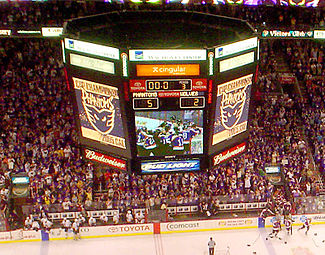
Deprived of an NHL to relate to, the lockout season started as especially difficult time in my life. While I was the only hockey fan in my school, I still could talk a little hockey with some of my sports-loving friends. One might catch the occasional game on ESPN (or at least see a highlight), and might seek me out with questions or for my brand of expert analysis. Hockey was, and is, so much a part of who I am that my classmates would rush to talk to me on a Monday simply because they had attended their first hockey game over the weekend. When the NHL season was lost I thought I’d lost my identity. I was no longer “the hockey guy”; I was the “guy who lost hockey.” As an angst-y fifteen-year-old, this was incredibly hard. And but for the Philadephia Adironack Allentown Phantoms, it would have stayed so.
In a year filled with pain and suffering for hockey fans across the world, I joined Philadelphia in embracing the Phantoms. I identified with them. The Philadelphia Phantoms were the minor league team in a city with an NHL team. The little brother. Mostly forgotten. They were the angst-y kid overlooked by the cute girls. Then, with the lockout, everyone knew me as the person most directly effected by the loss of a season and of a sport no one else cared much about in the small radius of our high school and town. In a strange way, the lockout didn’t take my identity at all; it bolstered my connection with something I thought I alone understood, and my reputation as someone with something at stake. That’s powerful esoteric sauce for kids figuring out who they are. (See: Cocca, Christopher; his love of Oasis). At the same time my identity formation was rising, the Phantoms went from Philadelphia’s forgotten team to the biggest story in hockey; among my friends and peers, I was the biggest story in hockey. The Phantoms were the greatest hockey team in the world, and I was the world’s biggest fan.
#
The Daily Cocca is happy to report that Eric is a well-adjusted college student preparing to lead our children into the 21st century as a teacher and weekly screener of Happy Gilmore. When the Phantoms come the Allentown, the local support Eric talked about will be crucial. So many of us have been rooting (and working) for downtown revitalization for so long, rooting for the Phantoms will require no adjustment. To the doubters or people less connected with the history of the city, we’ll need your help, too. Great things are already happening downtown. This could be a rallying and tipping point that helps foster a new stage of smart growth.
Superman, Mark Twain, and Lawrence Lessig: Congress Is The Light That Never Goes On

A few days ago, I posted a link to this piece by Lawrence Lessig. It’s something of a love letter to Newt Gingrich in which Lessig blames the former Speaker for most of Washington’s current dysfunction. According to Lessig, Newt was the architect of the current winner-take-all, reelection obsessed profanities posing as politics. I’m not entirely convinced by the narrative, which isn’t to say he doesn’t make salient points.
The thing is, some of this goes back to Andrew Jackson. Most of it goes back to Thomas Hobbes. It’s been chronicled by Mark Twain and in Action Comics #1 (where we also learn that populist Superman was also an isolationist in the build-up to World War II? That’s a post-and-a-half).
Has Congress ever worked? Has it Congress ever been this bad?
Related articles
- Reclaiming the Republic: An Interview with Lawrence Lessig (3quarksdaily.com)
- Video: Lawrence Lessig: Obama Failure to Take Money out of Politics a “Betrayal” (americanpeoplesplatformblog.com)
Did NPR Just Endorse Newt Gingrich?
This is from 2011. I actually met Newt Gingrich in 2000 when I was an intern at ABC News. The former Speaker has done and said many things since this post that would probably color how I would write it now. But these thoughts below are in the context of the 2012 GOP primaries. That was a at least two lifetimes ago. – CC, 2018
Did NPR Just Endorse New Gingrich?
It depends on how you feel about the ’90s. Brian Naylor’s Friday piece, entitled “To Imagine a Gingrich Presidency, Look to the ’90s” ends on the obligatory NPR dead-note (“It’s impossible to predict what kind of president Gingrich would make, but if his speakership is any guide, it seems safe to assume a Gingrich White House would be one of bold ideas and polarizing politics,”) but otherwise paints a picture of Speaker Newt as a shrewd, if closeted, bi-partisan compromiser due a big slice of the credit Bill Clinton often gets for making the 90s rock just that hard.
Even the title sounds like an endorsement. Weren’t the ’90s the last good American decade? The last American decade, period? Oh, sure, we were blissfully sewing the seeds of every problem we now face, only kind of trying to contain Al Queda, and doing a Wag the Dog war in Kosovo because Kosovars are white (even if they’re Muslim, right?) and Clinton had a sex scandal.
Whoa, wait a minute. That sounds really, really cynical. But maybe that explains the influx of visitors to this blog searching for information about Thomas L. Day’s recent Washington Post op-ed.
In any case, I will always love you, The ’90s. You had me at hello.
Lawrence Lessig has a different take on Gingrich. What do you think?
Ward Sutton and the Village Voice Illustrate The Daily Cocca? (I Did See Michael Musto on a Bike in Chelsea Once)
Do Ward Sutton and folks at the Village Voice read The Daily Cocca? You know I like to think so.
Finally, there’s proof. Via Graphic Policy:
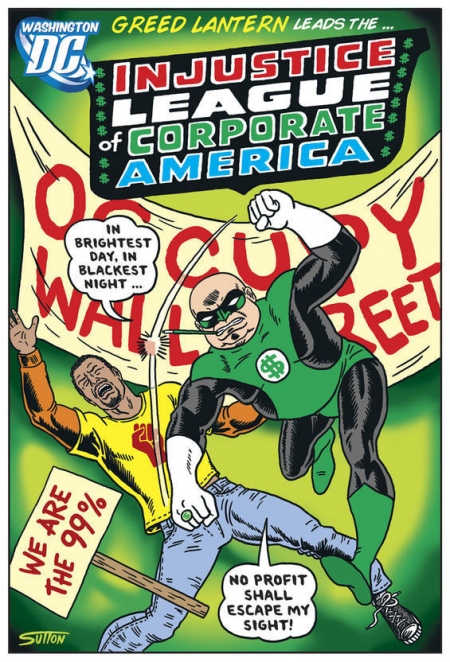
See 7 more designs at “Washington DC Reboot” via the Village Voice. We anticipated as much here on November 1.
In related news, NPR basically endorsed Newt Gingrich yesterday, perhaps not realizing what they were really saying by saying a Newt presidency would bring back the 90’s. More to come on that later.
 Chris Cocca