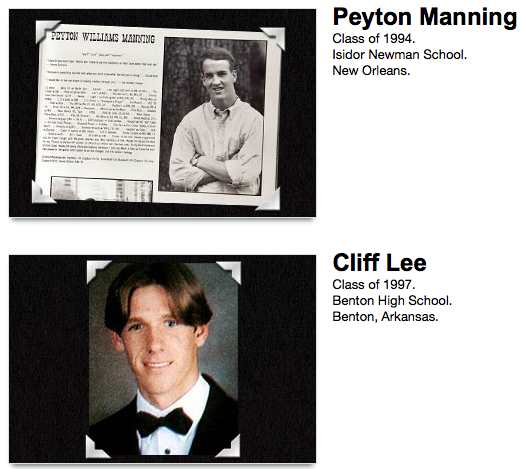
This image is via Yahoo!Sports. Peyton Manning, you look exactly the same. Cliff Lee, how is it possible that you were a teenager at precisely the same time I was? It’s not that you look old now…it’s just that you’re so talented, I assume you’ve been pitching since the dead-ball era.
Should we be so blessed as to reach them in good health, it turns out our 80’s might be our most righteous years. It may seem counter-intuitive, but I totally get it: the older I get, the more I suspect I’ll enjoy getting even older, as long as I’m able to stay healthy. That said, I totally wanted this to be an article about why THE 80’s were awesome. Alas. But the good news is that if the decades of our lives match up, sweetness-wise, with the decades of the late 20th and early 21st centuries (um, yeah!), then all of us late Gen Xers (I’ll just call us the 96-99ers) will have an even better time in our 90’s (which will be the 70’s). The bad news doesn’t start rolling in until our 100’s, because let’s face it, the 2000s kind of sucked. Our 20s kind of sucked. We got a crap decade to be 20somethings in, but it happens. The good news is that in our 3os, that is, now, we’ll do the ethical, artistic, and socially responsible equivalents of all of those life-affirming-in-the-1930s-sketchy things the expats did. Which means, if my math is right, our 110s will be our new 30s. And since 30 is the new 20, and because of advancements in technology, we’ll actually start to age backwards like Jonathan Winters on Mork and Mindy or Cindy Crawford in real life. I could handle that.
But yeah. I love getting older. I loved turning 30. 31 feels even better. 40 still sounds depressing, but doesn’t 50 sound so full of vim and vigor? That’s when you start defying expectations instead of living into them. 50 is hardcore. I don’t know how old Terry O’Quinn is, but John Locke is my role model for being 50. And, you know, my dad. I mean, my dad’s also a good role model for being 50. (Terry O’Quinn is not my dad).
Here’s the thing. Older people are smarter than younger people. It’s just freaking true. Not about everything, not in every situation, not all across the universe. But 7 times out of ten? I think so. Sure, sure, you have a fancy degree and a smart phone, friend, but they have these intangibles called experience and perspective. It’s mostly true. It’s truish. Get a haircut, hippie.
Three Pillars Trading Company is a client of mine. I’m producing blog articles for this fair-trade, sustainable import business, and from time to time, I’ll be sharing pieces of them here. My first post at Three Pillars is about the disgusting conditions that factory workers in Shenzhen, China endure while they put together our computers and hand-held devices. Yes, as fellow Apple fanboy Mike Daisey exposes, even our MacBooks and iPhones.
An excerpt:
Monologist and raconteur Mike Daisey recently spent hundreds of hours exploring the treatment of industrial workers in the Shenzhen region of China. His findings are nothing short of chilling, and he’s taking to the stage (and Internet) to get the message out. Mike makes the stunningly simple observation that while most justice-minded people work very hard to integrate their ethics and consumer choices when buying socks and sneakers, very few of us ever really stop think about the fabrication and delivery chains that produce our favorite hand-held devices.
Continue reading here. Whatever you do, be sure to click through and watch the video interviews TechCrunch conducts with Daisey. They’ll make you angry, sad, and sick. The fact that people like Mike Daisey exist might also make you feel some hope. As I’ve said before, if I ever link to anything I’ve been paid to produce, I’ll say so. That’s the case here, but, as you might know, I only take jobs from organizations I can get behind. It would be great if you surfed from here to my cool new client, but much more important to me and to Three Pillars is that you please, please, please hear what Mike Daisey has to say. In fact, here’s a direct link right to the TechCrunch article with three video segments. They are worth your time.
As for Three Pillars, one of the chief goals of their blog is to provide a place of interest and information gathering around the the kinds of issues that people interested in fair-trade goods are likely to also care about. If you do make your way there, I know the Three Pillars folks would appreciate any feedback or comments you might have about how to make the blogging experience on their site all it can be. My job is strictly on the content side and I get to pick the issues I blog about there. If you have suggestions, please let me know.
While we’re on the subject of sustainability, and since I used “hell” in the title (that’s just a figure of speech, Rob Bell), I’ll also say this: after watching Daisey speak, I’m seriously worried about the state of the Western soul. Most of us don’t know that a company as seemingly with it as Apple is party to the things happening in Shenzen. We get great products for low Western prices, but at an unknown human cost to people with even less access to power than most of our own unemployed homeless.
I’ll be honest. This makes me feel like shit. Since I read Karl Rahner in div school (Savvy Sister, are you a fan of his? I am.), I’ve always thought his take on original sin made the most sense: everyday, we’re part of sinful, evil systems that we don’t even know about. Doing something as simple as buying a banana (let alone an gallon of gas or an iPod) might end up supporting unspeakable evil. The same goes for your retirement funds. Unless you’re in a socially aware mutual fund, chances are your IRAs are funding weapons and Chinese petro companies with dirty hands in Darfur. Shit, when I worked in finance, even the so-called “socially responsible funds” invested in Big Pharmaceuticals and Big Banks because after taking out cigarette makers, arms makers, gambling companies, pornographers and environmentally destructive firms, Banking and Medicine were the only two industries left. If you want a brief rundown on how powerful those industries are, consider if this is true where you live like it is here: most of the most consistent new construction going on prior to the banking crisis and even after was and is for new banks and new drugstores. I’m not saying prescription drugs aren’t legit or that there’s something wrong with taking medicine as directed, but we all know that on the R&D and supply ends, opportunity for corporate abuse is rife. I don’t think I need to say anything at all about banks and financial institutions. You know where I’m going.
Where does all this bullshit evil come from in the first place? I know the following:
everyone we meet is fighting a great war.
Karl Barth, (Karl Rahner’s Protestant Number) said that evil is the aggregation of humankind’s repeated choice of Das Nichtige (very basically: choosing “Not God” (aka “Nothingness”) instead of God, who is life) played out in history. He’s not very far from Rahner here when it comes down to it: Evil is a given, and it gets amplified as we continue to choose it (or, finally, participate it in unknowingly because it’s so entrenched). Its the manifestation of everything that isn’t God, actualized by aggregate choices and non-choices framed by the earlier actions of others (which, in fact, may not have been truly free choices, given #1).
be kind, because (see #1).
Crunch.
A dear friend of mine, wry with a sort of common-sense Pennsylvania German-Lutheran fatalism would say this leaves us pretty screwed. But I’m not so sure about that in the end. Shortly after I got out of the mutual fund industry, another friend of mine with many years in the retirement-planning business told me that it was impossible to invest with your conscience. As you might expect, I disagree. You probably do, too. Whether you’re a person a faith or simply a person of faithful ethics, you already know that voting with your dollars, so to speak, requires certain sacrifices. I’m due for a phone upgrade this month. Oh, how I want an iPhone. But maybe I won’t get anything. I know the phone I would have bought will still be made in shit-hole conditions and will still be sold. I know it will be the best looking chunk of original sin on the market. How funny that it’s made by a company who’s logo is a piece of bitten fruit. Well, not funny ha ha. Funny strange. Actually, not so funny at all.
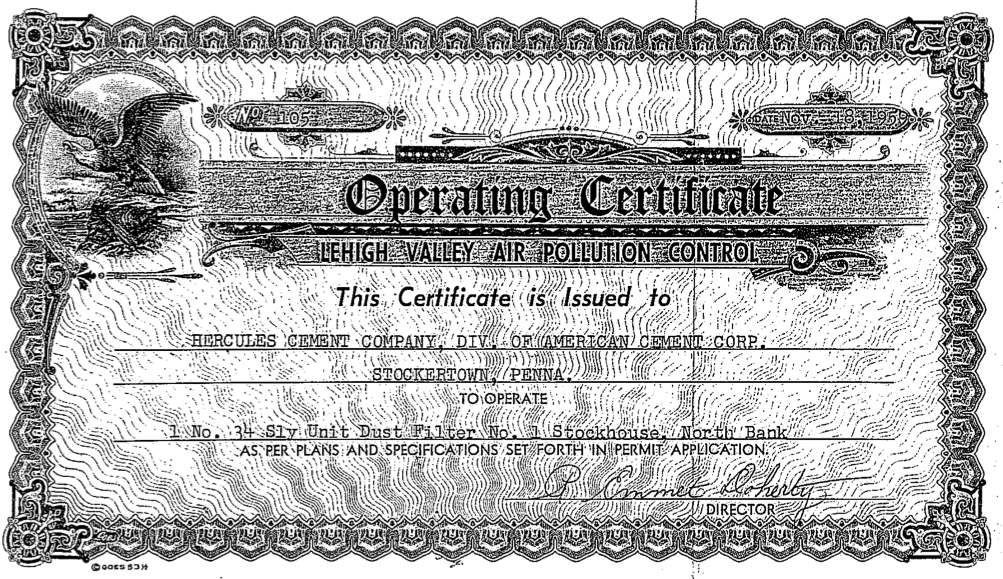
This is an Operating Certificate for the Hercules Cement Company in Stockertown, issued in 1959 by Lehigh Valley Air Pollution Control and signed by one R. Emmet Doherty. Since 1970, the R. Emmet Doherty Clean Air Award has been presented to a regional air quality leaders in recognition of their service and of Doherty’s considerable legacy. Maybe you’ve never heard of him, but not everyone has their own award or their own page on the Pennsylvania Department of Environmental Protection’s website.
Keith Williams, the chairperson of the Lehigh Valley Air Quality Partnership, sent me these images. It’s something special to see documentation from the early era of air quality control, signed by one of the issue’s most respected pioneers. Click to enlarge.
This is another dip in the old search-query-that-brought-someone-here-mailbag. This question is honest and simple, and I spent a good part of my mid-20s trying to figure it out. Here’s what I came up with:
Generation Y.
Yes. Everyone who was just becoming a teenager as the 90s wore down, I’m talking about you. This is what happened:
Your boomer parents gave you a lot of disposable cash for no good reason.
You spent it on Britney Spears, boy bands, and clothing that wasn’t ironically cool (that is, clothing that cost more than $4.)
You did not spend it on Oasis or Nada Surf or Harvey Danger. You did not spend it on The Flys or New Radicals. You absolutely did not spend it on REM. You also didn’t didn’t spend it on AOR or Adult Contemporary (goodbye, that whole genre). No New Bohemians, no Mazzy Star. Good bye John Mellencamp. It’s been fun, John Secada. Peace out, Tonic, Gin Blossoms, Dishwalla, Joan Osbourne, Black Lab.
Hello, TLR.
Hello, all delighted teensters with your expendable non-work-related dollars. Hello, Generation Bigger Than The Baby Boom. Hello, malleable taste-makers, hello.
Goodbye, alternative radio formats. Goodbye, Y-100. Goodbye, you last hangers on of Generation X, you would-be Cusacks. Goodbye, Empire Records.
I think this is a fantastic assessment of President Obama’s basis of preemption in Libya. It calls everyone out on the carpet and ends with this:
And for those Democrats who are either cheering on or grimly supporting the president’s actions…there’s a reason why the biggest fans of last night’s speech were hawks like William Kristol: If you didn’t like Iraq, you really won’t like Iran. And when that day comes, please don’t debase yourselves by crying crocodile tears over the Constitution, or pretending for even one second you are anti-war.
My only real point of contention with writer Matt Welch comes from this graph, in which he makes an important mistake:
Set aside the administration’s ever-elastic definition of “interests,” and instead grok this: The Democratic foreign policy best and brightest have admittedly adopted as their causus belli for dropping bombs on a sovereign country the same test that former Supreme Court Justice Potter Stewart used for pornography: They know it when they see it. As for the rest of us taxpaying, war-weary plebes, we’ll receive an “update” from the president now and then to let us know where his own eyes have taken him next.
I agree that the president’s definition of “interests” is ever-elastic. I like that Welch used the word grok. I admire the Stewart analogy, although for some reason I thought O.W.Holmes owned the quote. The last sentence would be funny if it wasn’t so sad.
But the Gaddafi regime is not sovereign. When you murder you own people, you lose whatever tenuous grasp on those straws you ever managed to muster. The Libyan people are sovereign. Their idea of Libya is sovereign. The reigning government is not. But what does it mean to say that a people are sovereign if they’re not also free? If protests are met with bullets? If that popular sovereignty cannot be expressed. The truth is that we don’t know what set of priorities the sovereign people of Libya would choose for themselves if given the chance (apart from deposing Gaddafi). That doesn’t mean they don’t deserve the rights of self-determination. They deserve it and they deserve the support of free peoples. But I continue to question the degree to which the Obama doctrine really supports the people of Libya. Yes, preventing a massacre of a civilians provisionally registers as a just casus belli, but Welch is right: people who based their opposition to Iraq on the previously unprecedented doctrine of preemption who don’t see the Libyan engagement as a preemptive war are kidding themselves. This is a war, and it is a preemptive one. I am wont to say that the disagreeable means justify the ends of preventing a civilian massacre, even as I’m wont to say that no one except committed pacifists would now oppose preemption in Iraq if WMDs addressed to the US had ever been found there.
Good God, what a mess. And now there are reports coming from a Vatican official that US NATO bombs have killed 40 Libyan civilians. Remember that line in the president’s speech about the Libyan civilians coming to the aid the American rescue team that came for the pilots of the grounded F-15? For the first time ever, I have started to believe that Barack Obama has bigger brass ones than Bill Clinton, because guess what? Our guys mistakenly shot six of those helpful, peaceful, friends. One was a kid. No one died, but the boy might lose his leg. Is this the acceptable collateral damage of “kinetic military involvement,” or is this the basic stupidity behind all wars and behind all acts of aggression?
Getting back to my original point: Libya, the nation, is sovereign and is without a legitimate government. That vacuum is dangerous, provisional, and fraught with hardship. But it doesn’t cede Libyan sovereignty to NATO, the West, the US, or Barack Obama. We’ve seen that play out here before. It doesn’t end well. As commenter SingleMaltMonkey said here on a recent post, none of this ends until we stop selling arms, until we get serious about dialog. Until we don’t brazenly assert our right to stop humanitarian crises when they’re happening in countries who’s fate is somehow fundamentally aligned with our “interests and values.” (Ed. note: the following sentence is added to clarify SMS’s position and what I’m adding to it as per our discussion in the comments below). To that, I’d add: until we stop saying we’re justified in intervening to protect civilians because our national interests and values are also at stake. I mean, what the hell does that even mean? It’s in our interest to stop humanitarian crisis everywhere, isn’t it, because that’s what people with souls want to do. But when we say “yes, we can get kinetic on this one because, oh happy day, we can justify intervention by some vague appeal to natural law and universal rights and happy unicorns, and, um, also our (bwa ha ha ha) interests,” we sound like the opportunistic douches the most extreme haters say we are. I guess that’s why John McCain and others are saying that regime change has to be our ultimate military priority like it was with Slobodan Milosevic and Saddam Hussein. I guess that’s why attacking military installations, sending the CIA, and hoping that the regime in Tripoli just says uncle strikes so many as the worst combination of a bunch of ways forward.
To recap:
This is a preemptive war.
War probably doesn’t really help the net good of Libya or the planet.
But Libya’s already in a war, and civilians should be protected by powers that can protect them.
By attacking his own people, Gadaffi has formerly ceded power. That power sits in a vacuum, and that’s cause for bot concern and hope. And that makes everyone uncomfortable.
This power does not belong to the US or any outside force. It belongs to the Libyan people. But ff the Libyan people are left unprotected, they might be massacred, even those who don’t pick up any arms to fight Gadaffi.
We feel like we should do something, but we can’t call it war or preemption because those are things George Bush does. We are not George Bush.
So we call war “kinetic military action” and we say that the massacre of civilians is always bad, but it’s only bad enough to stop when our other interests are also at stake.
We sound like assholes.
We kill and maim civilians.
This all gets very ugly.
Does the humanitarian crisis end if Gadaffi isn’t deposed? Does deposing Gadaffi ourselves line up with our humanitarian military mission? Is a humanitarian military mission a contradiction in terms? Does deposing Gadaffi ourselves ice the so-called Arab Spring?
Pennsylvania Gov. Tom Corbett seems to have it wrong re: former Gov. Ed Rendell’s use of federal funding. Line of the article: “I don’t see how education is shovel-ready.” Yeah, a shovel is exactly what we need. I’m on record as not being the biggest fan of Fast Eddie (that is to say, I make fun of him on this blog every now and then), but Corbett is way off here. Never mind the fact that funding transportation over education seems like a good idea to precisely no one besides Corbett: Eddie says he spent the money the way he was supposed to. Rendell, always too enthusiastically himself to rise to national office, appears nuanced and genteel this context. It’s a day early for that, so I’m thoroughly confused.
In case you’re wondering, yes, Corbett really is selling Rendell’s bus, Commonwealth One (which doesn’t even run), as is. Awesome. Hey Tom, let’s not convince some energy company to trick it out with hybrid technology for free as a way of promoting Pennsylvania as a green-teach state committed to reducing emissions. Let’s not do that.




 Chris Cocca